

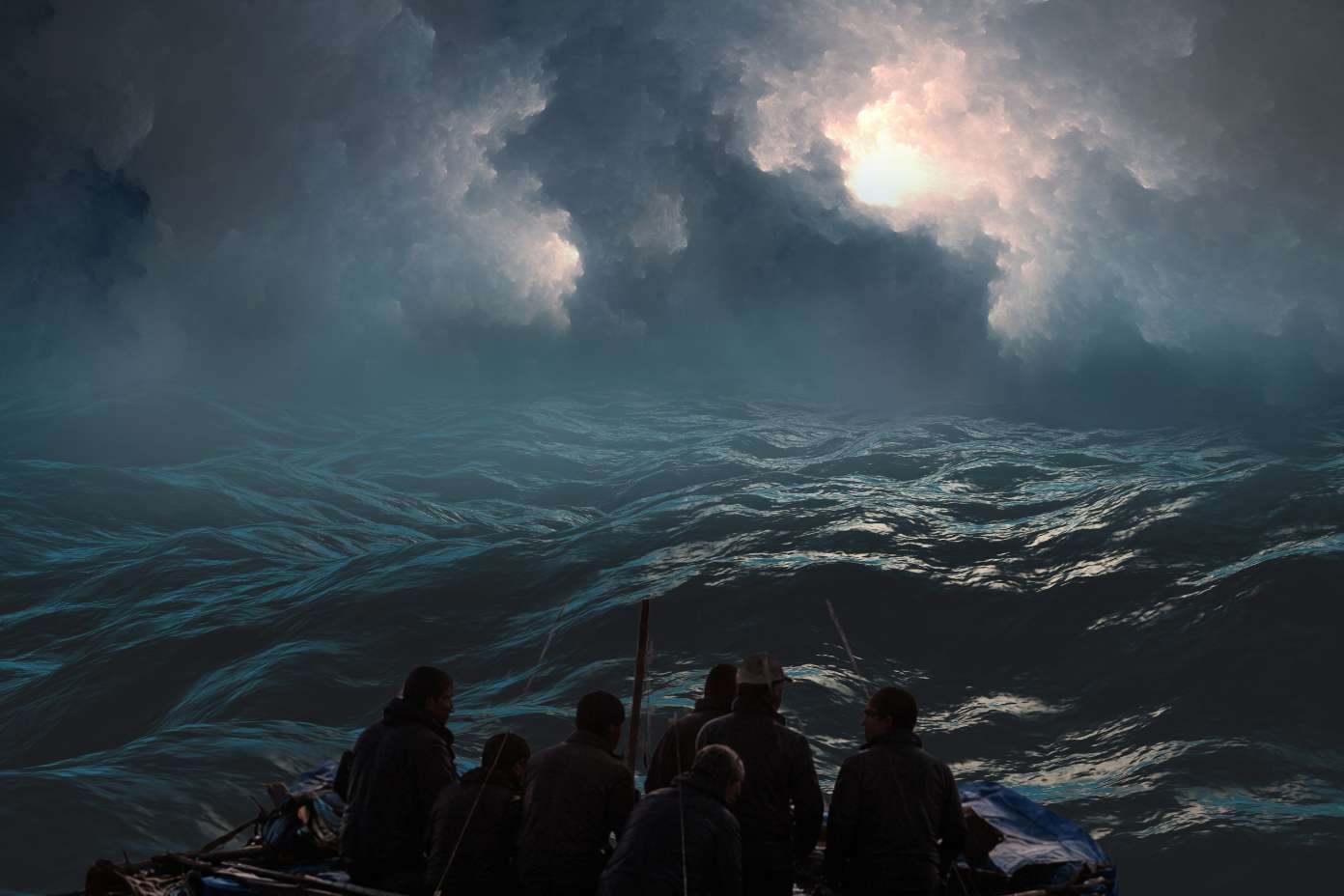
This account of a Cuban refugee’s journey to the Cayman Islands is based on the first-hand testimony of a migrant who arrived by raft at sea. The details and quotations are presented exactly as described by the source, with names and identifying information withheld to protect their identity.
The boat pushed off just after dusk, its fresh resin still tacky to the touch.
For days, the men had worked in silence in a remote stretch of mangrove and river in central Cuba, assembling a vessel from whatever they could source or salvage – pine boards, flattened zinc roofing, fibreglass, and a repurposed engine once used to pump water through rice fields.
They had done it under constant threat of arrest, moving materials in secret, hiding behind trees, speaking in code.
By the time they launched, they had already failed seven times.
This time, they did not intend to fail again.
What followed was a journey that would stretch across nearly a week at sea – through storms, mechanical breakdowns and navigational error – before ending, unexpectedly, on the shores of Grand Cayman.
Building a way out
The plan to leave Cuba covertly by sea was not unusual in concept, but its execution required precision, trust and resources – all in short supply.
In earlier efforts, he lost money to plans that never materialised or were intercepted before departure. In one case, a boat was nearly complete when the group was discovered and detained for a week. In others, materials were stolen or partners disappeared.
By the time they began work on what would become the successful journey, he estimated he had lost the equivalent of tens of thousands of Cuban pesos.
“I wasn’t willing to lose another cent,” he said.
Eventually, he insisted on being directly involved in every stage, from financing to construction.
Secrecy was a necessity.
“You could tell your wife you were leaving,” he said. “But nothing else.”
The group built their boat in stages, often far from the coast to avoid detection. Materials were hidden, transported in parts and assembled in isolated areas. Even then, discovery was a constant risk.
Into the river
The final attempt began in early April.
The group moved from an inland municipality toward a remote coastal area, navigating what he described as dense, mosquito-filled terrain locals referred to simply as “the jungle”.
The river they used to access the sea was narrow, obstructed in places by felled trees – deliberately placed, he said, to prevent escapes.
They spent two days rebuilding the hull of a previously seized boat, applying resin, sealing joints and preparing the engine mount.
Then word came: The authorities were searching for them.
With the resin still drying, they rushed to complete the build, mounting the engine on improvised rails, and pushing the boat into the river as the day turned to night.
They could not use the motor immediately. Instead, they dragged and lifted the vessel through the shallow, debris-filled water, moving largely by hand through the night.
By morning, they reached open sea.
They waited several hours for the tide to shift before starting the engine.
For a time, the journey settled into something like rhythm.
But then, near a chain of small cays, the boat struck coral, damaging the rudder and propeller.
“I had to jump into the open sea, where the water is as dark as night, to keep the rudder from falling into the deep and leaving us truly adrift,” he recalled.
Without steering, they were forced to return to shore, swimming alongside the vessel to pull it back for repairs.
One man who could not swim jumped into the water to help.
“He didn’t know how to swim,” he said. “But he had courage.”
They spent the night repairing the boat.
Back at sea
The following day, they set off again, but conditions deteriorated quickly.
Storm systems moved through the area, bringing waves estimated at over 10 feet. At times, he said, the boat was suspended between walls of water.
“Water in front of you, water behind you, and you in the middle,” he said.
The engine failed soon after – one piston breaking, leaving them without reliable propulsion. The failure, he said, stemmed partly from a missing tool that had been left behind.
In that moment, he described feeling something close to rage rather than fear.
“Not because I wanted to die,” he said. “But because one mistake could kill everyone.”
With the engine compromised, the group improvised a sail from wooden planks and fabric, rigging it to catch the wind. At night, visibility dropped to almost nothing. They navigated using a handheld GPS powered by batteries and rationed food and water carefully.
Sleep was limited. Water began to collect in the bottom of the boat. They took turns bailing it out.
Some panicked.
“There are people who jump into the sea,” he said, recalling accounts from other missions. “People who lose control.”
His role, he said, became one of control and stability – keeping order, managing resources, maintaining direction.
“There’s no time for fear,” he said. “Only for survival.”
Landfall
At one point, they passed close to an island – Little Cayman, he believes – its outline visible against the dark. But without steering, they could not reach it.
“It was there,” he said. “But we couldn’t enter.”
By the fourth day, fatigue had set in.
Sleep came in short intervals. Food was rationed – dry biscuits, peanuts, concentrated fruit paste. Water was shared carefully.
There were moments of tension, but the focus remained on staying afloat.
The storm came later.
He described waves rising beyond their line of sight, lifting the boat and dropping it again. Some of the men panicked, convinced they would not survive the night.
“If we get through this,” one man said, “we’ll reach land.”
They did.
By the following afternoon, the outline of Grand Cayman appeared, first as distant structures, then as a continuous strip of land.
They arrived in East End in the early evening.
People on the beach saw them first.
Tourists approached with water and food. Some offered phones. Others stood back and watched.
Police arrived later.
After several days at sea, he said, the feeling was one of relief, but not resolution.
From the moment he stepped ashore, he said, he understood that the journey had shifted from one kind of uncertainty to another – one that would unfold not on the water, but within a system he would need to navigate in order to stay.
He described the shift not just in circumstance, but also the emotional weight that followed the decision to leave his lifelong home.
“I speak of the feeling a man carries in his chest or in his mind once you decide to trade your life for your freedom; and then there is the other feeling, for a greater good: the noble cause that keeps a man alive,” he said.
“That mission to fulfill what he was brought to this Earth for. The feeling of a man when he is forced to leave his family, his home and his land. The feeling of a man who feels a lifetime has been stolen from him.”
Related Videos









Send him/ them back! They shouldn’t be treated any differently than anyone else who wants to live there! Unless you send these squatters back how is it fair to us whom you demand $2.1 million in banking or a house or a 9 yr work permit to get residency? KY government has their priorities mixed up as do the citizens. We must show a means of supporting ourselves, spend millions, work for 9 years and just washing up in a boat qualifies one or more to stay? What a joke you are. You say jobs are for Caymanians first, you don’t want people living there feeding off the system and yet you have let hundreds of not closer to a thousand stay and call KY home! Yup, and they bring crime, weapons, drugs, rape etc., with them. SEND THEM ALL BACK PRONTO!
While the human element of this individual’s journey is undoubtedly harrowing, we cannot allow emotional narratives to dictate our border policies or use them to build a sympathetic case for undocumented refugees.
If Cayman creates an environment where arriving by boat guarantees entry, it completely undermines our legal immigration system and unfairly bypasses those waiting to come here legally.
As we have seen in Canada, allowing an ‘easy way in’ rapidly deteriorates the integrity of the immigration system and overwhelms local resources. It’s tier-1 importance to prioritize the integrity of borders and the stability of community.
This story is only one of a thousand of similar cases during the past few decades, since the Cuban Revolution. It is a modern-day “profiles in Courage” account.
Thanks to everyone in Cayman who assist these poor desperate people, and for an Immigration and Refuge system which must be as empathetic and humane as possible.
I pray that cool and intelligent minds will prevail during this “ectra special period”, with a resolution which provides hope and a positive future for the Cuban people, and a Caribbean Basin which evolves from ‘Good to Great”
Thanks for writing this Story, James and team.