


Tougher sentences for sex offenders are on the way amid a “painfully upsetting” rise in crimes against children.
A new Public Safeguarding Bill, approved by Cabinet, aims to overhaul sexual offence laws and update legislation to counter new threats through social media and AI.
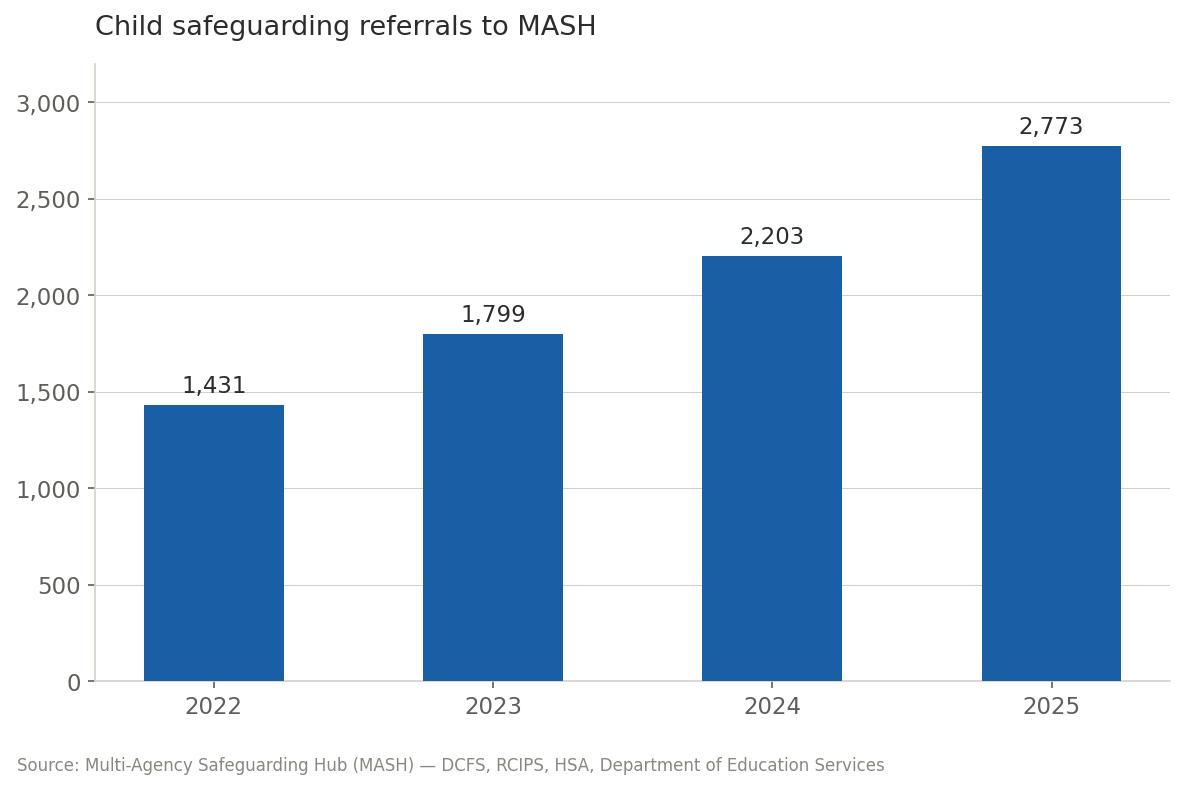
Reports of threats to children have doubled in the last three years, something Minister for Social Development Isaac Rankine has described as a “painfully upsetting trend in the wrong direction”.
Referrals to the Multi-Agency Safeguarding Hub increased from 1,431 in 2022 to 2,773 last year. Sexual offences recorded by police also jumped 20% in 2025 to 125 reported crimes, with children accounting for more than half of all victims.
Speaking in Parliament last month, Rankine said Cabinet had been stunned by the data and extent of crimes against children during a recent presentation. Several times over the last five years, he said, the number of sexual offences recorded by police was greater than both robberies and firearms offences combined.
“We cannot let our children continue to experience such crimes,” he said.
Police and prosecutors believe the reform is needed to bring legislation into the 21st century and ensure the punishment properly fits the crime for sex offenders. Some elements of the Penal Code have not been updated for decades, leaving archaic statutes on the books.
One extreme example is the requirement to prove consent was not given in cases of child rape.
Rankine highlighted specific concerns for girls in care homes. The minister referenced more than 200 incidents where young girls had absconded from care in the past year, saying they were at increased threat of exploitation.
He told Parliament that adults are deliberately targeting girls at heightened risk.
“Let us speak plainly in this honourable house. This is not misguided behaviour; this is exploitation, this is abuse, and this is rape.”
Predators warned: ‘We are coming for you’
Deputy Governor Franz Manderson backed the reform and said more must be done by the community to protect children. “If you are harming children, if you are neglecting our children, if you are having sex with children, you need to stop now. We are going to come for you, and we are going to get you.”
Manderson, who has chaired the Child Safeguarding Board since its inception in 2016, said the picture that had emerged was more serious than anyone had anticipated. “The issues are graver than we all imagined,” he said.
When perpetrators are caught and brought to justice, Rankine said the sentences were often less severe than their “heinous crimes” deserved.
Both were speaking as the minister announced the establishment of a working group to reform legislation and policy in an effort to address the troubling trend.
Trevor Gibbs, deputy chief officer in the Ministry of Social Development and Innovation, who is leading that group, said the rise in offences against vulnerable people had not garnered the same headlines as other crimes.
“They happen behind closed doors. They’re sort of a bit taboo, whereas you hear a liquor store was robbed with a gun, and everyone is on alert, rightfully so. But it doesn’t happen as frequently,” Gibbs said.
Cabinet approved the drafting of a bill, provisionally titled the Public Safeguarding Bill, on 22 April.
Prosecutors see rising caseload
The scale of the problem is also reflected in the caseload arriving at the Director of Public Prosecutions’ office.
“I’ve signed two indictments today, I signed two indictments yesterday, both for children, both for sex offences committed against children,” DPP Simon Davis said in a recent interview.
Davis attributed the rising numbers to improved investigations, greater public awareness, and older cases being reinvestigated and charged, in some instances many years after the fact.
The increased reporting is also a result of increased monitoring and reporting from adults in positions of responsibility.
Gibbs highlighted an incident in which a librarian’s referral triggered an international investigation.
“When librarians are making referrals, something is happening,” Gibbs said. “The level of understanding within the public has increased exponentially over the last few years.”
But as reporting improves, the legislation used to charge and sentence offenders has struggled to keep up. One specific problem lies in the section of the Penal Code which covers rape.
“It is an old piece of legislation and it needs to be updated,” said Davis
‘Children cannot consent’
Other sex crimes in the statute have been revised to clarify that children cannot legally consent to sexual activity, but the rape provision has not.
“When a judge comes to sum up the case … in respect of rape, you’ve got to consider whether that child was consenting,” Davis said.
That is something that will change in the new draft, Gibbs indicated.
“The way that law is written as it relates to rape it implies or requires that the jury evaluates whether or not a 12-year-old child gave consent. That shouldn’t even be part of the question.”
In practice, the gap has affected charging decisions, with some offenders prosecuted for defilement, which carries a maximum sentence of 20 years for offences against children aged under 12 years, rather than rape, which carries a maximum of life imprisonment.
A Court of Appeal decision in 2022 upheld the conviction of a man found guilty of defiling two girls aged between 7 and 11, while noting that the offences could have been charged as rape.
The judgment stated. “Given that these children could not have consented, and that these offences might have been charged as rape, it seems to us that thought needs to be given as to the appropriate balance in the Sentencing Guidelines between sentences for defilement and rape in circumstances such as the present.”
Davis said the court made clear that a rape conviction would have significantly increased the sentence imposed.
Despite the legislative gap, Davis said his office now advises prosecutors to charge rape where the evidence supports it.
“My strong advice to my team is to charge rape where the child is under the age of 13, because that’s generally what’s happened: it’s difficult to conceive of a situation where a child under 13 could ever be consenting,” he said.
Tackling sex offences online
Beyond the consent gap, the reform effort is also targeting how sexual offending has migrated online, an area where Cayman’s legislation is acknowledged to be significantly behind.
“We know that there are things happening online that we need to get our hands around and be able to charge these predators appropriately,” Gibbs said.
The existing provision, which covers use of ICT networks to defraud, abuse, annoy, threaten or harass, has been tested only a handful of times and is widely regarded as too vague, Gibbs said.
Online grooming and sexual conduct are not adequately captured by the current statute.
The Public Safeguarding Act will seek to address that, with Gibbs saying the intention is to future-proof the legislation as far as possible.
“We want this to be as future-proofed as we possibly can, understanding that in a year, what is available via AI and other things, it will be completely changed,” he said.
Positions of trust involving teachers, youth workers, and similar figures will also be included in the new legislation. This will enable specific charging of offences rather than a general abuse of trust offence.
The bill will also extend protections to vulnerable adults, described by Gibbs as a known and longstanding gap. Persons with intellectual or physical disabilities or mental health challenges currently lack adequate legislative protection, and the Public Safeguarding Act is intended to close that gap alongside parallel amendments to the Disabilities (Solomon Webster) Act.
The working group bringing the legislation together includes representatives from the DPP’s office, the Ministry of Social Development and Innovation, the Ministry of District Administration and Home Affairs, the Royal Cayman Islands Police Service, the Ministry of Health, Environment and Sustainability and the Ministry of Education and Training, as well as the Attorney General’s Chambers.
Ultimately the aim is for the attorney general to bring legislative changes to Cabinet.
Related Videos













Compass, can you make a list of all organisations, RCIPS departments, public agencies, and public figures who promised to tackle the most heinous crimes—sexual abuse of children—in the last 15 years?
I believe only leaders with young children like Florida Governor Ron DeSantis can swiftly implement and enforce draconian laws to prevent and punish such crimes.
Florida laws regarding sexual crimes against children are among the strictest in the United States, prioritizing heavy mandatory minimum prison sentences, strict post-release monitoring, and continuous legislative updates to address digital and physical threats. The core statutory framework is built around severe felony classifications, the elimination of common defense strategies, and a strict tracking network managed by the state.
Sexual battery on a child under 12 is classified as a capital felony for an adult offender. It carries a punishment of LIFE IMPRISONMENT with NO POSSIBILITY OF PAROLE OR THE DEATH PENALTY.
The next question is: are the offenders expats or locals?
As a certified and licensed professional, I had to get an FBI clearance to work in the Cayman Islands. If offenders are expats, how in the world do they end up there?
What loopholes allow some expats with criminal records to slip through?
What causes individuals who arrive with clean criminal records to cross the line into sexually predatory behavior against children? Are conditions in the Cayman Islands favorable for sexual crimes against children, and if so, what are those conditions?
Are parents legally obligated to provide constant supervision for children under 12, given the safety risks they face?
Effective enforcement begins by addressing root causes; while stricter laws may deter some offenders, they will not eliminate the crime entirely. To truly protect children, the focus must shift toward absolute prevention and severe punishment, ensuring that potential offenders face consequences terrifying enough to deter them completely.
Furthermore, early childhood education on this topic can be counterproductive, as it risks stripping away children’s innocence and inducing long-term anxiety or mental health issues. Because these crimes are strictly committed by adults, the burden of prevention should remain on adults. Parents must maintain unwavering vigilance and watch over their children with absolute scrutiny.
It is deeply concerning that one of the world’s major financial hubs has seen its reputation marred by a doubling of documented child sexual offenses in recent years.
P.S. In my view, the tight costumes worn by children in the Cayman Islands’ Batabano carnivals risk contributing to the sexualization and endangerment of minors. Some costumes have been transformed into loose-fitting pants and dresses; still, many costumes remain inappropriate.
While I agree that the primary cause of abuse is the predator’s mindset and actions rather than the fabric or fit of a child’s clothing, the doubling of child sexual abuse cases in Cayman suggests we should perhaps re-examine this established opinion.
I would suggest that legislative progress take the form of a “Statutory Rape” Law making it felony for an adult (18+) have sex, regardless of consent, with anyone under the age of 16. When consent of an underage victim is unnecessary for prosecution; the commission of the act itself provides the basis for the offence.
Sex crime against under age persons
I am of the view that there are two distinctions the child who is not biological mature and the child that is biological matures in either case the consent of under age persons biological mature is bad, hence the justice system punishing the perpetrator However the punishment is not about what he did rather what he should not have done against the Under 16 years old teen. Why he should not have done against the under 16
First the abuser has a cognitive sense of trust, family, community, justice, emotional damage that he may caused and social responsibility therefore the environmental moral compass does not exist and the punishment shall be for all of the above
Now the issue of children who are not biological mature is not and shall not be defend by a lawyer regardless. If a lawyer try to defend a rapist he or she should be brought to justice too
Raping/ abusing sexually a under age child that is not biological mature shall be a secure sentence and his /her name should be published