Get ready to dive for a good cause – emptying the seas of a threat and filling your belly with great fish.
A lionfish culling competition is scheduled to run from 25-28 January with the fish caught cooked at the Taste of Cayman food festival.
Prizes will include a private dive charter from Ambassador Divers, dinner at Michael’s Genuine Food & Drink, entry tickets and VIP passes to Taste of Cayman and a cash prize, according to the Cayman Islands Tourism Association.
Categories include most lionfish caught, most overall gross weight, biggest fish, and smallest fish – with random prize drawings as well.
Check-in time for the contest will be at 7.30 on Wednesday, 25 January at Ambassador Divers located next to Comfort Suites on West Bay Road. A $5 registration fee will be taken upon sign-in. This fee will be pooled and offered as the cash prize.
Ice ice baby
All culled lionfish must be kept cold on ice and brought to the weigh-in at the Camana Bay Dock behind the fountain on the Crescent each afternoon at 4pm. The final weigh-in and awards presentation will be held at 1pm on 28 January.
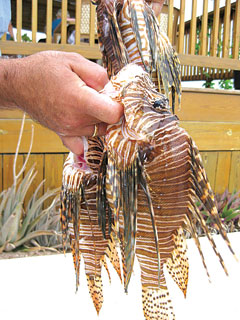
In the Caribbean, Indo-Pacific Red Lionfish have no natural predators; they are skilled at out-competing the native species like the Nassau Grouper and are eating an unsustainable amount of juvenile reef fish. A single adult female can lay as many as 30,000 eggs every four days. Native to the tropical waters of the Indian and Pacific oceans, the fish is said to have been accidentally released off Florida and for several years invading the waters of the Western Atlantic and Caribbean Sea.
Since 2008, the Cayman Islands have been fighting these gluttonous eaters as they prey on the fish that maintain the health of the Islands’ reefs.
“Stings from the spines of the red Lionfish’s dorsal fin are not fatal, but can be uncomfortable and cause nausea so they must be handled by licensed fishermen,” said Jason Washington of Ambassador Divers. “The good news is that it is completely safe to consume once the venomous spines are carefully removed.”
Chowder power
For two days before the much anticipated Taste of Cayman culinary event in January 2011, more than 100 divers assembled by Mr. Washington, in partnership with the Department of the Environment, removed what amounted to 300 pounds of lionfish meat. Using the catch the main ingredient for his event tasting station, chef Thomas Tennant of Michael’s Genuine Food & Drink prepared Lionfish Escabeche, Cayman-style, with roasted tomato, Worcestershire, pickled vegetables, avocado, extra virgin olive oil, scallion, and cilantro.
This year, Mr. Tennant will offer West Indian Chowder, also cooked in a live demonstration for event attendees. Michael’s Genuine offers lionfish on its menu and hopes to encourage more people to try it.
“I’m an avid diver and am excited to have a new fish to work with in the kitchen,” Mr. Tennant said. “Lionfish has a nice, thin skin and, just like snapper, you can do almost anything with it; you can pan fry it, you can pan sear it, you can take the skin off, you can do tempura. As long as there are lionfish in the water, I’ll be finding new ways to get them in the restaurant and cook them.”
The competition is sponsored by the Department of Environment, Ambassador Divers, Home Gas and Michael’s Genuine Food & Drink.
Rules:
Teams must have at least one certified lionfish culler with proof of certification.
Teams must have a minimum of two participants and a maximum of eight participants.
All participants MUST register at the start of the culling contest on Wednesday morning, 25 January.
Please use only the official lionfish nets.
Only persons licensed by the Department of Environment may use DoE issued spears.
Only a certified lionfish culler should handle the lionfish.
All lionfish must be freshly caught the day they are turned in or the team will be disqualified.
Please keep all lionfish caught on ice. These fish will be eaten
.
For more information on certification, contact the Department of the Environment on 949 8469 or email [email protected]. Call Ambassador Divers on 949-4530 for more information on lionfish nets.

Related Videos