

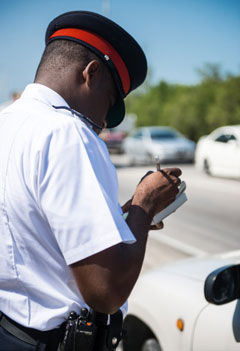
A precipitous drop in the number of speeding tickets issued by the Royal Cayman Islands Police Service has been revealed by a Caymanian Compass examination of annual crime statistics since 2007.
According to RCIPS data for those years, speeding offenses have dropped to a fraction of what they were just seven years ago.
In 2013, the number of speeding offenses detected for the calendar year totaled 811. That’s a 53 percent drop from what was seen in 2012, when 1,735 offenses were detected by police.
That 2012 number of offenses represents less than one-third of the traffic citations handed out by RCIPS officers during 2009 and 2007.
In 2007, more than 5,700 speeding offenses were detected by police. In 2009, there were more than 5,500 such offenses, according to police traffic statistics reports. Police officers handed out more speeding tickets during a two-month period in 2007 than officers did for all of 2013, statistics show.
The numbers dropped a little in 2010, but the department still ticketed more than 4,000 speeders. It wasn’t until 2011, that police records show speeding offences really tapering off.
In 2011, there were 1,956 speeding offenses detected and the numbers continued to drop during 2012 and again last year.
It was in 2011 that the RCIPS reorganized its traffic enforcement unit, in an effort to put more patrol officers “on the beat.”
“What we’ve done is, where the officers that were predominantly placed at traffic management, we’ve now moved those officers over into regular shift,” RCIPS Chief Inspector Angelique Howell said at the time.
Instead of working out of the traffic management building near the intersection of Crewe Road and Lyndhurst Road, the police officers are now responding to calls from the police station, which essentially gives the department more flexibility in deploying police rather than designating a specific group of officers as traffic investigators. So, if the traffic officers are not out on accidents, they can respond to other calls for police service.
“Every policeman is a traffic officer,” Ms Howell said. “When the officers were being deployed from traffic, yes, of course, they would answer a call, but they were mainly focusing on traffic matters.
What we are trying to do is maximise our officers’ skills and potential.”
Other articles you may be interested in:
- ROAD SAFETY: Campaign Ends – January 8, 2014
- HOLIDAY CRACKDOWN 2013: 39 arrested – 24 December, 2013
Specialist investigative skills are still needed at certain types of accidents.
Reconstruction experts employed by the RCIPS are called out as necessary to recreate the scene and do damage assessments in fatal collisions.
Those officers are called out on assignment as necessary, Chief Inspector Howell said. For routine accidents where there are no serious injuries, and that mainly involve vehicular damage, there’s no reason that any line officer can’t handle it, Ms Howell said.
Mostly administrative staff now works out of the RCIPS traffic building on Lyndhurst Road in George Town, although officers can go there to complete paperwork and file reports as needed.
Some local insurance companies privately expressed concerns, when the change was first made, that traffic officers might be depleted by the move, which, in turn, could end up affecting insurance rates.
The total number of traffic accidents recorded by police in 2013 increased by about 11 percent, compared to 2012.
However, there were significantly fewer wrecks in the past two years than occurred during 2010-2011, according to police statistics.
While speeding tickets have sharply declined, other traffic offenses have not, and overall traffic offenses recorded by police increased during 2013.
The main reason for that is the more than 1,300 tickets the RCIPS handed out for cell phone driving offenses during 2013. Talking on a handheld cell phone while driving was made in illegal in Cayman during 2012.
Other ticketed traffic offenses, like failure to wear a seatbelt or drunken driving declined slightly in 2013, when compared to 2012.

Related Videos













The Crime up 40% concerns me a little more than the speeding tickets issue quite honestly.
I never heard of traffic officers being deployed from traffic. Managing traffic from the police station? Must be Caymanian thing. Maximize skills and potential? What exactly does that mean?
Lucia, this is just a repeat of what happened in the UK about 15 years ago.
When the now-discredited fixed speed camera programme kicked off in the late-1990s many police forces used it as an excuse to break up their traffic (called Roads Policing in the UK) units with many of their specialist vehicles and crews becoming little more than glorified patrols cars.
The result of this was that in 1999 road casualties in the UK increased for the first time in nearly a decade. Where I lived road deaths went up from under 70 a year to well over 100. The cut backs were so severe I can remember one fatal crash where officers from a neighbouring county had to be called in to deal with the investigation because there was no one available locally.
Since then the UK has rolled back many of these changes but a lot of people were killed or seriously injured before the message got across that the only way to make roads safe is for the police to have a very visible and pro-active presence on them.
An 80% decline in speeding tickets is a direct result of a decline in police vigilance. I personally witness dangerous driving practices daily. I have lost count of the number of times somebody has turned in front of me, when I have the green arrow at a light. I have nearly been wiped out twice this month alone, because a vehicle was overtaking either at a traffic light or passing on the incorrect side of the vehicle they wished to overtake. It is also common practice for vehicles to turn at the junction between Anderson Square and RBC, without using an indicator. Not to mention the vehicles with smashed taillights or broken windows cobbled together with tarp or plastic, among other road worthiness violations. There are no shortage of texting and driving violations either.