

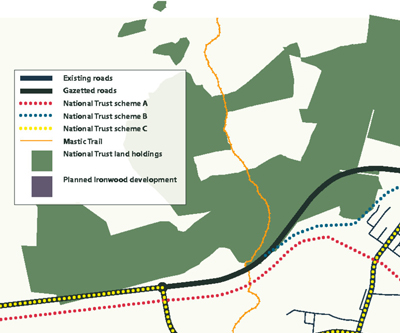

Public coffers may have to directly fund a portion of a proposed 10-mile extension to the East-West Arterial highway between its current terminus in Newlands to Frank Sound Road in North Side, government officials have confirmed.
The road extension is considered key to the proposed US$360 million Ironwood resort development planned just east of the Mastic Reserve in the central bush land of Grand Cayman. Developers have said that if the road is not built, the development will not proceed.
According to a nonbinding agreement between the developer and government leaders late last month, the backers of the proposed Ironwood project would fund the initial construction of the 10-mile stretch of road. That cash outlay would be refunded to the developer through concessions based on import duty fees.
The entire 10-mile road extension is expected to cost $40 million, although that amount could change as the project moves forward.
The revenue that might be derived from import concessions on the project were estimated at a minimum of between $20 million and $25 million by Works Minister Kurt Tibbetts, who was asked about funding arrangements at a Tuesday press conference.
According to the nonbinding agreement: “[The Cayman Islands government] anticipates that additional revenue to the islands will be generated from the development in the form of, for example, stamp duty [arising from the development itself as well as from adjacent properties along the length of the road] and which will go toward the cost of the government’s annual road user fee.”
The annual road user fee, as defined by the agreement, is to be paid by government to the developer in a stipulated payment schedule over the useful life of the road extension – estimated at 20 years.
Mr. Tibbetts said Tuesday that “various methodologies” were being considered for the rest of the road funding.
“There are also other developers who have approached the government who want to do certain projects in the vicinity of where the road is going to be,” Mr. Tibbetts said. “Some of the developments might start to take place before the road is built.”
Other options for paying for the road construction could include allocating stamp duties from land transfers that would “naturally occur,” according to Mr. Tibbetts, when the road is built and the Ironwood development gets under way. A third option might be paying whatever annual amount is still owed from government’s capital projects budget.
“Your worst case scenario is your capital projects for roads every year,” Mr. Tibbetts said. “If you have to cut back a little bit on that and use some of it to pay for that, fine, because you will already have that much road you didn’t have before.”
Mr. Tibbetts acknowledged Tuesday that there were still significant doubts regarding the United Kingdom’s acceptance of the funding scheme proposed, and also doubts about whether the National Trust, which owns a portion of the property slated for the road extension, would agree to let its land be used for such purposes.
The works minister and other government officials met with National Trust leaders last week to discuss potential alternate routes for the East-West Arterial road extension. Three alternatives were proposed by the trust, one of which was previously rejected by the project developer, but Mr. Tibbetts said the positives from the meeting outweighed the negatives.
“I believe we can get an arrangement with the National Trust,” Mr. Tibbetts said. “If that can happen, and we can get to this point where the U.K. says ‘OK, your business case makes sense’ … they have already indicated to us, in principle, that they support the project.
“[The developer] has been talking for four years about this project; they talked to the previous government. It was announced by one of the former premiers in a public forum. We believe that the type of project that it is … it’s not something that’s going to be finished in a year….
“It complements a lot of things that are happening [in East End] as we speak and are intended to happen. Why not [continue with the project]? Why should we continue down this [western] side [of Grand Cayman] and sooner or later we’re going to tip the island over.”

Related Videos











Whoevers negotiating this deal needs to grow a pair. The developer clearly wants to get the IronWood development going and if they want the road so bad they should agree to better terms. What the CIG currently agreed to seems to be giving up any revenue they would make for the IronWood development for years to come, why not offer them a 50 Percent concession like Dart got. They expect the project to take 20 Years to complete.