

A woman given three months to live dedicated her remaining time to hunting lionfish
A “bucket list” adventure to cull lionfish in the Cayman Islands has developed into the region’s first commercial fishing operation targeting the invasive predator.
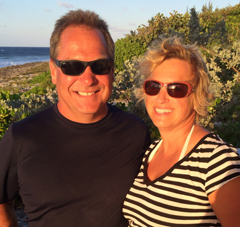
When diving enthusiast Maria Yapelli was told she had three months to live, she married her long-time partner, moved to her favorite holiday destination – the Cayman Islands – and decided to dedicate what time she had left to culling lionfish.
The diagnosis of an inoperable brain tumor turned out to be incorrect.
But the near-tragedy was the catalyst for Ms. Yapelli, 47, and her new husband Mike Foreman, 48, to take the plunge on a unique fishing venture that could be at the forefront of fighting the lionfish infestation plaguing the Atlantic.
Spinion Exports Ltd., started by the Chicago couple with local partner Brent Mclean, has been given a trade and business license to operate in the Cayman Islands.
They have bought warehouse space in George Town to transform into a processing unit, which they hope will be the focal point of a pan-Caribbean culling business.
They plan to export the fish to the U.S., where it can sell for up to $35-a-pound as a niche food, favored by environmentally conscious diners.
Ms. Yapelli said she and Mr. Foreman loved scuba diving and had been coming to the Cayman Islands for more than 10 years.
“We saw the island recover from Hurricane Ivan and then we saw what the lionfish were doing to the reefs,” she said. “When I was diagnosed with the tumor and given only a few months to live, we sat down and said what are we going to do? I said, let’s go to Cayman and kill lionfish.”
She said facing her own mortality had given her a fresh perspective on life and helped the couple take the brave decision.
“We don’t plan to get rich from it, we want to make a living and make a difference,” she said. For now, the business is in the early stages, but they are already covering day-to-day costs by selling lionfish to local restaurants for $5-a-pound.
The couple, who have hired two young Caymanians as part-time divers, use a hookah system, favored by hunters in Australia who dive for abalone, a type of sea snail.
The divers are linked to a floating air source by long, flexible hoses, allowing them to stay underwater for longer.
Mr. Foreman hopes the Cayman operation will ultimately be the hub for a regional export business. He plans to work closely with the Department of Environment on new culling methods and partner with commercial fishermen and cullers further afield to increase the supply.
He has established a partner operation in the U.S., Lions Den fish company, to handle imports from Cayman. The couple also invested in transforming three warehouses at the Condor facility in George Town into a 12,000 foot processing plant, where staff will remove the venomous spines from lionfish, and pack and freeze the fish for export.
“From a financial perspective, the only way this is going to work is as an export business,” said Mr. Foreman.
“For this to be a sustainable business, we will need to get fish from further afield and we will need to sell in markets where the price point is highest.”
Initially, that could mean Dallas, Chicago and possibly New York.
A paradox of the lionfish culling business is that the ultimate aim is to eliminate the catch entirely. But Mr. Foreman believes that there are enough fish out there, particularly in more remote reefs across the Caribbean, to make the business viable for many years.
“Because this is an invasive species, it doesn’t really follow the typical plan for a commercial fishery. You don’t want it to be sustainable.
“Right now, I think the problem is so great that even if we do start eating this fish on a regular basis, it is going to be hard to eliminate entirely,” Mr. Foreman said.
He said the business was initially targeting “low hanging fruit” – the lionfish that inhabited shallow reefs within the range of open water divers.
Ultimately, he believes the culling efforts, from an environmental as well as commercial perspective, will have to find a way to focus on fish at greater depths – outside of divable range.
He plans to split his time between the operation in Cayman and the U.S. – building the export market for lionfish.
He hopes to hire Caymanian staff to fill key positions in the local operation and work with schools to provide internship opportunities and get young people involved in the business.
Bradley Johnson, a research officer with the Department of Environment, said the couple had worked with the DoE to comply with licensing requirements. He said the department was supportive of the business and hopeful that it could make an impression on the lionfish infestation.

Related Videos








All the best to them!
This is fantastic for Cayman reefs …. getting to greater depths and to areas where cullers rarely frequent. Thanks to Bradley at DOE for getting the permit as well.
I think this is a great idea. There are probably a lot of divers locally that would hunt for the lion fish for free if just given the tanks to dive
Where innovation meets necessity, there will always be a opportunity.
Good luck and I hope you make a killing.
This is great news, although I find it disheartening that now local entrepreneur jump on this opportunity to start a new industry in Cayman but I am glad to hear the have plans on hiring local people and creating opportunities for young people. Starting a market for Lion Fish meat is just what’s needed to deal with the invasion. Humans have long been known for eating animals into extinction. The higher the price on their head the more people will hunt them, there will be plenty of divers maybe even some snorkelers bringing lion fish to the warehouse to sell. The fact that they have to be caught by spear will most likely drive the price of the meat up.
Thank you all for your comments. My husband and I love this island. If you are interested in following our story on Facebook you can check us out at Spinion, Ltd. You can see our Caymanian business partner, our Caymanian employees and the local Caymanian kids that we are mentoring. Our business plan is not to take from this your island but to help create jobs for CAYMANIANS and create an industry that actually is good for the environment. Thank you again.