Environmental officials say that the coral restoration project under way off Don Foster’s Dive site might be an ideal candidate for funding from Cayman’s Environmental Protection Fund, but acknowledged that access to the money is unlikely to happen any time soon.
At a meeting for divers last week to kick-start the restoration project, Timothy Austin, deputy director of the Department of Environment, said that the fund, which currently contains more than $46 million, could be an ideal resource for the effort.
“The Environmental Protection Fund has criteria for the use of that fund. And it’s not unrealistic to think that a restoration like this, if there is no one who can be held accountable, this is the type of thing that you could apply to the Environmental Protection Fund for,” Mr. Austin said.
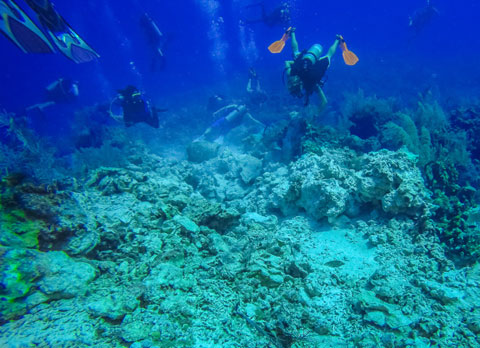
Volunteer divers have already begun removing rubble from the site after nearly 12,000 square feet of previously pristine coral reef was wrecked when a Carnival Magic Cruise ship accidently dropped its anchor there last month.
Mr. Austin further clarified to the Cayman Compass this week that the damaged site is in line with some of Section 46 of the National Conservation Law (December 2013). The environmental fund is outlined in the National Conservation Law, which was gazetted earlier this month.
“There continues to be established and managed an Environmental Protection Fund to be used for the acquisition and management of protected areas and for measures to protect and conserve protected species and their critical habitat pursuant to an appropriation in accordance with the Public Management and Finance Law,” according to the National Conservation Law.
All species of coral are protected under Cayman law, and the area of damage to the reef is in a marine park, a zone also protected by law.
Issues
While the restoration project may seem to be an ideal candidate for funding, “the problem is that the National Conservation Law is not yet in full effect,” said Mr. Austin. “Administrative sections … were brought into effect on September 12, but these just provide for the establishment of the National Conservation Council …
“The real heart of the law and the sections that relate to the Environmental Protection Fund are not yet in effect, although they will be soon, hopefully,” Mr. Austin added.
The Environmental Protection Fund is managed by the National Conservation Council, whose members were announced a short while ago.
In order for the fund to be used, the council would need to gain knowledge of the project and then approach the government’s Finance Committee for release of the money under the Public Management and Finance Law, explained Mr. Austin.
The fund, as of the end of June this year, had accrued $46.7 million, from government taxes collected from tourists since 1997.
“The money in the fund has only been utilized by government on a couple of occasions, so it has amassed a sizeable amount of money,” said Mr. Austin.
Government collects $4 per airline passenger, $3.20 per seasonal cruise ship passenger and $1.60 per year round cruise ship passenger to inject into the fund.
“Every departing passenger, cruise and air, visitor and resident alike pays the fee when they leave the island,” said Mr. Austin.
Mr. Austin explained that the fund cannot be used for every environmental cause, as certain projects would take priority. To date, the vast majority of the fund has remained unspent.
For this project, he said, “The area in question is a protected area marine park and the coral is a protected species, but that might not put it to the top of the list of priorities that the council is charged with developing.
He estimated it would cost around $200,000 to $650,000 to fund a typical reef restoration of this size.

Related Videos