Deputy governor takes the stand
WEDNESDAY, 9 a.m. update: As the cross-examination of Deputy Governor Franz Manderson continued on Tuesday afternoon, McKeeva Bush’s defense team produced a series of emails from former Governor Duncan Taylor which they suggested showed there was a “conspiracy” to bring down Mr. Bush.
In one message from Mr. Taylor sent several weeks before Mr. Bush’s arrest to an employee in the U.K. Foreign Office, named only as Tony, the former governor suggests that “senior and trusted officials” have indicated to him that the arrest of the premier alone would be a “game change event,” adding, “all the more so if police are seen carting away boxes from McKeeva’s office and home.”
In the email exchange, excerpts of which were read to Mr. Manderson and the jury by Mr. Bush’s barrister Geoffrey Cox, QC, the then governor goes on to speculate that the arrest could lead to Mr. Bush being ousted from office by his colleagues.
“We know they want him out and an arrest, let alone a charge, might just help them rediscover their backbone,” the email read.
He adds, “If it becomes public knowledge that he drew cash out on his card to gamble I think his position will become untenable.”
In the email exchange, Mr. Taylor suggests “we watch and wait” and take care not to be seen to be interfering or forcing Mr. Bush out of office, warning this might allow him to “play the victim card.”
He goes on to suggest to the official, “One possibility you might want to give thought to in London is encouraging trusted media contacts there, if you are confident it can be done without leaving finger prints, to write articles setting out the damage (that could be) caused to the Cayman Islands reputation if McKeeva does not step aside after his arrest.”
The content of the emails was put to Mr. Manderson, as Mr. Cox suggested to him that he was part of a plot, along with the governor and others, to oust Mr. Bush from office.
Mr. Manderson said he was unaware of the content of the emails until they were read to him in court and had not been part of any plot.
Asked if he was aware that the Governor was eager to have Mr. Bush arrested, he added, “I was aware that the governor took his responsibility for good governance seriously and did everything in his power to ensure the Commissioner of Police was able to do his duties properly.”
The cross-examination of Mr. Manderson was scheduled to continue on Wednesday.
Original Story:
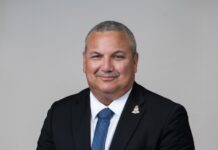
Deputy Governor Franz Manderson testified that he never used his government credit card for personal use and considered it “wrong” to do so, as the trial of former Premier McKeeva Bush continued in Grand Court on Tuesday.
“The way I viewed it, if we are spending other people’s money, it’s not ours, so we had to do that in the most judicious way possible. It is the people’s money,” Mr. Manderson told the court.
Asked if he had ever used his card for personal use, Mr. Manderson said, “The thought never crossed my mind.”
Asked by prosecutor Duncan Penny, QC, why not, he replied, “It’s wrong, sir.”
Under cross-examination from Mr. Bush’s barrister later on Tuesday, Mr. Manderson acknowledged that he had been aware that the then Speaker of the House had also used her credit card for personal use, though he could not recall exactly when this had taken place. Mr. Manderson’s evidence continued on Tuesday afternoon after press time.
Mr. Bush is accused of withdrawing just under $50,000 on his government-issued card and using at least some of the cash to gamble in slot machines at casinos during a series of personal and business trips to the U.S. and the Bahamas in 2009 and 2010.
Mr. Manderson, who was chief officer in the Ministry of Internal and External Affairs at the time of the alleged offenses and has since been promoted to deputy governor and head of the civil service, told the jury that his understanding was that credit cards issued to chief officers and ministers were designed to make their work easier and more efficient. He said he believed it was also designed to help get better rates for official air travel and hotel bookings by enabling them to book online.
He agreed with the suggestion from Mr. Penny that a set of guidelines for anyone working in government, known as General Orders and later as Personnel Regulations, contained guidelines about official travel and what expenses could be claimed – for example, hotel rooms, air fare and meals but not alcohol.
Mr. Manderson said those regulations were implemented for his employees in the Portfolio of Internal and External Affairs.
Under cross-examination by Mr. Bush’s lawyer Geoffrey Cox, QC, Mr. Manderson accepted that there were three people in the Portfolio of Internal and External Affairs who had credit cards, including the Speaker of the House. Mr. Cox produced an internal audit report for the Portfolio of Internal and External Affairs, which highlighted concerns about the use of credit cards in that portfolio between July 2008 and June 2009, just prior to Mr. Manderson’s appointment as chief officer and officially released after he had taken up the post.
Mr. Manderson said he had no recollection of that report or its findings, which were said to include concerns about nearly $9,000 of unaccounted for expenditure on credit cards held by officials in that portfolio.
“You’re talking about something that happened many, many years ago. I’ve seen hundreds of reports since then,” said Mr. Manderson.
Mr. Cox, reading from the report, said it raised concerns about inadequate records of financial transactions, including $5,500 of expenditure from the then chief secretary for which there were no receipts.
Asked if he was aware that the Speaker of the House at the time had used her card for personal use, Mr. Manderson said that he was.
“I remember that was brought to my attention. I was aware there was a transaction that appeared on the credit card statement of the Speaker of the House and it was thought to be for personal use. I don’t remember if there was more than one,” he said.
Mr. Manderson also testified that he had received a late night phone call from Mr. Bush on Nov. 5, 2012, during which he confirmed to the then premier that he had provided documents, including his credit card statements, to police earlier that day, following an official request.
He said he had spoken with Mr. Bush again the following day, just before the Cabinet meeting was due to begin.
During that conversation, he said Mr. Bush had told him that he had used his card for personal expenditure. “He told me he had used the government card for personal use for himself and his wife for medical purposes. He said that the card didn’t have a PIN so he had used the card to withdraw money in casinos, where it was easier for him to obtain money from the card…
“He said he had repaid the money back to government but he now realized that there was some money outstanding and he was going to pay it back.”
Related Videos