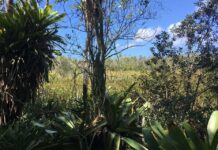
It appears a road will be built through a rare section of George Town forest land, despite recent pleas from environmentalists to keep the area – known as the Ironwood Forest – intact.
However, Leader of Government Business Kurt Tibbetts said Thursday that officials would do everything in their power to preserve the remainder of the Ironwood, which botanists said contains several endangered plant species.
‘I, more than many, understand the value of this forest and know that it represents an irreplaceable part of our history and culture,’ Mr. Tibbetts said. ‘For the sake of my own children and grandchildren, my greatest desire is to preserve this distinctive ecosystem.’
Plans to build Phase 3 of the extended Linford Pierson Highway through the forest have been in the public domain for a number of years. A rough sketch of the road extension was even included in a 2001 street atlas published by the Cayman Islands Lands and Survey Department.
Various iterations of the road’s design have been drawn up through the years. The current plan shows a single road cutting through the heart of the forest northwest of Agape Family Worship Centre and Triple C School, passing south of the Windsor Park area and connecting with Walkers Road just north of the UCCI campus.
At one stage, government had planned to build a roundabout in the centre of the land, but National Roads Authority Managing Director Brian Tomlinson said those plans were scrapped because officials realised it would destroy more of the forest than was necessary.
Those concerned about the potential destruction of the forest were soliciting comments on www.ironwood-forest.com and asking site visitors to ‘let your opinion be heard.’ The site functions as a sort of internet petition where people leave their name and can also type in any message they want to send.
Mr. Tibbetts said government has thoroughly explored several alternatives in building the road, including the elimination of the Linford Pierson Highway extension through the forest. But he said the cost of ever-worsening traffic tie-ups to Cayman’s residents and the country’s overall economy is simply unsustainable.
‘For those who must sit morning after morning in this traffic it is highly frustrating,’ he said. ‘Annually, it amounts to millions of dollars in lost productive labour hours.’
The NRA has looked at building around the forest to the north, but Mr. Tibbetts said that would increase the cost of construction from the currently estimated $7 million to anywhere between $12 million and $17 million. That plan would also involve taking other residents’ land.
Another option, widening nearby Fairbanks Road, would also force government to seize property on either side of that street and remove many homes and apartments lining the area.
‘This approach would be extremely cost prohibitive,’ Mr. Tibbetts said.
The possibility of purchasing the remaining acres of privately owned land following the road’s construction through the Ironwood Forest has been explored.
The Department of Environment is seeking to have the area designated as a national forest. Right now, the Crown only owns a small portion of the land directly behind UCCI.
‘We have been unsuccessful in our attempts (to purchase the land),’ Mr. Tibbetts said, adding government is still pursuing the issue with several families that own forest property.
The man who owns what’s believed to be the largest remaining tract of land in the Ironwood Forest – about 22 acres – said in an interview with the Caymanian Compass that the forest land has been in his family for generations and he has no intention of selling the remaining portion, which is not being used for the new road.
Andrew MacGregor ‘Greg’ Yates said he’s not opposed to the road’s construction. However, he told the Compass he’s furious about activities that have occurred on parcels of his family’s forest land without his knowledge or consent.
He said scientists were apparently allowed to trespass while on a tour of the property, that indigenous plants were removed without his approval, and said an unattended bulldozer rammed through a section of forest land not designated for the road’s construction when the machine’s operator fled after being attacked by bees.
Mr. Yates received an offer letter in October 2002 from the Lands and Survey Department for the approximately 4.5 acres needed to build the road through the forest. But he said he’s never received any money from government and has not even agreed to a purchase price.
According to Mr. Tomlinson, there’s nothing unusual about the circumstances of the purchase offer.
Section 3 of the Roads Law allows the NRA to begin work in a gazetted area within a certain time after publishing a road map and notifying land owners. After the road is built, government officials then negotiate with the property owners about a purchase price.
Mr. Tomlinson said that purchase price must reflect the value of the land at the time the road was gazetted. In other words, if the road was put on the books in 2002 the land purchase must be negotiated at 2002 values, not its current value.
‘They just did it,’ Mr. Yates said. ‘They sent the letter saying the land had been acquisitioned, and they were going to build this road. This is several years later, the road still isn’t built and I’m still not compensated.’
Mr. Yates also questioned whether government actually wanted to preserve the land as a national park. He said he was recently approached by high-ranking officials who enquired whether he was willing to sell the land so that it could be cleared and used as a cricket pitch.
‘I am looking to preserve (the land) by owning it, not by my selling it to take a trip to Miami,’ he said.
Once the road is built, the value of the remaining land owned by Mr. Yates and others is likely to go up in terms of commercial value. Right now, there’s no road access to the parcels of undeveloped land.
According to the Lands and Survey offer letter sent to Mr. Yates in 2002: ‘It is clear that the resulting increases in the value of the retained land would more than outweigh any financial loss associated with the compulsory acquisition of the acquired land.’
If government wants to purchase the remaining parcels for a national forest, it may find the cost has gone up.
Related Videos