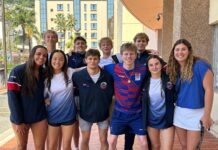
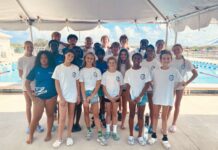
The Cayman Islands Amateur Swim Association (CIASA) took another step towards safety, as seven members recently took advantage of an opportunity offered by the Health Services Administration to take a First Responders course that includes CPR (Cardio pulmonary resuscitation) and use of AED (automated external defibrillator) machines.

From left, Dominic Ross, Jeanine Rix and Sara Mackay practise CPR on mannequins using a personal isolation valve. |
The CIASA already has their own portable defibrillator, generously donated by Frank Flowers and Dr. Sook Yin for use at Sea Swims, especially the annual Flowers Mile event in June with its huge number of participants. The next step was to get a number of people trained in its use.
The HSA course is available to all of Cayman. Paramedic Debra Gaffigan and Catherine Pride of the HSA’s Life Support Training Unit taught this class at the hospital.
‘It was excellent.’ said one attendee (use my name if nec). ‘Very clear and confidence instilling. I’m usually pretty intimidated by this kind of stuff, but now, I wouldn’t hesitate to help, no matter where I am.’
‘The machines are brilliant in their simplicity, explained Debra Gaffigan.
Dr Sook Yin, Medical Director of the CIASA, explained the concept is for CIASA to be self-sufficient in first aid and medical response during sea swims and triathlons, as most of the time the Red Cross and HSA have to respond to the public first.
Studies have revealed that fewer than 5% of Sudden Cardiac Arrest (SCA) victims survive. In most cases, their key to survival is prompt defibrillation therapy. More than 90% of SCA victims survive when automated external defibrillation occurs within two minutes of sudden cardiac arrest. AED helps with most loss of heart rhythm, that can happen to healthy, fit people, not just heart stoppage.
Thus Cayman’s drive, part of a universal drive, is to get defibrillators everywhere there are large numbers of people; airports, supermarkets, sporting events etc. At least one large department store chain in the U.S. is placing four per store, so one will always be close.
The CIASA will have someone walking the beach with their AED during all their sea swims (8-10 each year). The machines are now so simple, they can be used by anyone. Many models turn themselves on as you open the cover. Then the machine ‘talks to you’, actually gives oral instructions. Once the paddles are attached to the chest, the machine then analyzes whether the problem is one defibrillation will help, tells you go ahead or not.
At the First Responders class, there was one adult and one infant mannequin per student, so everyone got to ‘practice’ repeatedly what they learned. The class included coverage of the updated guidelines of CPR ratios, differing treatment for adults, children and infants, procedures. Each attendee went away with a manual, a one page highlight sheet, a personal isolation valve for CPR use, and an understanding that the sooner the treatment, the less the damage to the heart.
Simultaneous to the training of the government sector, i.e. police and firefighters, Swimming is first Cayman sports association’s to be trained. Three of the coaches of the Lions Aquatic Center attended along with other CIASA members. CIASA covered $100 of the $130 per person HSA fee, Stingray Swim Club covered $30 of their members. Another class will be offered to CIASA members at a later date.
Associations and businesses should consider making this simple potentially life-saving training available to their members, employees and associates. The course coordinator is Joanne Taylor and her contact telephone number at the HSA is 244 2874.
‘It was great, a morning very well spent,” said a newly trained first responder, ‘and might be the most important thing I’ve done in a very long time’.
Related Videos