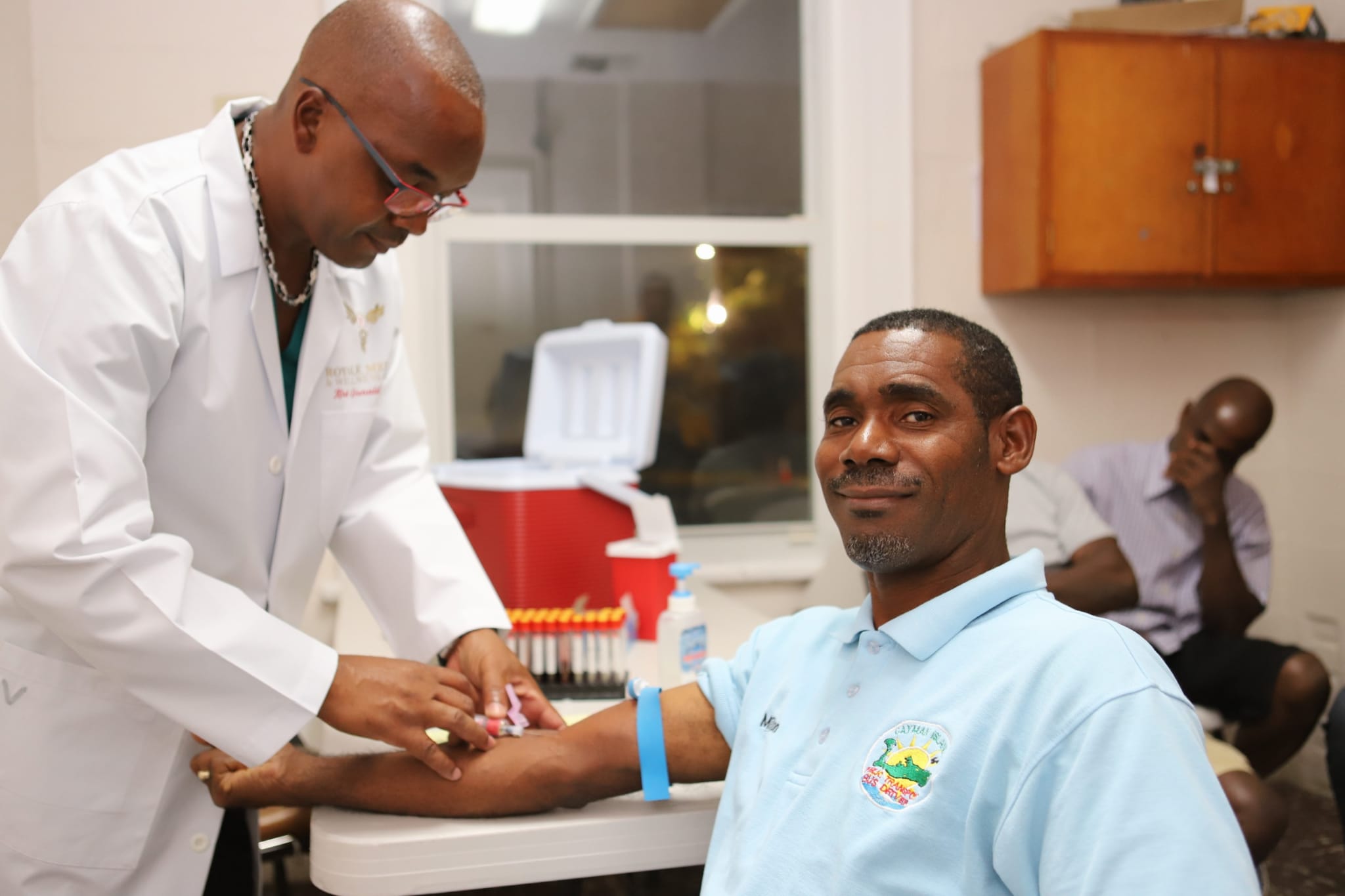
While health supplements may be a helpful regimen to stave off symptoms of prostate or colon cancer, urologist Dr. Paras Singhal has said they do not reduce the urgency of, or need for, regular screenings.
Singhal, a consultant urologist at Health City Cayman Islands, made the point as he addressed a Lions Club of Grand Cayman seminar on prostate and colon cancer at Constitution Hall in George Town Monday night.
He said testing for the prostate-specific antigen (PSA) is an essential practice for the early detection and treatment of prostate cancer even if men are taking regular health supplements to boost their defences.
“Whenever someone asks me about supplements, I say, ‘You can take them if you want’, but that does not mean that it is going to prevent any cancer from happening,” he said, adding that anyone at the age advised for getting the PSA test should do so.
The recommended age for PSA testing is 50; however, men at higher risk for cancer due to family history should be tested from age 40, according to the American Cancer Society guidelines for early detection.

Health supplements, Singhal said, have not been proven to prevent or cure the cancer, but “definitely many men in my own personal experience report good symptomatic outcomes using these supplements”, Singhal told the Cayman Compass at the seminar.
The seminar is part of the Lions Club’s signature focus on prostate and colon cancer. At the event, which was attended by over 40 men, Royale Medical provided free PSA testing.
Singhal said it is important for men know their PSA numbers. He said any result between four and 10 on those tests should be a marker for further investigation.
“Anything above four or between four to 10, there is a 20% chance of cancer, an 80% chance for prostatitis (inflammation or swelling of the prostate gland) and anything above 10, the chance for cancer increases. A lot depends on the PSA testing,” he added.
Singhal said when the PSA number is four, symptoms are minimal.
However, with age the patient may detect issues with the urinary tract and that is usually because of an increased prostate size.
“Once the prostate size increases and causes symptoms, then one has to be alert to the possibility that this increased size, although more likely to be benign, can also be a cause of cancer, and discuss that with his physician or a urologist… With two simple, basic tests – PSA and rectal exam – we can find out if it is more likely to be a cancer or more likely to be a benign disease and then treat and advise accordingly,” he said.
According to the Health Services Authority, the top three cancers found in the Cayman Islands are breast, colorectal and prostate.
Dr Sunil Mathai, who discussed colorectal cancer at the seminar, reminded those present that the Caribbean is second in the world for incidence and mortality for this type of cancer. Locally, though, statistics are limited, he said.

However, the HSA reported that last year 1,351 patients visited its Chemotherapy Unit.
Mathai said screening can make a huge difference.
He pointed to the death of actor Chadwick Boseman from colon cancer last August at age 43 as a reason to get checked, since the disease not only hits older men but also affects younger Afro-Caribbean men.
Lions Club president Carmin Godfrey welcomed the high turnout at the event as a sign that more men are taking an interest in their health.
“It shows that men are no longer fearing it,” Godfrey said, as she pointed out the PACCE awareness meetings have been growing in attendance.
These events, she said, has been hosted by the Lions Club for over 10 years with tests performed for free.
Earlier this month, the Lions Club of Grand Cayman and the Lions Club of Cayman Brac jointly hosted a similar education night at the Brac Reef Resort.
The Cayman Islands Seafarers Association recently donated $5,000 towards the club’s PACCE (Prostate and Colon Cancer Event) initiatives following an awareness seminar held to educate its members and conduct free PSA testing.
The next PACCE meeting is planned for West Bay. For further information, visit the Lions Club of Grand Cayman official Facebook page.
Related Videos