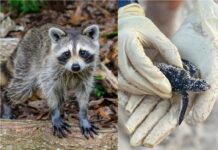
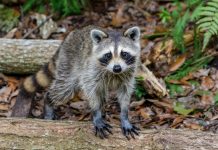
The raccoon captured in West Bay on Tuesday has been “humanely euthanised”, the Department of Agriculture has said.
The DoA also confirmed that tests on the first raccoon captured last month found that animal to be rabies-free.
The DoA, in a statement issued Wednesday afternoon, said the raccoon captured Tuesday had a compound fracture of the leg which was discovered after examination when it was found near Republix Plaza in West Bay, not far from where it had escaped last month.
“Given the animal’s injury, it was humanely euthanized shortly after capture to prevent any further pain and suffering. Tissue samples were collected for mandatory testing necessary to determine its disease status,” the DoA stated.
The animal was one of two found in a shipping container on 22 Oct. The first raccoon was trapped that day, but the second escaped.
A tip from a bus driver Tuesday led DoA team members from animal welfare, animal control and the Veterinary Services Unit to where the animal was spotted and captured it.
The DoA said the animal was confirmed to be a juvenile male, like the first raccoon.
What is rabies?
Rabies is a virus that infects the central nervous system. If a person does not receive the appropriate medical care after a potential rabies exposure, the virus can cause disease in the brain, ultimately resulting in death. Rabies can be prevented by vaccinating pets, staying away from wildlife, and seeking medical care after potential exposures before symptoms start. (Source: Centers for Disease Control and Prevention)
That raccoon, the DoA said, tested negative for both rabies and canine distemper viruses, which are known to be carried by raccoons.
“The Department of Agriculture is relieved to learn that the animal was free of both of these very serious diseases, especially given that following the animal’s capture it was showing clinical signs of ill health”, Dr. Larry Caven, senior veterinary officer, said in the statement.
On Tuesday local social media site Everything345 was in the area in West Bay when the DoA animal control officers nabbed the raccoon from its hiding spot on Tuesday, and recorded the animal’s capture.
Brian Crichlow, DoA assistant director, in explaining why samples were sent for testing, said it is essential that the department confirms the rabies status of both animals “in order to determine if the Cayman Islands rabies status has in any way been compromised”.
“Maintaining the Cayman Islands rabies-free status is of utmost importance as any change to this would not only pose a serious risk to the local human, and animal, population, but would have significant implications as it relates to animal and human vaccination,” he added.
Crichlow said the department was grateful for the assistance of the people who reported the original and subsequent sightings, “which led to the capture of the animals. It shows how important the public’s assistance is in these situations.”
He pointed out that the DoA is obligated to report the matter to the World Animal Health Organization and provide evidentiary proof of the disease status of both animals as part of its international obligations.
Related Videos