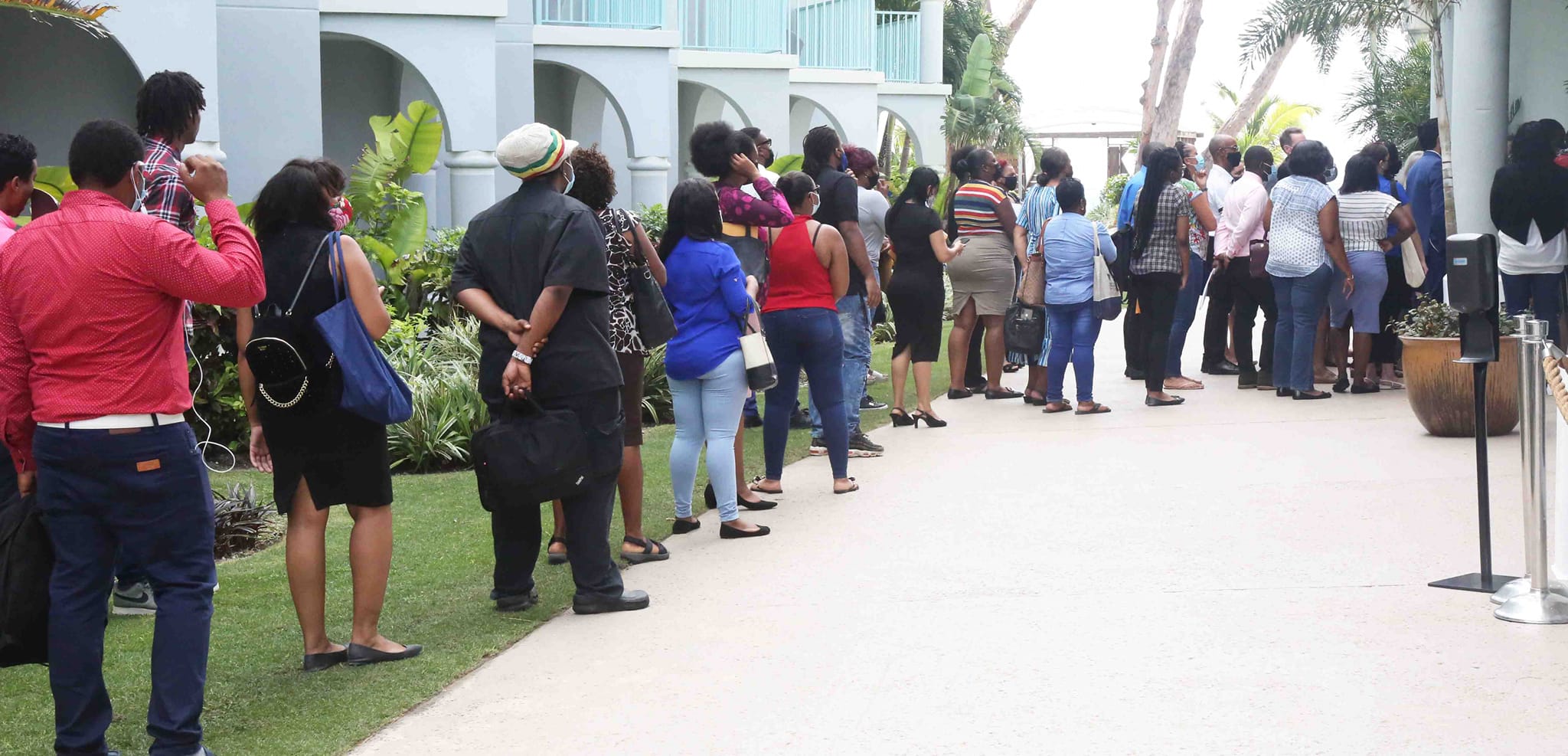
More than 600 recipients of a stipend for displaced tourism workers who are now employed full-time will be receiving reduced financial assistance from government this month and in March.
Following a review by the Ministry of Border Control and Labour, which took over responsibility for the monthly stipends last month from the Ministry of Tourism, 625 people will receive $1,000 this month and $750 next month. Previously, the government had paid them $1,500 a month.
According to a statement from the ministry issued on Thursday morning, 2,400 individuals will continue to receive the $1,500 monthly stipend.
The ministry said the February payments will be made on Friday, 18 Feb.
After the labour ministry took over the stipend-payment scheme, which had been costing the government $5.5 million a month, it issued a survey asking recipients to provide information on their employment status and other data – the results of which led to the restructuring of the initiative.
Recipients who failed to complete the survey will not have their February payment processed this week, the ministry said, and it urged them to respond to the survey “at their earliest opportunity, in order to ensure that they have provided their most accurate and up-to-date information”.
In March, the 625 people who have been transitioned from the Displaced Tourism Employees Stipend scheme to the new Tourism Recovery Grant programme in which they’re receiving the reduced payments, again will be asked to answer a questionnaire on their current status to find out if they need to continue in the grant programme or if further support is needed, the ministry said.
Wesley Howell, chief officer in the Ministry of Border Control and Labour, said in the statement, “At the height of the COVID-19 pandemic, the Displaced Tourism Employees Stipend was an emergency measure put in place to assist all of those Caymanian workers who had suddenly lost their incomes. Since the reopening of tourism in November of last year, the economy and local situation have steadily improved, and we are pleased to say that around 625 previously unemployed stipend recipients are now back to work full-time.”
He added, “As the Ministry responsible for Caymanian employment, having responsibility for this stipend changes the focus to a more active pursuit of full-time employment for these job seekers. With the new Tourism Recovery Grant programme, we are stepping away from simply administering stipend payments without continued vetting and assessment and moving to providing proactive support in both finding jobs and providing training and certification opportunities to those who have resumed employment.”
Job opportunities
Deputy Premier and Minister for Border Control and Labour Chris Saunders said several training and job placement opportunities had been and will be made available to stipend recipients, in an effort to ensure Caymanians could return to gainful employment as the borders reopen.
He said his ministry was working with Workforce Opportunities and Residency Cayman (WORC) to encourage all Caymanian job seekers to register via the JobsCayman employment portal.
“The leadership teams at the Ministry and at WORC have made a concerted effort to encourage tourism stipend recipients to both register with WORC for employment assistance and to register via the JobsCayman portal to assist in their search for full-time employment. At the moment, there are over 800 jobs available on the JobsCayman portal – with many of them in the tourism industry. We have tourism industry partners who are eager to employ Caymanians as the hospitality industry continues to recover from the dire effects of the pandemic,” he said.
Acting Director of WORC Laura Watler noted that there were “limitations with accessibility to the job listings and we are working on solutions to remove these”.
“In fact, this week, we will begin advertising all local job listings in the printed weekly newspapers so job seekers can see the available jobs and then follow the registration process to apply online. This is being done in tandem with our efforts to make job listings on the JobsCayman portal visible without registration and looking to make the application process through registration more streamlined,” she said.
Support still needed for ‘fully employed’
Chief Officer Howell explained that the Tourism Recovery Grant programme had arisen out of the awareness that some formerly displaced tourism workers would require financial assistance to make ends meet, given potentially reduced hours with the tourism industry not being back to its full speed. He also acknowledged the situation of self-employed tourism business owners who are back to work and considered fully employed but are not operating at their usual capacity, with a significant reduction in revenues.
“We fully understand that being back to work and fully employed does not mean that people are back to their former level of income,” he said. “It is understood that people will still need some support. To underscore that these people are no longer considered to be displaced workers but are instead part of the industry’s post-pandemic recovery, this support is going to be provided via the Tourism Recovery Grant programme, which will not be solely a financial assistance programme but will also offer training and other employment and business support.”
Saunders also referenced new programmes being put in place to provide remaining stipend recipients, as well as recovery grant participants, with training in new fields that would offer technical and vocational certification, as well as government-subsidised on-the-job training with participating local businesses.
“Through these new efforts, we hope to provide training and certification to stipend recipients, recovery grant participants and other Caymanian jobseekers that will equip them for success for the rest of their working lives and provide the Cayman Islands with a local workforce of certified technical and vocational employees and entrepreneurs. We will also be paying people to receive on-the-job training, while feeling the pride of doing a day’s work. More details on these efforts will be published in the coming weeks once we finalise agreements with training providers and local businesses,” he said in the statement.
The ministry noted that the stipends and grants will be distributed as normal either via direct bank deposits or cheque payments as previously arranged, but stated that requests for a change from direct bank deposit to cheque cannot be accommodated at this time.
Also, no new applications for the displaced tourism worker stipend are currently being accepted, the ministry said.
For more information on the Tourism Stipend Programme and the Tourism Recovery Grant programme, email [email protected].
Related Videos