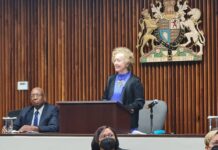
Lord Michael Cashman has introduced a Private Members’ Bill in the UK’s House of Lords to make same-sex marriage legal in the Cayman Islands and other British Overseas Territories.
The bill extends to six Overseas Territories where same-sex marriage is currently unlawful – Cayman, Anguilla, Bermuda, British Virgin Islands, Montserrat, and Turks and Caicos Islands.
If the bill passes, it would make marriage between same-sex couples legal and would empower local governors to make changes to the law to allow homosexual couples to wed.
Cashman’s bill also protects individuals and religious organisations that do not wish to conduct or participate in a religious marriage on the ground that it is a marriage of a same-sex couple.
The bill had its first reading earlier today, 6 July, in the House of Lords, and now awaits a date to be scheduled for debate.
In the release, Cashman said, “This Bill has one single purpose, and that is to bring about equality. Currently, same-sex couples can marry in the UK but are prohibited from marrying in six British Overseas Territories. This is wrong, and the UK Parliament can and should act to end this obvious inequity.
“I believe this Bill has wide support among all those who favour equality over discrimination and are committed to upholding fundamental human rights.”
Cayman Islands Governor Martyn Roper, in response to queries from the Compass regarding the bill, replied in a statement, “I understand the Private Members’ Bill introduced by Lord Michael Cashman in the UK’s House of Lords on same sex marriage in the Overseas Territories, including the Cayman Islands, has little chance of progressing. It is not a Government Bill and it is not yet clear if it will even be debated.”
Private Members’ Bill in the UK Parliament are pieces of proposed legislation that are initiated into a legislature by an MP or Lord who is not a government minister.
Privy Council ruling
In March this year, the UK Privy Council ruled that the Cayman Islands Constitution does not provide a right for same-sex marriage, as it dismissed an appeal brought by couple Chantelle Day and Vickie Bodden Bush who were seeking the right to marry in Cayman.
In its ruling, the Privy Council said that, in the context of Cayman’s Bill of Rights, the right to marriage is confined to opposite-sex couples. However, the judges added that this interpretation of the Bill of Rights did not prevent Cayman’s Parliament from introducing legislation which recognises same-sex marriage.
“[T]his is a matter for the choice of the Legislative Assembly [now Parliament] rather than a right laid down in the Constitution,” the Privy Council judgment read.
So far, Cayman’s Parliament has not introduced any legislation to legalise same-sex marriage here.
In another judgment issued around the same time, the Privy Council ruled that the Bermuda Constitution also does not have a provision for same-sex marriage.
Since September 2020, Cayman has had a Civil Partnership Act that allows same-sex couples to enter into legal partnerships, but LGBTQ+ groups say this does not go far enough and they should have the same rights as opposite-sex couples to marry. The Civil Partnership Act was initially rejected by lawmakers following a debate, but was pushed through by Governor Roper, under his reserve power under the Constitution.

Attorney Leonardo Raznovich, in the release issued Wednesday, said Cashman’s bill “aims to correct the serious injustices that the Privy Council’s decisions have manifested”, noting that the Privy Council’s decisions regarding equal marriage for Bermuda and Cayman had to be accepted “on the understanding that the UK Parliament, which was responsible for the implementation of their constitutions, failed to protect vulnerable minorities properly”.
The Privy Council’s ruling in both the Bermuda and Cayman cases had clarified that legal avenues to make same-sex marriage lawful in the Overseas Territories had been exhausted and the “British Government can therefore no longer escape its own responsibility for the situation of vulnerable minorities in Bermuda and the Cayman Islands and other territories as a matter of policy”.
He added, “Crucially, this Bill does not take anything from anyone but rather achieves a levelling up of disenfranchised vulnerable minorities with the rest of society. By bringing about full equality to these Territories, as Colours Caribbean has been advocating for many years, it will mean that Chantelle and Vickie and other couples will no longer need to
seek exile in other parts of the UK and its territories away from their homeland,
families and friends.”
Colours Caribbean, Stonewall and a number of academics, along with some members of the UK Parliament, worked with Cashman on the preliminary draft of the bill, according to a statement issued by Colours Caribbean.
The statement noted that if the bill is passed, it would place the Caribbean British Overseas Territories in line with all countries in the Americas that are subject to the Inter-American Convention On Human Rights, which requires equal marriage.
“It is with tremendous pride that we announce the introduction of this bill,” Colours Caribbean stated, adding that it had been championing for marriage equality in the Cayman Islands for years, with Raznovich’s assistance, including with respect to the same-sex marriage case involving Day and Bodden Bush.
“While we did celebrate the victory of the Civil Partnership Act of 2020, as expected, it was not without considerable pushback from our own local parliament as well as select conservative groups who are still fighting its introduction in court by the Governor,” the group stated.
It added, “If this bill succeeds, it will not face the threat of being reversed by local courts on the grounds of constitutional incompatibility as the governors of every applicable jurisdiction will be empowered and required by Act of the UK Parliament to ‘make provision for the solemnisation of civil marriage of same-sex couples that is equivalent to the provision made for the solemnisation of civil marriage of opposite-sex couples’.”
In the press release issued in response to Cashman’s bill, Nancy Kelley, CEO of UK-based LGBTQ+ advocacy group Stonewall, said, “The freedom to be who we are, to love who we love, and to marry if we want to, is a fundamental human right. Marriage equality is something we are rightly proud of here in the UK, but we cannot say that we truly have achieved equality when LGBTQ+ citizens in the British Overseas Territories are left out in the cold.
“This Bill is an opportunity to right that wrong, and we hope all parliamentarians will support it.”
Professor Paul Johnson, executive dean of social sciences at the University of Leeds, who
was one of the academics who helped create the bill, said in the statement, “The UK and the Overseas Territories, along with the Crown Dependencies, form one undivided Realm. It is wrong, therefore, that some same sex couples, simply because of where they live, are denied the basic human right to marry that is enjoyed by others. The UK Parliament should legislate to ensure that all couples, regardless of sexual orientation, are treated equally.”
While same-sex marriage is illegal in six of the British Overseas Territories, it is legal in the seven others, including the British Antarctic Territory; the British Indian Ocean Territory; the Falkland Islands; Gibraltar; the Pitcairn Islands; Saint Helena, Ascension and Tristan da Cunha; and South Georgia and the South Sandwich Islands.
What happens now?
Before a bill can become law in the UK, it has to be passed by both the House of Lords and the House of Commons.
According to the UK Parliament website, only a minority of Private Members’ Bills become law “but, by creating publicity around an issue, they may affect legislation indirectly. introduced in the House of Lords”.
Cashman’s bill has been given a first reading in the House of Lords. The next step, which has yet to be scheduled, would be to undergo a second reading, where, typically, the bill is debated by members of the House of Lords.
After that, it goes to ‘committee stage’ where a detailed line-by-line scrutiny is done and amendments added. There is then a third reading and a final chance to make amendments and votes.
If the Lords make changes to the draft bill, it is then sent to the Commons to agree, change or reject it. Once the bill is finalised and passed by both houses, it is sent to the queen for royal assent.
Related Videos