

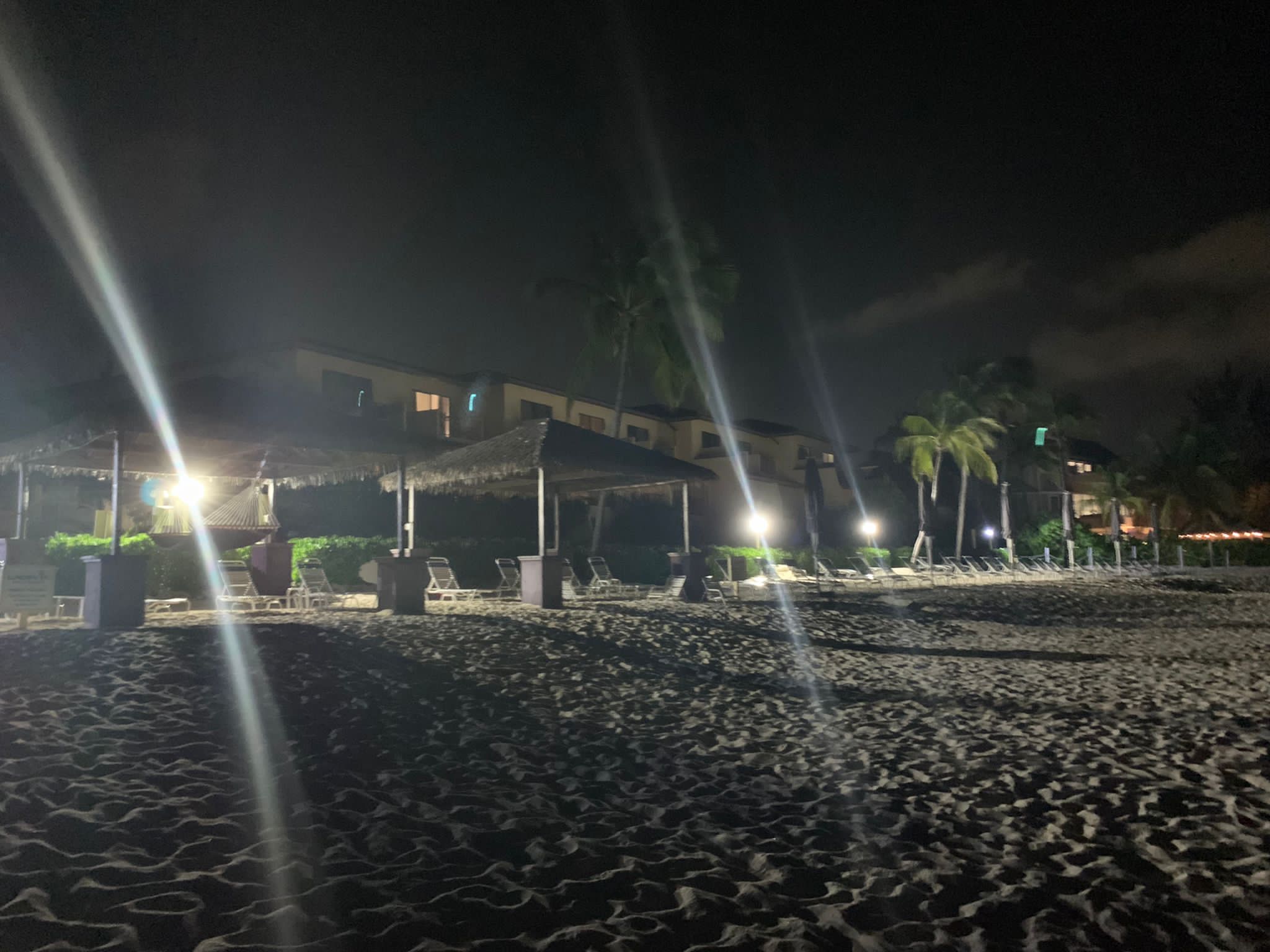
Cayman’s turtle population suffered a blow last week when a nest of at least 25 hatchlings, misoriented by condo lights, failed to find their way to the sea.
After the Department of Environment was alerted to the situation, a small number of the turtles were recovered, but most died.
On a post on its Facebook page today, 9 Aug., the DoE again pleaded for property owners to outfit their premises with turtle-friendly lights.
This latest incident follows the rescue of a nesting turtle that took a wrong turn and ended up in a pool after being misoriented by artificial lights along the coast on Grand Cayman.
In the post, the DoE said the discovery of the lost hatchlings followed a call to its turtle hotline on 3 Aug.
Lost hatchlings
The DoE said the caller, Milena Conolly, reported a lone sea turtle hatchling on the beach.
“The turtle team checked the location and realised this hatchling was from an an unknown nest. Ocean Sciences student and DoE Intern Danielle Seales investigated and unfortunately discovered that many hatchlings from the nest had been attracted to artificial lights as far as 2 condos down the beach and had not made it to the water”, the DoE said.
Based on the tracks on the sand, the DoE said, more than 25 hatchlings had misoriented and only a few were recovered.
“The DoE Turtle Team monitor every sea turtle nest across the island to ensure the hatchlings make it safely to the sea. However, sometimes nests are unidentified because the nesting mum’s tracks are either washed away by high tides or raked over by people cleaning the beach. Unfortunately, this means the team cannot ensure the safety of the hatchlings,” the DoE said.
Turtle-friendly lighting needed
“Only around 1 in 1,000 endangered baby sea turtles make it to adulthood so they need all the support they can get,” the DoE said, as it called for property owners to upgrade to turtle-friendly lighting.
This lighting is not mandatory; however, commenters on the DoE’s post on this latest incident have called for immediate action due to the situation with the hatchlings.
Back in 2019, the lights were proposed as a mandatory requirement in the draft Sea Turtle Conservation Plan from the National Conservation Council. At present, the DoE is revising that plan following its review by Cabinet.
In the interim, the DoE, in its post on Tuesday, urged owners to consider turtle-friendly lighting for beachside property as it said “sea turtle hatchlings are attracted to white lights and will become exhausted and die when they do not find the ocean”.
The department pointed out that every year it has retrieved hatchlings from “swimming pools, drains, car parks, roads, hedges and iron shore due to artificial lighting”.
Making the case for the turtle-friendly lights, the DoE said they are “warm, pleasing, amber-coloured lights which are still bright enough for people and safety and use very little energy”.
It cautioned that not all amber lights are turtle friendly and “not all [turtle-friendly lights] are made to the correct standards for turtle safety”.
The DoE is encouraging those who may want to change their lights to contact their team for assistance in selecting the right type of turtle-friendly lights for their property.
“If you live on critical nesting habitat, the DoE have funding to assist with your property’s (turtle-friendly lighting) retrofit,” the DoE added.
To find out more about turtle-friendly lighting, email [email protected].
Related Videos







we should have an island wide requirement for RED lights and black out curtains and no patio lights. it’s about the environment not our selfish conveniences.
Until owners and their renters are fined for leaving these lights unadapted, the situation will not change. A fine of $100 for each estimated turtle lost would fit the bill. However, DOE should walk the beaches at night during turtle season and issue an enforcement order against these places. FYI, the department does have a programme in place to assist with the costs of light conversion. And all owners of beachfront property are elligible.