

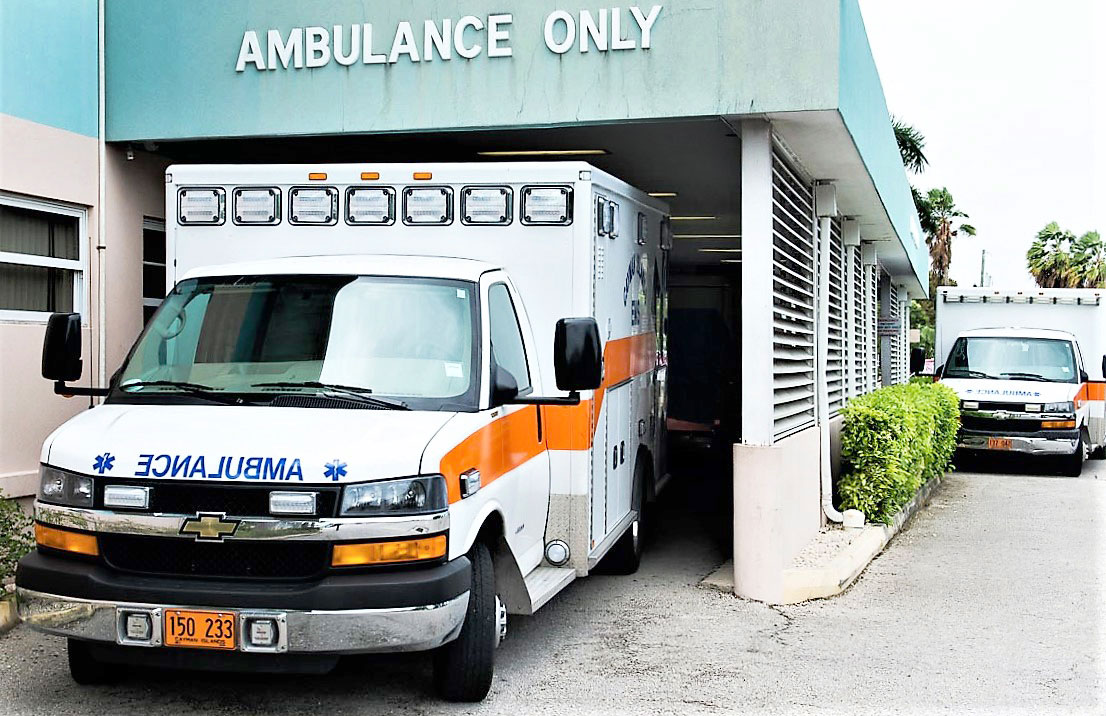
The only hospital on island authorised to take emergency ambulance cases is the Health Services Authority’s Cayman Islands Hospital, meaning Health City, despite having a 24-hour emergency unit and an ambulance bay, is not approved to accept such cases, according to the Ministry of Health and Wellness.
The ministry issued a statement on Tuesday to address questions about why Kashwayne McKenzie, who was fatally injured in a motorbike crash at Parker’s Raceway on 27 Aug., was taken by ambulance to the Cayman Islands Hospital in George Town – 14 miles from the race track – rather than to the much-nearer Health City hospital, just four miles away.
According to the ministry, not only is the HSA the only facility authorised to take emergency cases, it also operates the Emergency Medical Services’ ambulances which are the only ones licensed to respond to 911 medical calls, and the only hospital to have more than one doctor whose speciality includes emergency medicine.
Only HSA meets emergency standards
“The Cayman Islands Health Services Authority (HSA) is the only facility on island that has met the standard as established by the Health Practice Commission to provide emergency services in the Cayman Islands. As such, it is the only facility that has been authorised by the Health Practice Commission to provide emergency services within the territory,” the ministry said in its statement.
However, Health City, in response to queries from the Compass Tuesday, stated, “Based on our list of services approved by the Health Practice Commission, emergency services is included. As stated previously, we look forward to continuing to provide the highest quality healthcare to the people of the Cayman Islands and having continued conversation with the relevant authorities towards doing so.”
It added, “A recent case has reignited the need to review the current protocols for emergencies that take place in the Eastern Districts. Health City, as always, is willing to partner at a national level to ensure we can assist as many persons as possible when time is of the essence.”
The health ministry stated that in order to provide emergency services, a healthcare facility “must not only meet the physical requirements for emergency facilities – ambulance bay, designated area with emergency beds, specialised equipment, etc. – but they must also have the complements of experts, supporting staff, and supporting services (such as ambulances and trained EMTs and paramedics) that collectively determine the capacity and ability to deliver said emergency services 24 hours per day, 365 days per year”.
Cayman’s EMS ambulances are registered to the HSA, and are the only ambulances approved by the Health Practice Commission to respond to medical emergencies and authorised to be dispatched by 911 operators.
The ministry also said in its statement that while other facilities may have their own ambulances to transport patients, those vehicles are not licensed to provide the same level of service as the registered emergency service ambulances. The HSA is the only facility on island that has “registered ambulances with the appropriately trained staff,” the ministry noted.
It said ambulances are registered directly to a healthcare facility, and their staff, equipment and maintenance are subject to the same licensing standards as the facility itself.
The ministry also addressed staffing requirements for approval as an emergency services facility, stating that these include “two key components: personnel qualification and coverage”.
Specific qualifications
It said that in order for a facility to be able to provide emergency services, medical personnel are required to have specific qualifications and a minimum number of years of practice “to ensure that they have both the knowledge and the experience necessary to deal with complex emergency cases”.
“Furthermore, emergency services providers must ensure that staff qualified to provide emergency services are not only on-call, but physically present at the health care facility 24 hours a day, 7 days a week. The Cayman Islands Health Services Authority (HSA) is the only facility that meets the staffing requirements to be able to offer emergency services,” the ministry said.
It noted that out of the 16 medical doctors with a specialty of ’emergency physician’ or ’emergency medicine’ on the Medical and Dental Council’s list of licensed practitioners as of 9 Sept., 13 are located at the HSA, with the remaining three at three separate private health facilities.
Severe trauma is a ‘special case’
The ministry also stated that incidents of severe trauma as a result of a motor vehicle accident – as in McKenzie’s case – are special circumstances that are “the domain of 911 Emergency Services”.
“Severe trauma is a specific type of emergency that can best be handled by a facility that is equipped and prepared for these types of emergencies,” the ministry said, adding that the Health Practice Commission has not received any application from any private local facility to provide services for cases of severe trauma, “and as such the Cayman Islands Health Services Authority remains the epicentre of care for these cases”.
In a 29 Aug. statement issued following McKenzie’s death, Health City said the Health Practice Commission had approved its hospital “to provide emergency and intensive care services in its six-bed ER which is open 24 hours a day, seven days a week and is fully staffed around the clock by ER physicians”.
It added, “Our ER physicians are qualified with Masters in Emergency Medicine and capable of managing various medical emergencies, including where there is trauma involving multiple organs.”
Ministry ‘welcomes’ possible addition of emergency providers
Health Minister Sabrina Turner has not ruled out expanding emergency services to other facilities.
She said in the statement, “The Ministry of Health & Wellness remains committed to building our local capacity in an effort to enhance and improve emergency services. However, this must be done in line with best practices and the standards which we have set.
“These standards are there to ensure, first and foremost, patient safety. We welcome the opportunity to engage private sector providers who have met the standards as determined and enforced by the Health Practice Commission, and as such are authorised to deliver those services safely and responsibly.”
Hospitals and other healthcare facilities are certified by the Health Practice Commission, the members of which are appointed by Cabinet. Those members consist of the chairpersons of the four health practice councils – Medical and Dental Council, Nursing and Midwifery Council, Pharmacy Council, and Council for Professions Allied with Medicine – as well as one assignee each of the Attorney General’s Chambers and the director of planning, two representatives from healthcare facilities, and the registrar.
Inspections of facilities are carried out by the Department of Health Regulatory Services as part of the certification process.
Related Videos







well written , special thanks to author for sharing this . keep sharing such blogs.