For cricket legend Michael Holding, the fight to end racism in sports and in society is a long way from being won.
“I do not like the idea of so many black footballers in England saying they are tired of taking the knee. I will be taking my knee until it is bruised,” he said during a question-and-answer session at the Harquail Theatre in Grand Cayman.
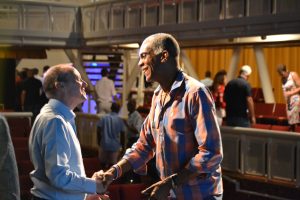
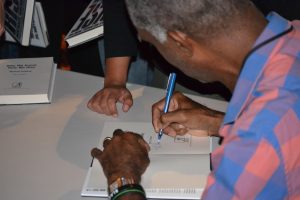
The former fast bowler and commentator, who has spoken eloquently and passionately about racism in sports, was back in Cayman to raise money for various charities and promote his book, “Why We Kneel, How We Rise”.
Holding, 68, retired from his illustrious commentating career in 2021, following his record-setting West Indies cricket career during the 1970s and ’80s, where he is still regarded as one of the greatest fast bowlers in history.
Now the cricket legend, who holds multiple records in the sport, is adding to his legacy by spreading the message of equality and ending systemic racism.
‘I do not expect to see equality in my lifetime’
During the well-attended event last Friday, Holding spoke about his book, which highlights accomplishments of black people throughout history and emphasises the importance of education as a means to achieve equality.
“I do not expect to see equality in my lifetime,” Holding said. “My grandchildren and great-grandchildren will hopefully see the light, where they can walk around and feel as if they belong and feel as if they are just as equal as anyone else.”
Holding told the audience his award-winning book was influenced by the death of African-American George Floyd in 2020. Floyd was killed when a white policeman kneeled on his neck for nine minutes and 29 seconds, while Floyd cried out ‘I can’t breathe’, ‘momma, momma’ before drawing his last breath.
His murder sparked outrage, with protests taking place around the globe and people marching for the ‘Black Lives Matter’ movement in the hopes of preventing any similar tragedies.
While the rallies and the phenomenon of sports stars taking a knee to show support for change seem to have subsided, Holding, who speaks about being on the receiving end of racism in his book, continues to advocate for the importance of educating people, noting that if people stay silent, “you are adding to the problem, that is inequality”.
“I was never taught anything good about black people when I was growing up,” Holding said, adding that white supremacy still exists.
“There are a lot of people in this world that grew up not having a clue about why they speak disparagingly towards other people. It’s just a society in which they are brought up. And they decided that must be the way to go.”
‘Don’t turn a blind eye’
But Holding urges people to help break the cycle that has existed for hundreds of years, saying, “You do not have to be racist, to keep on perpetuating a racist system; the system is there already.”
“If you see people showing racist tendencies, do not turn a blind eye. If you hear racist remarks and think you may be victimised… if you stay quiet, it will just continue as it is. When you take a stand like that, you may not see the benefit immediately. But down the road, it will eventually wear away, and progress will be made.”
He also spoke to the thought processes of kids growing up believing they don’t belong, or that they are not good enough because of their skin colour.
“We need to teach everything, so we don’t have little black kids growing up and believing that they are inferior to anyone or white kids growing up believing that they’re superior to anyone.”
Colourism in the Caribbean
Holding, who was born in Jamaica and calls Grand Cayman home, stated that colourism is a major issue locally and in the Caribbean as a whole.
“[Some] people believe the lighter their skin, the easier it is for them to progress,” he said. “We need to get rid of that. I see guys in Jamaica, with skin lighten cream but what they cannot get rid of, is the knuckles, the knuckles will stay black forever.
“But that is what is in their heads. That is the brainwashing that has taken place, that lighter skin people progress further than darker skinned people, it’s just the way this is structured and until we can educate people, we’re going to continue to have problems.”
Mental health
During the event, which raised funds for Jasmine, Cayman Islands Cancer Society, Big Brother/Big Sister and the Alex Panton Foundation (in memory of Addi Kelly), Holding spoke about how mental health affected those he loved.
“I grew up with a family that had mental issues,” Holding said. “I was unaware. It was after my mother died that my sister told me that my mother took a pill every day for depression, and I had no idea.
Holding spoke about how his mother was “disowned” by her own family because she chose to marry a black man. He noted his admiration for his mother’s strength after understanding the battles she faced. However, he pointed out that many people add to the stigma that those suffering from mental health issues are weak.
“It is not about weakness,” he said. “I know my mother was not weak. My mother confronted a man that shouted ‘you bastard’ at me – she confronted him in the stands. She wasn’t weak, but she had to take a pill every day.”
Holding became emotional when he brought up the passing of his goddaughter Addison Kelly, who died on 8 Feb. this year after battling mental health issues.
“The smallest comment you make to someone; you don’t know how big a change that can make in someone’s life,” he said. “You may think it’s a joke to mock someone, to mimic someone and your friends may laugh, but the effect it might have on that person, you are unaware of it.
“Addi was making progress and one unkind comment in the US at her school… I am no expert, but right now we need to help each other.”
Related Videos