


Government is considering extending the Owen Roberts International Airport’s runway 1,000 feet into the North Sound, building a new airport on Little Cayman, and moving and widening the runway at the Cayman Brac airport.
Canadian design consultancy firm Stantec has presented these airport proposals, and others, at public meetings across all three islands this week after being hired to help create a new 20-year master plan for the airports.
Tourism and Transport Minister Kenneth Bryan says the options presented by the consultants are not set in stone, and caucus and government have yet to make decisions regarding the suggestions put forward.
If approved by government, the work at the airports would be subject to environmental impact assessments, the consultants confirmed.
Proposed ORIA expansion
Bryan pointed out that a runway extension at Owen Roberts is a priority for government, as it wants to enable larger aircraft, capable of long-haul flights from all over the world, to land here. They cannot do so right now, because the runway is too short.
The consultants are proposing extending the runway to a length of 8,000 feet.
Bryan said Saudi Arabian Airlines (now Saudia) and Virgin had both considered adding Grand Cayman to their routes, but the runway length had made them reconsider because their wide-body jets cannot touch down at Owen Roberts.
Currently, the vast majority of international travellers who arrive in Cayman are from the United States. Bryan says it is important to diversify that market and make Cayman more accessible to airlines from other countries.
Philip Van Manen, an aviation planning and development consultant at Stantec, said the proposed runway extension is based on requirements for longer-haul aircraft.
“Speaking to Virgin Airlines and British Airways, they both feel that you cannot operate larger aircraft on a direct route to the UK. It’s a bit too far for the narrow bodies. An Airbus A321neo is a smaller narrow-body aircraft and it could go a long way, but not all the way to the UK, so that part is really out of reach, unless you go to Nassau first, as an example.”
From March next year, British Airways will operate five routes a week from London Heathrow to Owen Roberts, via Nassau.
A proposal to extend the runway on its western end, which had previously been considered, has been discounted, Van Manen told the audience at a public meeting at the John Gray High School hall on Wednesday evening, 23 Nov.
“Speaking with the National Roads Authority, we did look at the opportunity to extend to the west, but because of the existing congestion, the need for additional road development over time, this is not something that can be done quickly.”
He added that extending to the west would mean removing obstacles, like trees, houses and other buildings.
Van Manen said several meetings had been held with the Department of Environment on the proposals for all three airports, and he noted that environmental impact assessments would be carried out before work would begin, if the government greenlights the proposed options.
He said the area of the North Sound where the runway extension would be built is very shallow, and boat traffic was mostly concentrated on the east and south sides of the sound, “so the runway extension does not necessarily impact that marine traffic”.
As well as extending the runway at Owen Roberts, Stantec also recommends building a new general aviation terminal – for non-commercial aircraft – as well as an adjacent hangar, heliport and VIP parking area. A new marine dock with a connection to this terminal is also being proposed.
Van Manen said expansion of the current passenger terminal at Owen Roberts is necessary as arrival numbers at the airport have exceeded predictions from the previous master plan, and are expected to continue to grow by an average of 1.9% a year over the next 20 years.
In 2019, a record 502,739, passengers flew into Owen Roberts.
The consultant said a planned expansion of the recently revamped commercial terminal, which was officially opened in March 2019, did not mean it would have to be torn down and replaced. Instead, it can expand upwards to a second floor, he said.
“We can expand the terminal building towards the runway and move up to a second level, thereby adding in air bridges connecting the aircraft with the terminal,” he said.
He added that the proposal would involving expanding the terminal by a third of its size.
Bryan said the cost of expanding the runway and terminal has not been determined.
Owen Roberts proposals
- 8,000-foot runway with parallel taxiway
- Commercial terminal and apron expansion
- Future cargo expansion
- New ground transportation centre and landside access improvements
- New air traffic control tower
- Future additional engine run-up bay
- New general aviation terminal
- New hangar, heliport and VIP parking adjacent to general aviation terminal
- Expanded aircraft parking aprons
- Future marine dock with connection to general aviation terminal
Little Cayman proposal
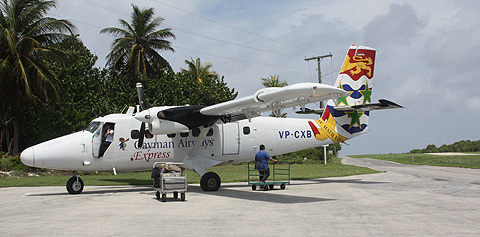
Noting that the proposal to replace the Edward Bodden Airfield on Little was perhaps the “most controversial” of the three plans, Van Manen outlined the plan to build a new airport on a different location from the existing one.
The current aerodrome is unlicensed, is on privately-owned land, and operates on the basis of special temporary exemptions from the Civil Aviation Authority of the Cayman Islands.
Van Manen said, “The existing airport does not meet any standards. This is, in my view, a dangerous place to land a public-paying, scheduled air service.”
He noted that government and the owners of the land on which the airport sits would be liable in the event of an accident on the runway, which, at 30 feet wide, he said, was “much too narrow”.
While consideration was also given to suggestions such as a seaplane port, a ferry service between Little Cayman and Cayman Brac, and a heliport, the consultants felt the most viable option is to build a new airport on government-owned land on the south side of the island, near the site of Public Works – moving the aerodrome away from the Blossom Village area.
Little Cayman residents, who pointed out at the public meeting on that island on Monday that there has never been a serious accident at the existing airport, have been reluctant to see the airport replaced, fearing that a larger aerodrome and runway would lead to large hotel developments on the island.
“There is a sensitivity to this development here that needs to be considered,” Van Manen said. “Little Cayman residents do not want to see a significant change in the operation and want to maintain the charm and feel of Little Cayman, and they do not want to see development occur unconstrained.”
Currently, about 30,000 passengers a year travel to Little Cayman. Within 20 years, that number is likely to grow to 40,000 a year, “so we are not opening a valve here to development, to all kinds of hotels. We are trying to accommodate the demand that exists,” he said.
Currently, the only planes in the Cayman Airways fleet that can land on Little Cayman are the 19-seater Twin Otters – limiting the number of passengers that arrive on island.
Recently, maintenance and repair problems with those aircraft have led to passengers being ferried by dive boats to Little Cayman from Cayman Brac, which had a runway large enough for a CAL jet.
The lack of airlift for the island has frustrated residents and hotel owners, who say demand is not being met. They have been calling for a third aircraft to be added to the Little Cayman route.
The consultants say a runway capable of taking larger planes will address this concern.
However, Van Manen said, “Before anything happens, we need a design, we need geotechnical investigations, we need a survey, and we need a significant environmental assessment. It’s not an isolated project. The DoE and many arms of the government will be involved in this development if it were to go ahead.”
Richard Smith, director-general of civil aviation at the Civil Aviation Authority of the Cayman Islands, pointed out that this site had previously been approved by government as a location for a new airport with a 4,000-foot-long runway. It had been cleared and filled in 2002, but the plans were then shelved when a new administration took over.
“All the groundwork had been done already for that development,” he said.
Little Cayman recommendations
- New runway and connecting taxiway
- Small terminal building and aircraft apron
- Landside access and parking
- Aircraft rescue and fire-fighting and maintenance equipment building
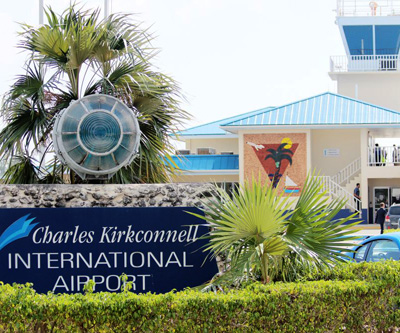
Cayman Brac airport
The consultants met with Cayman Brac residents on Tuesday evening to outline the proposals for that island.
Van Manen said a new terminal will likely be required at the Charles Kirkconnell International Airport within the next 10 to 20 years.
“The existing building is functioning quite well, though fairly old and becoming somewhat antiquated in its facilitation of passengers,” he said.
Passenger arrivals, currently at about 80,000 a year, are expected to grow by 1.8% annually, so “some expansion” of the building is necessary, he said.
An expansion of the taxiway would be also needed at some point, he noted, but there are no plans to extend the runway.
“We’ve seen previous master plans indicated the need to… fill in the ponds, get rid of all the birds,” he said. “That doesn’t sound sustainable, it doesn’t sound easy, it brings nothing but opposition from locals. We’ve heard that right from day one.
“We’re going to respect that and suggest that the Airports Authority invest in additional mitigation measures for bird hazards. There are many modern tools in the toolbox of an airport manager that can be incorporated. Some will require investment, but certainly we need to manage the bird hazard, that’s a key piece for this airport, and for Little Cayman.”
With turtle nesting sites at the end of the runway, Van Manen said, instead of extending the existing runway into the ocean, it is suggested to move the runway further to the east, “so airplanes would land on a slightly shorter runway”.
He added, “It’s safer, we believe it’s environmentally more sustainable, we’re going to not disturb those turtle nesting sites, and we don’t need 1,800 metres of runway. We’ve got just under 1,800 metres, and we’ll have a good long runway for the type of traffic that is currently using this airport.”
He added that a further runway extension is not expected in the future.
A potentially contentious issue regarding the Brac airport will be the moving of a part of South Side Road, which would enter the relocated runway strip.
“Therefore, the biggest impact for the public is, those residents who own property there are going to see that road move closer to their house, or closer to the beach, because it cannot be on the runway strip, it needs to move, and that’s going to be the more challenging project,” Van Manen said.
Cayman Brac airport recommendations
- Complete runway end safety areas and wider runway strip to meet requirements
- Existing runway, taxiway and apron rehabilitation
- New air terminal building
- Apron and taxiway expansion
- Expanded vehicle parking, access improvements and 100 feet security setback
- New air traffic control tower and new general aviation facilities.
Related Videos











Some had foresight on this and recommended strongly for CIG and agencies to take a longer view before expanding the airport.
I represented CITA in meeting with CIAA and their consultants at the time and recommended:
– runway extension (btw it is about taking off with a full fuel load, not about landing)
– jetbridges
– designing the building configuration to allow for future US pre-clearance facilities.
– moving the general aviation terminal to the other side of the airfield.
All of these thoughts remain valid.
In addition, I question the NRA narrative around need for roads. One could easily expand the runway inland by simply closing the road that runs around the end of the runway.
Government failed so deeply on the airport’s last renovation, and people need to be held accountable. As for another expansion, the government should be very wise when it comes to overdevelopment of the island. Our family chooses GCM because it is not like other islands, like Aruba, where it is just one massive hotel after another. The more accessible you make the island, the more crowds you will attract which will lessen the experience for everyone as a whole. Grand Cayman is a small island that does not need Boeing 787 Dreamliners flying in everyday dumping 300 passengers. Government should focus on more pressing issues like the current traffic situation, instead of adding to the problem by wanting to add more and more flights. The runway is perfectly fine for Boeing 737s and Airbus A320s to carry passengers to and from the US where they can make their connections to Europe. Part of the fun is landing at a small airport and walking right onto the tarmac…I don’t want to deplane via a jetway.