


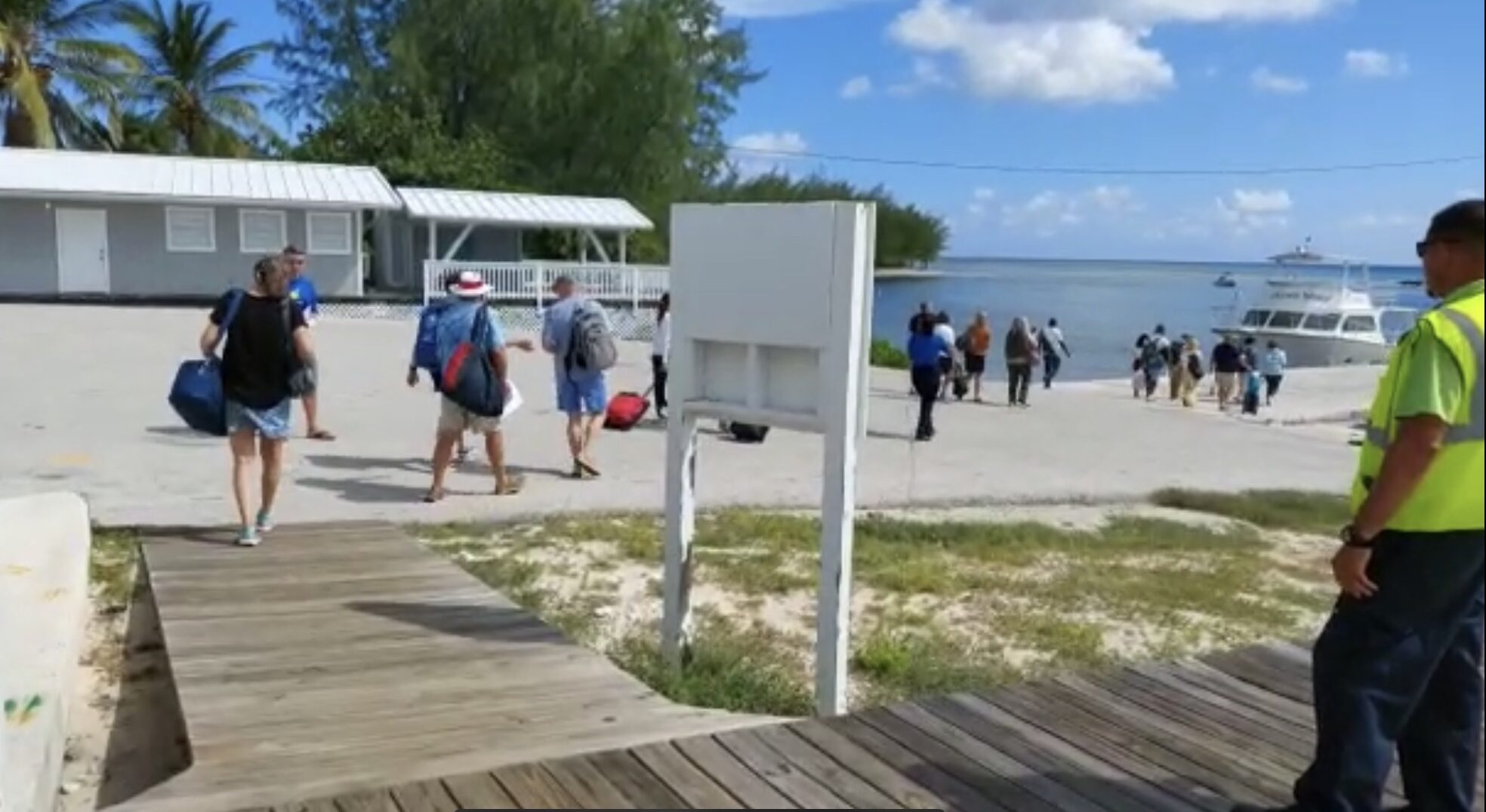
Tourists had to be ferried to Little Cayman on dive boats from Cayman Brac last weekend because both Twin Otter aircraft that fly into the island were out of service.
The scenes – with 72 passengers and their luggage loaded on to specially chartered boats – were the culmination of months of challenges with airlift into the island.
The two 19-seater aircraft – the only planes in Cayman Airways’ fleet that can land on Little Cayman – have been struggling to carry the burden as tourists from all over the world flock back to dive resorts on the famous Bloody Bay Wall.
Mechanical problems have led to flights being delayed or cancelled and luggage routinely arriving late, according to resort owners on Little Cayman.
Now the Sister Islands Tourism Association is pleading with government to fund a third aircraft to help meet demand and provide redundancy when issues occur.
Peter Quilliam, president of SITA, said there had been productive discussions between Cayman Airways and the businesses on the island and a sub-committee established to tackle the problem.
Ultimately, he believes a third plane is essential.
“That would solve 90% of our problems. If we don’t have that in place sooner rather than later we are going to see a big drop in tourism to the sister islands.”
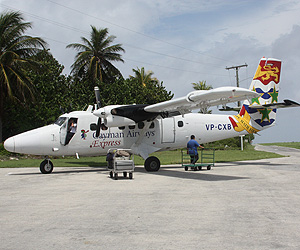
One of the Twin Otter aircraft is in Canada for a service and the other has suffered periodic mechanical issues, resulting in delays and some reduction in service. Cayman Airways acknowledged that this time of year – when the fleet is essentially halved due to annual heavy maintenance work – is a “vulnerable” period for its Little Cayman operations.
An airline spokeswoman told the Compass that upgrades to the island’s airport to allow a larger, more modern aircraft like the Saab 340B+ plane that services the Brac or purchasing a new Twin Otter aircraft were among the possible solutions.
Slow boat to Little Cayman
Weeks of challenges came to a head, Saturday, when both planes were out of action.
Dive boats from Cayman Brac Reef Resort were used to transport passengers off Little Cayman on Saturday and to bring in 72 new arrivals on Sunday.
Bosses at the resort say it is not the first time their boats have been put into action to cover for cancelled flights. And they fear inadequate inbound air service is costing them vital business as the island recovers from the impact of the COVID lockdown.
General manager Jason Belport, said the guests were understanding about the situation but he feels it gave a poor first impression of the island.
He said it wasn’t always possible to make the crossing easily from the Brac, with high passenger loads on dive boats.
The Twin Otters, he said, were the crucial link to the outside world. He said Cayman Airways had made huge strides in the past decade with the new Max 8 aircraft and the Saab that services the Brac.

Meanwhile, Little Cayman has had the same air service for over a decade.
“Since the pandemic it feels like the air service has taken a step backwards. We are back where we were 12 or 14 years ago and we do feel a bit choked out with the service.
“Little Cayman is one of the premier dive destinations in the world. We are on the bucket list of places to go, it is just challenging for people to get here.”
Airfield limitations
Limitations with the airfield mean that only smaller prop planes can land on Little Cayman. And any expansion is complicated by the fact that the site is in private ownership.
Airlift has been restricted further by a policy decision to restrict capacity on the planes to 12 people – a move that was made in response to concerns about baggage, including dive equipment, not making it to the island on time because of capacity restrictions.
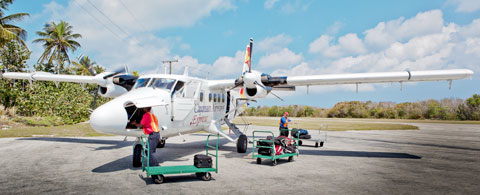
While that resolved the luggage concern, Quilliam said that solution had created a new, larger problem – reducing seat capacity into the island by as many as 50 people on a busy Saturday, when the small plane makes up to ten trips to Little Cayman.
Combined with the aircraft being out of use, this has led to a serious restriction in airlift.
“It is something that has to be addressed and we are working with CAL to find a solution,” he said.
‘Total chaos’
Another resort manager told the Compass the island desperately needs a third plane.
They said the situation had been “total chaos” over the past month. The manager, who asked not to be named, said guests had missed out on dives, lost room nights and had bags go missing as a result of the challenges.
They said using dive boats to ferry guests across from the Brac was not a sustainable solution, citing concerns over safety including a lack of life vests.
“The other issue we are having is that it seems impossible for people to be able to get flights; the availability isn’t there to keep up with the demand for passengers or luggage,” they explained.
“We have had groups of guests who have said that unless they can arrange a private charter to get them to the island then they will not return.”
Some of the problems facing Little Cayman were highlighted by former Cayman Airways board chair Jude Scott in his resignation letter in August.
As well as highlighting concerns that the current air field is unlicensed and operates under a waiver, he urged government to fund a third Twin Otter aircraft for the route.
“In order for CAL to accommodate the current and growing airlift demand of Little Cayman and provide sufficient redundancy capability when a Twin Otter is undergoing scheduled required maintenance, Government needs to provide support for CAL to obtain a third Twin Otter Aircraft,” he wrote.
Scott said in the letter that lack of action from government on those and other critical issues prompted him to resign.
Cayman Airways working on solutions
Cayman Airways issued an emailed statement in response to questions from the Compass.
It stated that every year between September and November – the typical slow season for tourism in the Cayman Islands – the airline sends each Twin Otter away for required annual heavy maintenance, leaving only one Twin Otter in service at any given time during this period.
“While the Twin Otter is a very reliable aircraft, this is a vulnerable period for Little Cayman operations because there are occasions when an aircraft has to be removed from service for unplanned maintenance or as a result of other factors beyond the airline’s control, such as weather conditions, bird strikes, or the like,” it stated.
“Unfortunately, until the Little Cayman aerodrome facilities can accommodate another type of aircraft, such as the Saab 340B+ or similar aircraft, the only solution would be the acquisition of a third Twin Otter, either on a short term lease each year, or as a long term acquisition.”
However, it states short term leases are generally unavailable in this time period leaving the reliability of service extremely vulnerable at this time of year.
“Cayman Airways has been working with its shareholder with respect to the long term planning for the Little Cayman aerodrome facility, with a view to streamlining and rightsizing the fleet of aircraft for future use,” the statement adds.
Related Videos











September and October are slow months due to maintenance services being carried out on hotels and condos, etc. on all 3 islands, but the month of August is also quiet for tourism. There are two more solutions to good fleet management in addition to expanding the mini-fleet of aircraft that can be accommodated at Bodden Airfiled on LC: 1) set up periodic regular inspections of the Twin Otters through the year so that small repairs can be carried when they are discovered, at times other than peak tourism seasons; and 2) larger aircraft maintenance services can be pre-scheduled to begin early in September [get in line for service earlier with off island providers]. There should never be fewer than 2 aircraft available for the limited runway facility at LC, and while unanticipated repairs are always coming about, better timing of managing routine inspection and repairs will head off having to deal with downtime as an emergency can be avoided. And of course, do get that 3rd aircraft, and work that one into a regular inspection and service plan as well.