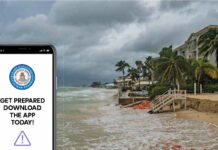
Hazard Management Cayman Islands is asking the public to get in touch if they had problems with the tsunami alert app during the national exercise on Thursday morning, 23 March.
Those signed up to the National Emergency Notification System (NENS) should have heard a loud siren from their phone for two to five seconds during the exercise – even if it was on mute.
“We’re really strongly encouraging the public to email us,” said Danielle Coleman, HMCI director, in a Facebook video post.
“Any problems you had with your app, any feedback – we’d love to hear it. We’re always here.”
HMCI had “minor technical difficulties” during the test when the alert came to them five minutes late, leading to a delay in activation of the alarms from the planned time of 9:25am to 9:30am.
But Coleman said learning from these mistakes is what the exercises are for, and encouraged more people to sign up to the alert app in case of a real emergency.
So far 6,552 residents and visitors have registered.
School preparedness
After the alert was triggered, thousands of school children across Cayman took part in the Caribe Wave preparedness exercise during which they conducted a tsunami drill.
“We saw in 2020 a lot of schools, their evacuation protocols weren’t ideal, and we’ve been working with them ever since on their plans,” the HMCI director said.
The main causes of tsunami in the Caribbean are earthquakes, submarine landslides, volcanoes, and large earthquakes which occur far away and generate a large tsunami.
Once created, they may spread out from the point of creation very fast – up to 435 mph – and can arrive within minutes.
In the ocean, these waves may only be 1.5 feet high, but up to 60 miles wide. As they enter coastal waters, their speed decreases and height increases.
Caribe Wave is an annual tsunami exercise of the Intergovernmental Oceanographic Commission of the United Nations Educational, Scientific and Cultural Organization.
Its purpose is to advance tsunami preparedness efforts in the Caribbean and adjacent regions.
This year’s scenario was a tsunami generated by a magnitude 7.6 earthquake located near Honduras.
To give feedback on the app or exercise, email [email protected].
To download the app, go to the NENS website or watch this YouTube video for instructions.
Anyone experiencing difficulties signing up for the NENS app can call the HMCI technical team on 946-4625 or email [email protected].
What to do
According to the HMCI, in the event of a tsunami:
Never go to the beach to watch the wave come in. Stay away from all low-lying coastal areas.
If you are in school, follow the advice of teachers and other school personnel.
If you are at home, make sure your entire family is aware of the warning. Your family should evacuate your house if you live near the coast in a single-storey dwelling.
Move in an orderly, calm and safe manner inland or to a safe elevation in a high building, and follow the advice of Cayman Islands government authorities.
If you are at the beach or near the ocean and you feel the earth shake, move immediately inland or to higher ground. Do not wait for a tsunami warning to be announced.
High, multi-storey, reinforced concrete buildings and hotels are located in many low-lying coastal areas and in George Town. The upper floors of these buildings can provide a safe refuge.
Homes and small buildings located in low-lying coastal areas are not designed to withstand tsunami impacts. Do not stay in these structures should there be a tsunami warning.
Related Videos