

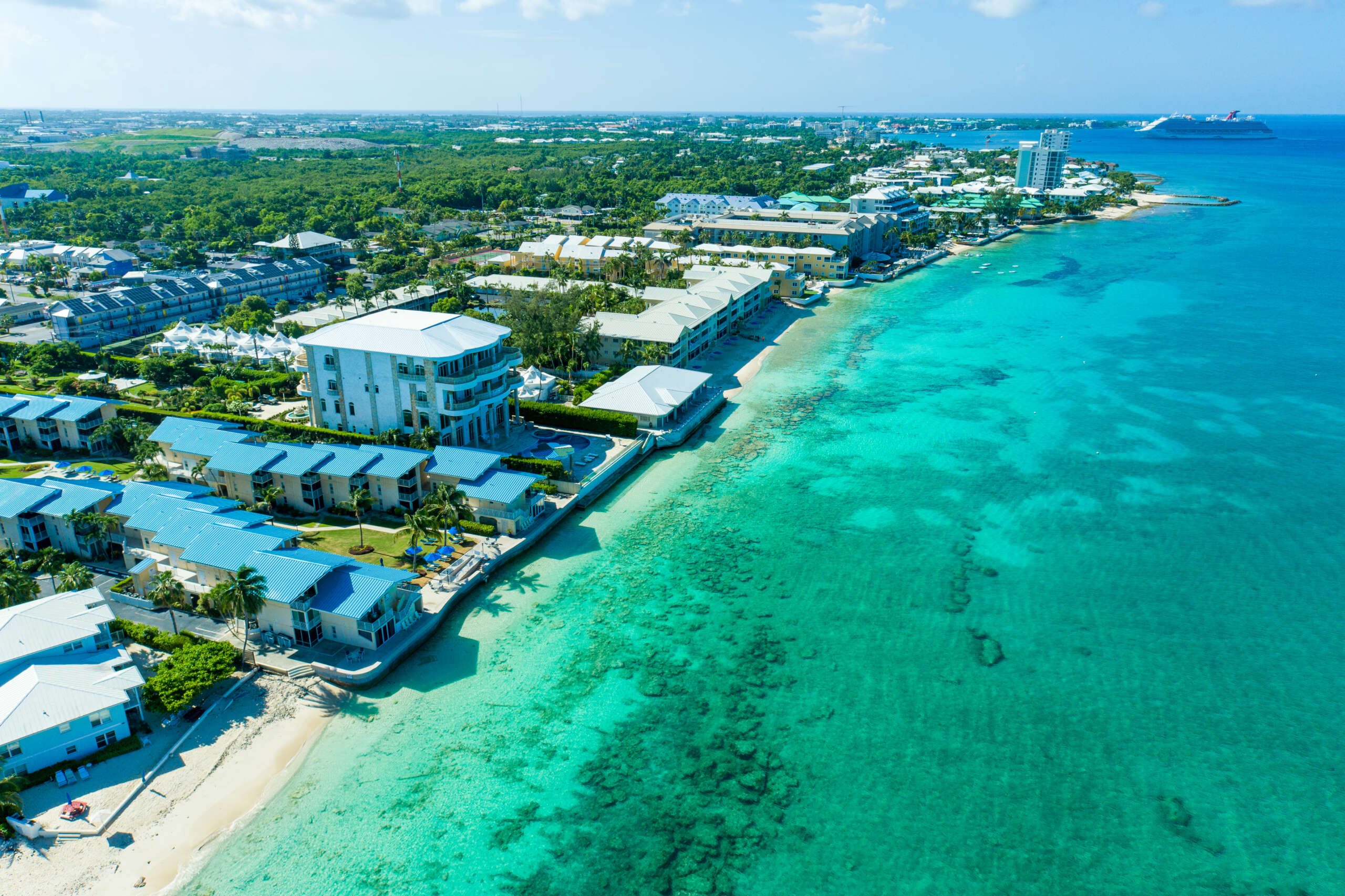
The southern end of the world-famous Seven Mile Beach was once a pristine stretch on Cayman’s biggest tourism attraction, but now much of the beloved beach in that section has disappeared.
Repeated assaults from storm surges, the most recent following the passage of Hurricane Idalia which skirted Cayman, have reclaimed the prime beach, leaving gaping spaces where white sand used to be.
The Compass recently observed the length of the beach using a drone camera to get the most up-to-date images of the impacts of the storm and ongoing erosion. It showed that some areas along the southern stretch have suffered a total loss of beach, and in at least one section, a near-5-feet-high ledge of sand has been created by the bombardment of the waves.
The beach loss has been causing physical and financial distress to properties, like the Marriott, Laguna del Mar and South Bay Beach Club, which have been hardest hit by the erosion.
Though not a new issue, the situation has been exacerbated by intense surges and an apparently slow government response.
“The erosion is impacting our bookings for the property as prospective guests want to know if there will be a beach when they arrive for their winter vacation,” Maggie Mendes, manager of South Bay Beach Club, told the Cayman Compass via email.
She said, as far as she knows, there has been no damage assessment after the recent surges.
“Property owners are very concerned about the continuing beach loss and what it may cause to property values,” she said, adding that government has not allocated any funds to assist with replacing sand.
“I have submitted an application to renourish our upper beach which is private; this application was made last October, and I am still waiting for a response from the planning department. [T]his project is being paid for by the owners of South Bay,” Mendes added.
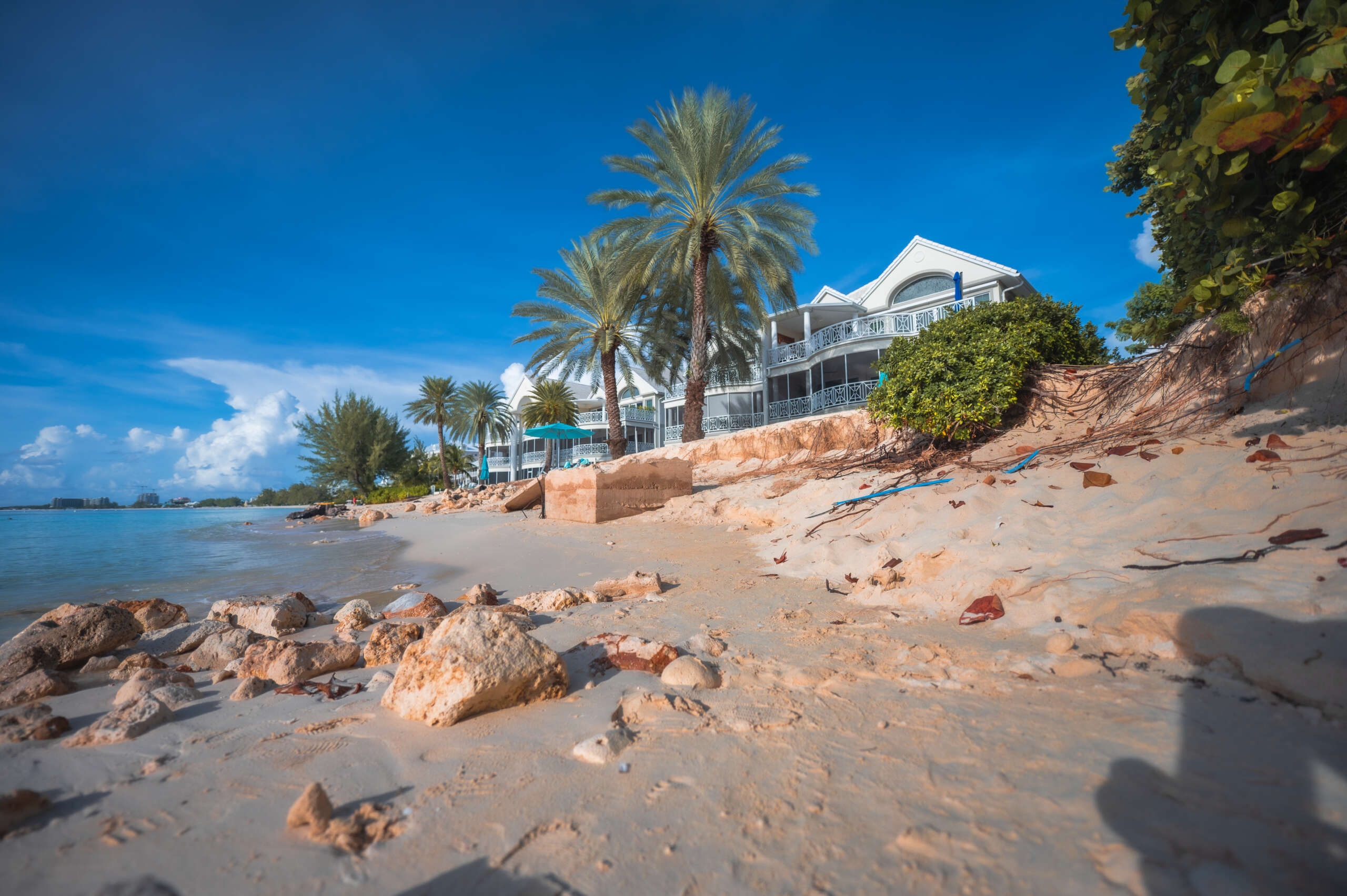
Swimmers now wade waist deep where sunbathers once lay on sand in front of properties on the southern end of the beach, while those seeking a leisurely walk along the coastline either have to go into the sea to continue their trek or turn back.
Other property owners in the area, including the Marriott resort, have made previous applications to restore or protect what little beach remains.
The hotel, which no longer advertises beachfront, is in the process of a major renovation.
Beach unlikely to return
Department of Environment Deputy Director Tim Austin, in a 7 Sept. comment to the Compass on the situation, said the DoE completed a drone analysis of the entire Seven Mile Beach.
While a detailed assessment of the extent of beach movement is still under way, he said “immediate observations and site visits confirm that the southern portion of the beach was once again the most heavily impacted”.
The southern section of Seven Mile Beach, from the Sovereign to Crescent Point condominiums, had already experienced a “catastrophic loss of sand reserves that have shown very little signs of recovery of the past year”, he said.

This was due in part to the interaction of the sea with the “numerous seawalls” that have been required to protect the buildings from being undermined and from seawater inundation, Austin said.
“Given the continued presence of seawalls and buildings on the active beach and the predicted climatic changes associated with a warming planet, including forecasted sea level rises, it is highly likely that recovery of this section of the beach will not occur without large-scale costly beach restoration efforts or active removal of structures impacting the recovery,” Austin said.
He explained that the southerly movement of sand reserves from the northern sections of Seven Mile Beach, which historically replenished this area, “have likely been reduced due to the lack of favourable weather conditions, including strong winter Nor’westers”.
“The current situation highlights the importance of adhering to appropriate and conservative building setbacks that take account of future climate-related scenarios. Beaches, as a coastline, have constantly evolved and adapted naturally with the islands they surround and they will continue to do so if given the ability to respond to the climatic conditions that sustain them,” Austin said.
Setback revisited
The Ministry of Sustainability and Climate Resiliency has said it is in the process of preparing a proposal for an updated coastal setback reference line for Seven Mile Beach, based on decades of coastal data.
“We foresee this as being a first step towards proposing updated coastal setback reference lines for all three islands. Damage to coastal communities and properties is an ongoing risk of climate change that is expected to be made worse by rising seas and severe weather events,” a ministry spokesperson told the Compass in an email.
Revising coastal construction setbacks, the spokesperson said, is one of several strategies suggested in the draft Cayman Islands Climate Change Policy that aims to mitigate this risk going forward.
“The public consultation for the Climate Change Policy wrapped up at the end of June and, since that time, our Ministry has been working to review the hundreds of comments received to produce an updated Policy which will be submitted to Cabinet in the coming weeks,” the spokesperson added.
Funding support questioned
In 2021, government pledged to allocate $21 million over two years for a project to remediate the lost sand at the southern end of Seven Mile Beach following severe damage from storms that year.
But businesses and property owners in the area said they had received few updates since that time and are still waiting for action.
Tourism Minister Kenneth Bryan, speaking on the 6 Sept. episode of the Compass weekly talkshow ‘The Resh Hour’, said while he was concerned by the beach loss, he was not inclined to support public funds being used to replace a beach that could potentially be lost again.
“How do I say take $20 million to put sand back, that potentially is at risk of being lost again in any Nor’wester, as well as… [risking] taxpayers’ money and they can’t even go to the beach? I can’t support that,” Bryan said, qualifying that this was his personal opinion.
He said he had not heard a convincing argument to move his view as minister of tourism, “even though I want to protect the product”.
He said he wanted to protect “my people” first. “I can’t… sacrifice my people and their money.”
He added the remit for dealing with the issue falls with the Ministry of Lands and the Ministry of Sustainability and Climate Resilience.
Bryan said there is a shared responsibility, but the developers of the properties took a risk when they decided to build close to the coastline.
He added, “This is a unique situation that we’re finding ourselves in with global warming and the sea level rise… that are changing the dynamics of expectation of our natural environment”.
Bryan said there was no easy solution, adding the problem was a result of weather patterns, global climate circumstances, hurricanes and “possibly [what] one would consider bad planning” previously.
The Compass reached out to government for an update on the beach-replenishment project, which is now the remit of the lands ministry, after initially being under the sustainability ministry. We are awaiting a response.
Cayman is currently undergoing a storm-surge modelling exercise which will be used to help prepare for any further impacts on the coastline.
Related Videos









Brian is correct; why spend $20 million on putting sand on the beach only for it to be washed away? Even a 10-year-old would agree! It’s only renting it as it will just wash away to 1000 feet off shore our OR, worse, disappear over the edge in what is called “sand shoots”. However, it’s called beach restoration/remediation, which happens worldwide with coastlines. It costs money, but there are solutions! I find it very strange that no one cares enough to implement a fix.
I arrived in Cayman in 1964 in my late teens, we lived next door to what is the present day Westin Hotel, my brother and I could walk South on the beach as far as present day Treasure Island Resort. North we could walk all the way to Boggy Sand, but for a few holiday homes, nothing else.
What has happened in the last 60 years to Seven Mile Beach and Cayman is a tragedy. No Governments or Planning Boards have identified Seven Mile Beach as a natural treasure, and even though my home of the time is well set back beyond any current laws, and the beach still looks like I knew it, the rest has gone to the greedy developers and un concerned Caymanian Governing Boards.
Now we start to pay the price.
I agree it is a tragedy. One that that has been successfully ignored at the cost of nature, and the real beauty of the island. And there does not seem to be an end to it! The ugliness of greed is changing SMB into an ugly skyline. It just doesn’t work, or make sense in the long run.
As I have written on this site numerous times. Something has to be done. The government brings in more than the 20 million dollars mentioned from tourists coming to the beach. The wall or cove at Sunset Cove works. I propose again a wall from the tip of that cove to the Sovereign about 5o feet out and filled with sand. The wall will hold the sand in and there will be a beach. The beach use to go out much further so it would only be restoring what was there and not destroying
My first visit to Cayman was a stay at the Royal Palms in 1975. The beach was huge. The CI Planning Boards lack the courage to tell developers that they need to adhere to setback rules. Why? I think we all have an idea. This is so sad. Now Morritt’s is planning another structure that is 85 feet closer than the legal setback. They have standing proof of the erosion problem named The “Londoner”. At some point this needs to stop.
Not just a seven mile issue. Can the compass go and check other places? Barkers virtually gone. Anyone been to what used to be Starfish Point in the last few years? Also gone. What about Kaibo? Trees at the park waiting to fall into the sea the erosion is so bad. In the next couple of years it will hit the tourist product so hard and all those MLAs and government self servants will panic like they did with the iguanas and go ‘whoa we need a committee quick!’. Meanwhile the private sector will be well into their long term investments elsewhere.
According to the internet ads I get on my cell phone every day from Century 21 Cayman the beach at Plantation Village is doing just great! 25 feet of white sand at least! smh