

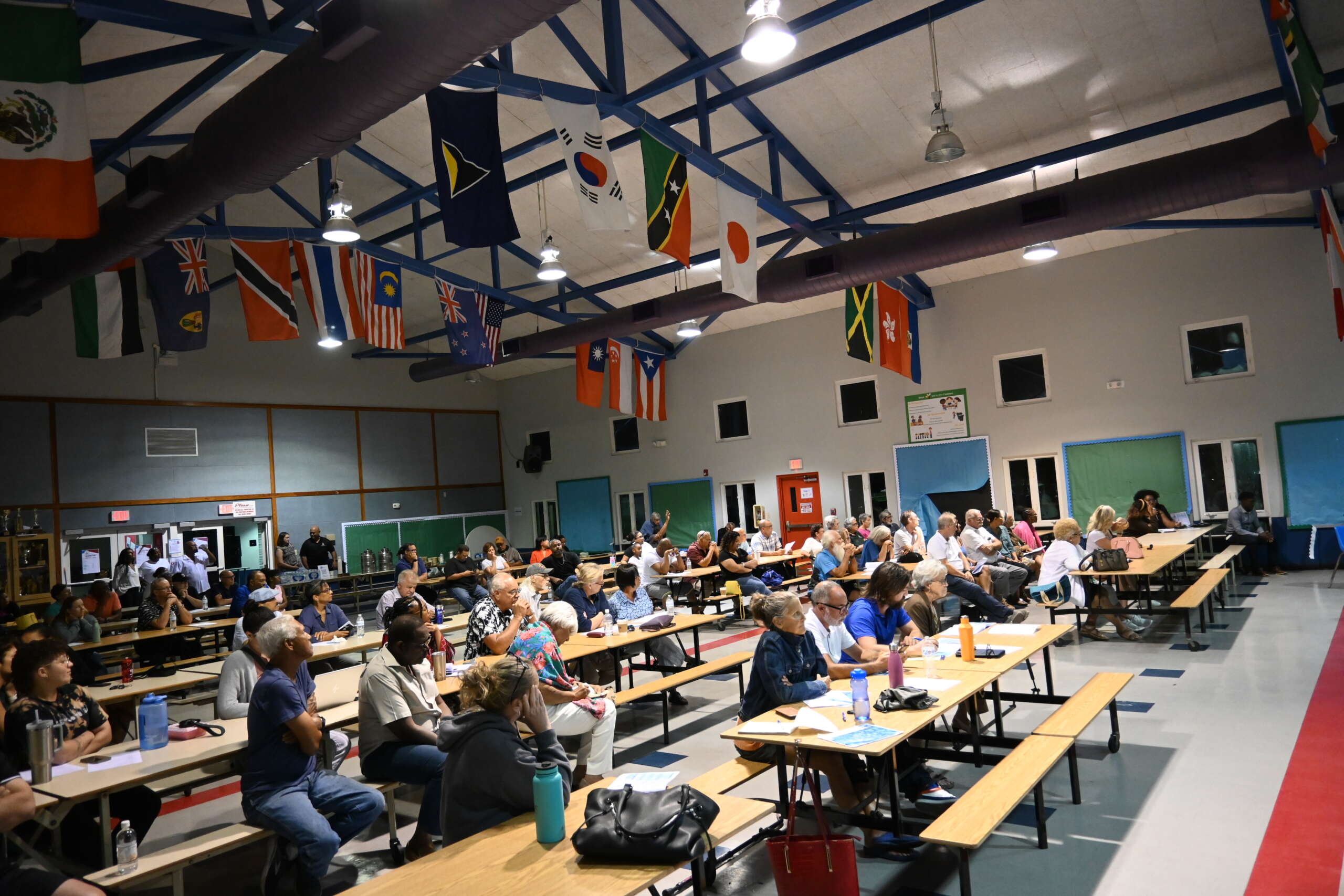
Population growth, rolling power cuts, corruption, skyscrapers and a lack of political will were among the many topics and concerns raised by West Bay residents on Tuesday night in the first of a series of PlanCayman public meetings.
Members of the Department of Planning and the Central Planning Authority brought details of the proposed new national development plan – the first since 1997 – to the Sir John A Cumber Primary School hall in a bid to inform people of its contents and get their feedback.
The first phase of the proposed plan is undergoing a public consultation, which will end on 30 July.
At the start of the meeting, which was attended by more than 100 people, Richard Mileham, policy and development planning officer at the Department of Planning, outlined the contents of a 30-page Planning Statement. That document lays the foundation of the national development plan, known as PlanCayman.
Later elements of that plan, which will also be subject to public consultation, include specific area proposals for each district, zoning maps and regulations.
Following Mileham’s presentation, in a wide-ranging question-and-answer session that lasted almost two hours, local residents raised a plethora of concerns and queries.
Population growth
Taura Ebanks was the first of several people on the night to question how PlanCayman would address population growth, when there did not appear to be any overall plan or target for the islands’ population among government officials.
“How does PlanCayman understand or have knowledge on how it can plan for Cayman when the people of this country… don’t really know what the plan is for population growth… or what the population goal is,” she asked.
The Planning Statement document notes that Cayman’s population tripled – from 26,969 to 81,547 – between 1990 and 2022, and that the population in 2022 was 18,000 larger than it was five years earlier. It acknowledges that responding to the increasing population is one of the “key challenges” it faces.
Mileham responded that planners use a process called “performance-based planning”, in which, if a development brings a certain number of jobs or people, “it must also bring certain community benefits and the infrastructure to meet that need”.
“That’s the only way we can plan,” he added.
Responding to a question by an audience member on whether there was an intentional policy within government to increase Cayman’s population, West Bay North MP Bernie Bush insisted there was not.
“The new immigration law that we’re working on or trying to change definitely shows we’re not trying to increase Caymanians,” he said, seemingly referring to status grants.
Some residents called for an extension of the consultation process, saying the current two-month deadline, till the end of July, was too short.
Mileham noted that this current public consultation is merely the first one in the process, and there would be several more opportunities for residents to give their feedback on other areas of the plan.
Overlay zones
The proposed plan expands on ‘overlay zones’ in the Cayman Islands. These are areas that may exist within normal planning zones, but involve special circumstances that require additional considerations, such as the preservation of natural resources or historic sites.
Alanna Warwick-Smith queried how historic overlay sites would be preserved within areas that are zoned as high-density residential, giving the example of the traditional neighbourhood of Boggy Sand Road in West Bay, where a number of developments have been erected over the years.
Mileham responded that a historic overlay would mean that if a development is planned adjacent to a historic building or within a historically important area “there would be additional considerations, whether it be in design, scale, landscaping, whatever it might be, to help to contribute to that location or mitigate any adverse effects that might come forward.”
He added that he hoped planning could work more closely with the National Trust, which has a heritage register that is an extensive record of heritage assets in Cayman.
Central Planning Authority member Christine Maltman said the new development plans needed to “get a handle on” historic overlays, as currently “it’s easier to overlook an overlay zone than it is the zoning itself, so we need to find a way to make sure it’s specifically addressed in the development plan”.
She noted that in other jurisdictions, there are restrictions in place for developing or changing historic overlays, but in Cayman, the Development and Planning Act prevents any such restrictions being introduced.
“So, at the moment, there’s nothing that restricts development, according to title,” she said. “It would only be whatever we can do from a design point of view, but our first step is to hopefully get the overlay zones to be a more integral part of the development plan, as opposed to being an afterthought.”
High-rise buildings
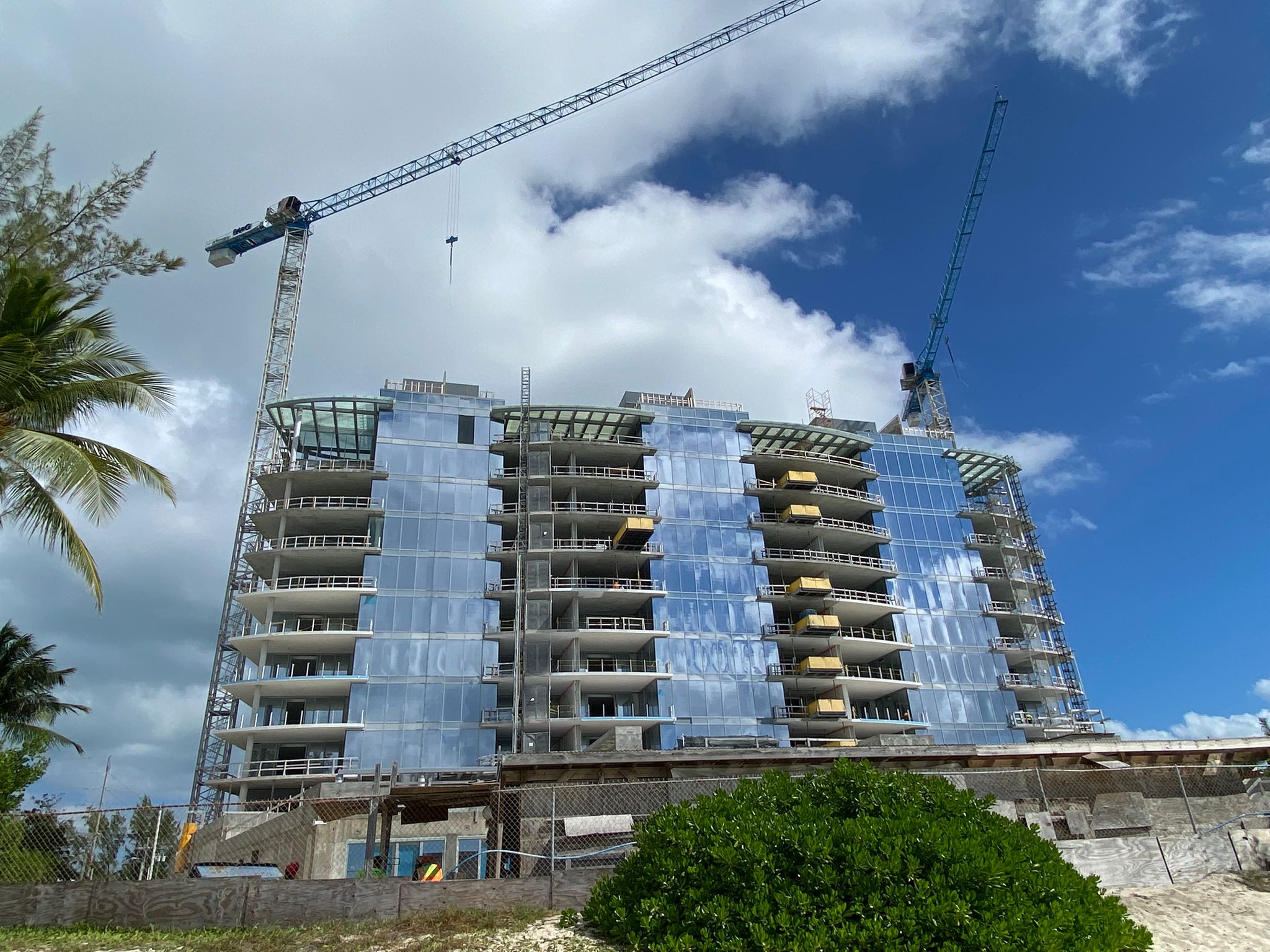
Mario Ebanks asked how PlanCayman would address the addition of more and more 10- or 15-storey buildings at a time when electric company CUC was introducing power cuts in response to growing demand from the increasing population and development.
“We’re an island. We’re not South Beach or Los Angeles,” he said.
Mileham acknowledged that building heights was a controversial topic in Cayman, but said an appropriate building height in one location was not necessarily appropriate in another.
“There is a debate to be had about where we’re going to go with Seven Mile Beach – is enough enough or is there scope for more if it’s done in a sensitive and suitable [manner],” he added.
Narrowing the discussion
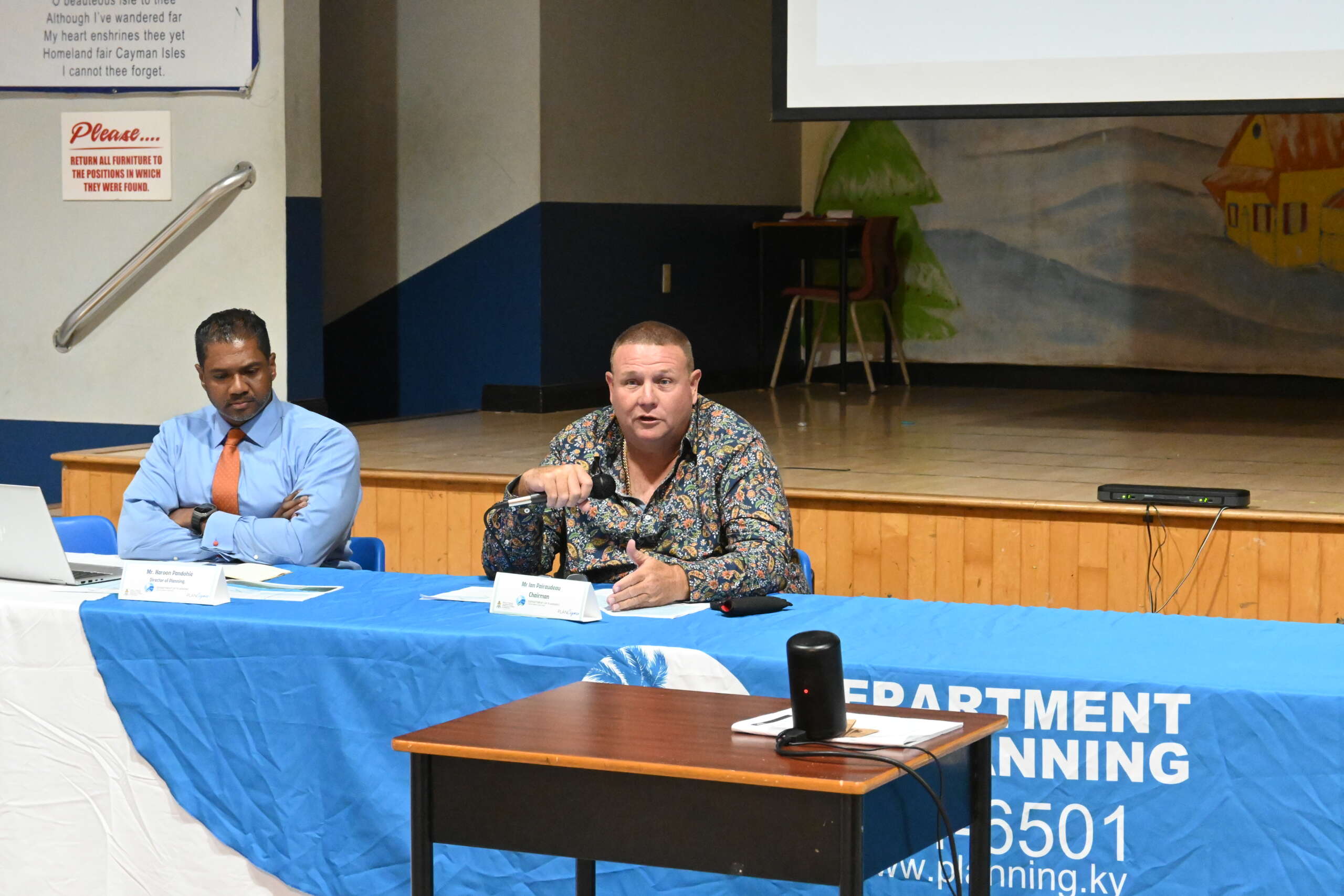
Director of Planning Haroon Pandohie, in response to a number of questions, highlighted the importance of a national debate and conversation on the subject of development on the three islands, saying this public consultation was a vehicle through which this could be done.
He urged all members of the public to get involved and take part in the consultation.
“Unfortunately, for far too long, I believe, we’ve had very broad discussions… This conversation that we’re having right now is to start to take those broad outcomes and, through the area plan process, start to filter them through,” he said.
Chairman of the Central Planning Authority, Ian Pairaudeau, speaking at the meeting, noted that the 1997 Development Plan was supposed to have been revised every five years, but that did not occur, meaning a “lot of catch-up” was needed.
Vanessa Burke, the CARICOM ambassador for the Cayman Islands, asked how the PlanCayman public consultation could be extended to young people in the community.
Pandohie responded that he was willing to take suggestions on how to get the message across to Cayman’s youth, but noted that it was a conversation, and needed the input from local young people.

Overdevelopment lamented
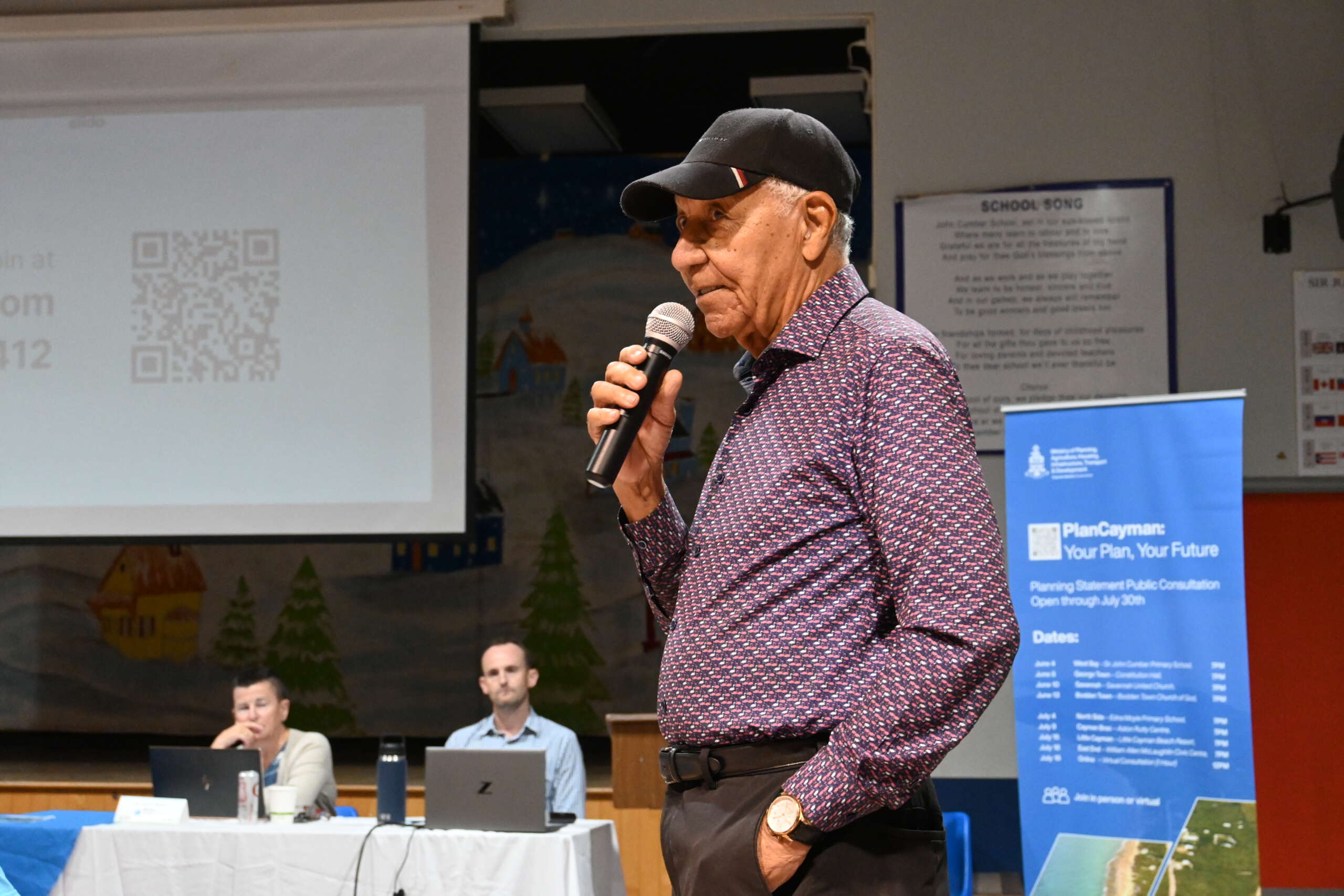
Rupert Ackermon decried the constant development of Grand Cayman, saying it was “destroying” the island. “The government has become obsessed with money, and anything they can make money from; they don’t care. That’s the problem.”
He added, “If you don’t have the infrastructure in place, if you don’t have the roads and all the equipment, and the electrical network. Look what’s happening right now with CUC [referring to planned outages amid increasing power demand]. You can’t live like that…
“Cayman used to be this beautiful place where tourists would come here and enjoy it. I’ve spoken to people recently who said ‘I can’t believe this is the Cayman I knew 30 years ago.’ Those people don’t want to come back.”
Esme Smith lamented the overdevelopment of coastal areas, noting that there are very few areas in Grand Cayman where people can see the sea from the road anymore.
‘Sell-ocracy’
Billy Adam was also vocal about the changing face of the Cayman Islands, placing the blame for rampant development squarely on the shoulders of local politicians.
Describing the islands not as a democracy, but a “‘sell-ocracy’ where Cayman is for sale”, Adam stated that feedback from earlier public consultations was ignored and efforts to revise the development plan over the years were scrapped.
He accused the government of using this current proposed revision of the development plan as an electioneering tool. “This is an exercise to try and fool people with an election year coming up,” he said.
West Bay Central MP Katherine Ebanks-Wilks, in response, insisted that politicians were not making decisions contrary to the will of the electorate, saying it was the responsibility of citizens to hold their MPs accountable and get in contact with them if they felt their concerns were not being heard.
“That was why they designated single-member constituencies, that was one of the reasons,” she said.
Late delivery of planning notices
Kelly Reineking raised a long-standing concern among potential objectors to planning applications who have complained about failing to receive notifications through registered post in time to make their objections.
Pandohie responded that the Department of Planning was communicating with the Postal Service about this issue. He advised people to regularly visit the Department of Planning’s website to keep updated on new applications.
Ebanks-Wilks, speaking as sustainability minister, said she felt the planning department needed to move away from “paper snail mail” and consider using an app to inform people of proposed developments that may impact them. “There has to be creative ways of getting information to people; the island is not very large,” she said.
Missing metrics
Another resident queried why the Planning Statement did not include a mission statement with success criteria and metrics, saying it listed seven strategic objectives, like housing, transportation and infrastructure, but did not prioritise one over the other.
“It doesn’t indicate how you will decide when some of these areas are competing against each other,” she said.
“This is why people here are very sceptical,” she said. “Why are they suspicious? Why are they frustrated? Why are they disillusioned? Why are they frightened even? Why are they disappointed? Because it’s a very obvious omission,” she said.
She asked how the government was going to measure the various aspects of the plan, such as providing housing for locals, bringing down inflation or making planning decisions regarding developers more transparent.
Future meetings
Seven more public meetings are scheduled in the coming weeks.
These are:
• George Town: Thursday, 6 June, 7-9pm, George Town Constitution Hall
• Savannah: Monday, 10 June, 7-9pm, Savannah United Church
• Bodden Town: Thursday, 13 June, 7-9pm, Bodden Town Church of God
• North Side: Thursday, 4 July, 7-9pm, Edna Moyle Primary School
• Cayman Brac: Monday, 8 July, 7-9pm, Aston Rutty Centre
• Little Cayman: Monday, 15 July, 7-9pm, Little Cayman Beach Resort
• East End: Thursday, 18 July, 7-9pm, William Allen McLaughlin Civic Centre
There will also be virtual public consultations via the Cayman Islands government’s live Facebook and YouTube feeds from 12-1pm on 18 July.
For more information, visit https://www.plancayman.ky.
Related Videos








Strange as this was the West Bay consultation, there was no mention of the ever increasing gun crime and other criminal offences that occur throughout Grand Cayman.
Decentralize the Central Planning Authority. Break up the Planning Board into seperate district planning commissions as independent cooperatives that work for each Electoral District and can accept applications and approve them independently of the current Central Planning Authority. Have each Electoral District planning office members have to agree on cross Electoral District boundaries for projects such as roads through habitat lands or lands of significance. Planning permissions for the regular or residential clients can be applied for and approved swiftly for building and construction projects more rapidly and in the applicants own district; and the people of each district would have more control and say, in big projects affecting or proposed in their district. Break up and decentralize the current planning board and do away with the Central Planning Authority and remove them from over all over lord power. Obviously, they do not have Caymanians or Caymans Environment in their best interest whatsoever. Place more power into the hands of Caymanians and land owners and the people of the districts. Make things more swift with implementation of a Self-Certification processes that the public can comply to and enter into the planning online system that do not need to take months and years for approval for small to medium projects. Make things less costly and time consuming by spreading out work load of applications. Having District Planning Offices could also open up new jobs and government positions for Caymanians. Do away with and Decentralize the Central Planning Authority! Do a Devolution of power. Devolve and divulge their power out distributed amongst the electoral districts.