


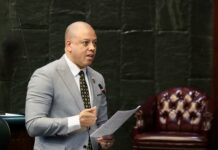
Steve McIntosh, the CEO of Cayman Finance, has warned an international conference that Caymanian complacency was a serious threat to the health of its financial services industry.
He said that despite an increased burden of international regulations, the biggest threat to the sector came from within.
“To retain our position as a leading financial centre, we urgently need to upgrade our operating system, invest in new technology and allow key government departments, on which the industry depends, to hire more people,” he said.
McIntosh added, “The financial industry employs more than 4,000 Caymanians and contributes more than 50% of government revenue, amounting to more than $500 million per year.”
He was speaking last week Friday, at the International Accreditation Council for Business Education conference, held at the University College of the Cayman Islands.
McIntosh said that – in contrast to major tourism and construction projects – jobs in financial services were “created or destroyed one job at a time”, warning of the risk of “death by a thousand cuts”.
He added it was also crucial to have workforce planning and support for Caymanians who want to forge careers in financial services, but that recruitment from overseas was still needed.
“We need to ensure that every Caymanian who is willing and able to work in the industry has the opportunity to do so, but we must also be realistic about the natural limitations of those efforts and allow companies to hire the people they need from overseas when no Caymanians are available.”
He highlighted government statistics which showed that unemployment among Caymanian graduates was just 2% and that the percentage of people with college-level education was only slightly lower than the UK and US.
Government spends more on tourism
McIntosh also pointed out that the government spent 14 times the amount of money to promote tourism than it did on pushing the financial industry, although tourism employed fewer Caymanians and brought less revenue.
The government spends about $1.4 million a year to promote the financial services sector and $20 million to boost tourism.
“By comparison, Jersey Finance, our counterpart in the Channel Islands, receives $7 million in funding from their government,” he said, adding that complacency about the industry meant “the hard work of industry pioneers” was at risk of being undone.
McIntosh highlighted that almost 60% of the Caymanian public had a “negative or ambivalent” view of the financial services sector according to a survey carried out in January last year, in the wake of the havoc wreaked by COVID-19.
He said the industry had propped up the entire economy and contributed significantly to revenues which enabled the government to provide financial assistance to more than 3,000 displaced Caymanian tourism workers.
“Cayman Finance is committed to enhancing the success of our members, our clients, and most importantly, our community,” McIntosh added.
The organisation also had a responsibility to promote the industry, he said, but could not “do it alone”.
He added that real gross domestic product per head was a major indicator of economic health and that Cayman’s had fallen from $68,000 in 2017 to $59,000 last year.
McIntosh said that, although the sector’s contribution to government coffers and GDP had doubled since 2009, employment in the area had “barely grown in absolute terms” and shrunk as a percentage, from 11% to about 7%.
He added research suggested that “significant growth” among suppliers of professional services had been largely offset by a fall in employment in once-strong sectors such as banking and fund administration.
Variety of issues
McIntosh said the problems affecting financial services employment could be put down to a variety of factors, including the cost and difficulty of obtaining work permits, the increased cost of living and the “relative ease with which international companies could hire people in competing locations”.
He said jobs had been lost not only to low-cost centres, but also to expensive locations such as Hong Kong, Toronto and Dublin.
McIntosh emphasised that his views were not a criticism of the government and highlighted the “tremendous efforts and accomplishments” of André Ebanks, the former minister of financial services, who earlier this month quit the ruling United People’s Movement administration, along with two other Cabinet ministers and a parliamentary secretary.
He told the gathering that the Cayman financial services sector could have been twice the size it is at present and contributed an extra $50 million to government revenues from work permits alone, if the government had allowed it.
But he said complacency about financial services was “practically a matter of national consensus” and that government would not throw its entire weight behind the sector “unless the Caymanian people did”.
Despite this concern, McIntosh commended the work of key government ministries, departments and authorities like the Ministry of Financial Services and Commerce, the General Registry and the Cayman Islands Monetary Authority, whom he described as “the unsung heroes of our industry”.
Related Videos










One of the biggest risks is undeniably cost of living due to over development with a focus on ultra luxury properties. It hardly makes sense for companies to hire lower level positions here due to costs, but it also hardly makes sense for many lower level employees to relocate here anymore, unless coming from developing countries. So of course hiring in other jurisdictions to service Cayman based companies is happening at an increased rate, which limits opportunities for Caymanians and imperils the future of Cayman companies who 10 years from now might find themselves with few options for tenured employees PR or status to promote.
Most of the “luxury” properties are on the water. There is no reason that either the government or some sharp builder couldn’t build lower cost housing in land
Almost anything being built now is luxury, whether on the water or not. West Bay, seven mile corridor off the bypass, George Town, South Sound, Grand Harbour are full of new builds barely affordable to upper middle class, much less average/entry level hires. Perfect example is One GT being built in the middle of George Town not near the water, basically being built as a luxury residential resort. This is happening everywhere in the world as builders, realtors, etc can make more margin selling luxury properties (and money launderers tbh) than affordable housing. In land as you say is basically past Hurley’s which is now a 45 minute commute which is not attractive to people moving here to support the financial services industry.
Since you mention water-front properties, less than 10 years ago they used to be affordable to new people moving to island which made it attractive to move here and work in the financial services industry. Now those condos are either demolished to make way for $10 million condos no one will live or stay in 95% of the time, or if they still exist they rent for at least twice the price of 5 years ago. This drives newcomers off the main strip, which then drives up rent elsewhere displacing families and Caymanians, and also making living here less attractive for those in the financial services industry since salaries haven’t kept up.
This does a good job explaining the impact of too high cost of living. This article addresses the healthcare and education sector, but equally applies to pretty much anyone below partner level in the financial services industry. You can’t reasonably expect an economy based on people living their day to day lives to compete with ultra luxury tourism and condos all in a tiny strip of land.
https://www.caymancompass.com/2024/05/22/surging-cost-of-living-prompts-fears-of-a-recruitment-crisis/
The financial services industry for import/export of intangible business products and services via technology and communication infrastructure would be worth it’s weight in gold and diamonds to the Caymanian people and the globe. Individuals and companies could work more efficiently and effectively both physically and remotely for overseas and locally from various locations throughout the island. This way Caymanians could have virtually unlimited job opportunities both physically and remotely as well as the foreign workers. The foreign workers do not actually have to be present here physically in the Cayman Islands to work or do business here; which would reduce the affect of costs of living, and over population and the further driving up the cost of living particularly in rental accommodation for Caymanians and expats alike.
Significant investment into technology and communications infrastructure in the Cayman Islands by both our Government and private sector along with more adequate support in advertising of our opulent financial services product with highlights of it’s local and global benefits and advantages would be extremely beneficial for the Cayman Islands economy, local job opportunities for young professionals as well as graduates, undergraduates and even the Caymanian unskilled worker. Having more of a digital presence than needing a physical presence is also a “green business” and has a very tiny carbon footprint as compared to the tourism industry, hospitality industry or development and the enormous environmental impacts it has with all its ancillary, substructures, networks and imports required to keep them functioning to make any significant profit to the business owners of those industries, the Caymanian people or the Cayman Islands Government.
If the Cayman Islands and it’s people want a clean, sustainable and environmentally friendly economy that will bring indefinite financial wealth and freedom to the Cayman Islands; as well as indefinite opportunities for its people as well as the globe, its best that the Cayman Islands people and the Government very-much need to consider investment into the financial services, corporate services and digital commerce industries.
The tourism industry highly depends on our environment and we need to facilitate persons physically here and this high impact industry has the potential to eventually destroy and pollute our natural environment and habitats to be able to utilize it and make anything significant in return from it. It is unsustainable. Additionally, for the tourism industry regular natural disaster and environmental changes pose risks to the sustainability of the tourism industry apart even from the man made effects of global warming. As you can see we currently have lost a significant portion of the 7-Mile beach just due to a storm. The sand should come back hopefully, its just shifted and not actually disappeared or eroded away never to return. Regardless of the development on 7-Mile Beach, this would probably still have happened, and the beach will return, it’s a natural effect of sand shifting. We however have no idea when it will or how big it will be each time. This makes this extremely hard to depend on our environment to be sustainable and have a dependable tourism product or luxury condo and residential beach front market.
Focusing more on opportunities, education and training in the financial services industry will be worth more than it’s weight in gold and diamonds indefinitely into our future. The Government could expand current under staffed departments and fill those positions with qualified Caymanians that are in turn properly managing and facilitating the financial services private sector industry. Furthermore, the financial services industry could facilitate the Cayman Islands Government in providing Government financial products such as; but not limited to, infrastructure and municipal bonds that can be used for Cayman islands infrastructure, upkeep and enhancement of our infrastructure instead of borrowing from the UK or a foreign jurisdiction.
The income and revenues generated by the financial services sector, with the Government fees and duties that can be applied can be distributed amongst the Government to support the current older persons care and coverage of indigent or persons with disabilities and mental conditions. This would remove the need for proposal made by (2) Members of Parliament generating the idea to place a 2% property tax on foreign owned properties. There are so many things that can be done to enhance the Cayman Islands Government and the private sector without employing additional or new taxes just by enhancement and promotion of what we already have going for us.
In conclusion, I am very pleased with Mr. Steve McIntosh’s speech and making the Cayman Islands aware of these issues. I myself as a Caymanian with a Bachelor’s of Science and Business Administration in Alternative & Renewable Energy Management and a Masters degree in Law & Policy US Jurisprudence and Cybercrimes Law I have observed much about our economy in the Cayman Islands that has significant room for improvement and is underserved and under promoted, and many young professional Caymanians are truly unrecognized and unsung heroes in not only our financial services industry but our corporate services, business and professional services industries.
Thank you,
Joseph Watler Jr.