

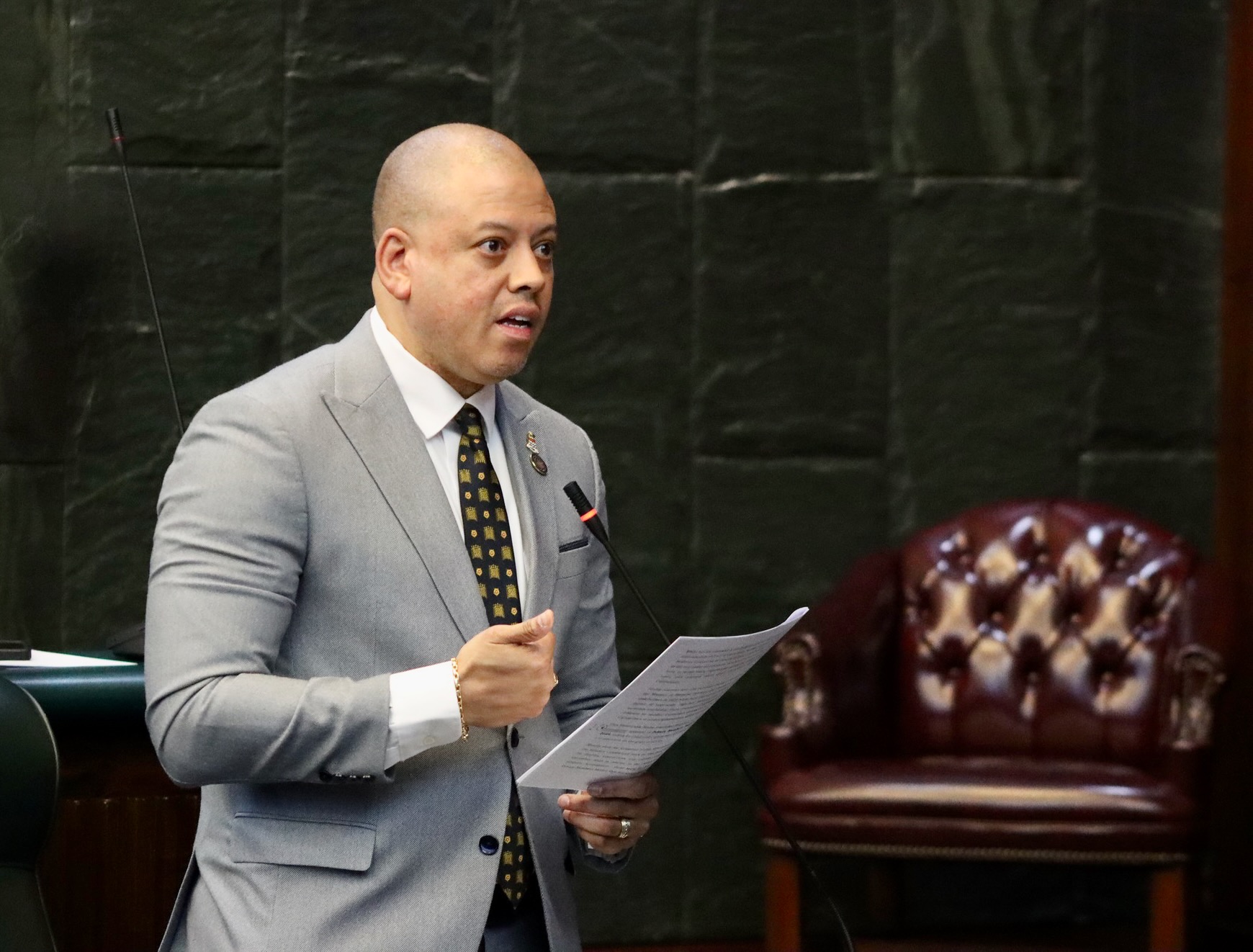
Even before assuming the position of premier and minister of Financial Services and Commerce, André Ebanks made clear that there were three financial services priorities: family offices, digital assets and reinsurance. One year into the National Coalition for Caymanians government, we explore what progress has been made on these goals.
Reinsurance
In addition to highlighting reinsurance in his election campaign, Premier Ebanks has also been a vocal advocate of the sector’s growth potential since taking power. The government’s Strategic Policy Statement published in October 2025 states that a key outcome is “to grow the reinsurance sector and obtain National Association of Insurance Commissioners (NAIC) equivalency to enhance our global competitiveness”.
In very simple terms, obtaining qualified jurisdiction status from the NAIC would give Cayman’s fast-growing reinsurance sector a reputational boost while potentially making the jurisdiction more attractive for some types of reinsurance business.
The government has been active with reinsurance, with the premier leading a Cayman delegation to an NAIC conference in December. In April, Premier Ebanks announced that Cayman would submit a bid for QJS by the end of June, which is notable for being the first time a specific deadline has been publicly set.
The first sign of progress would be if the application is submitted by that deadline. Experts told the Compass that the application would be a multi-year process meaning it will remain an ongoing test for the administration.
Family office
The family office sector was another financial services area highlighted by Ebanks on the campaign trail and the premier wants Cayman to grab a larger slice of the global boom in family office business.
The government hasn’t unveiled an overarching family office policy but proposed or enacted modest legislative changes that could bolster Cayman’s appeal. For example, in January 2026 the premier announced planned enduring powers of attorney legislation. Similarly, the Companies (Amendment) Act 2024, which took effect on 1 Jan. 2026, is a broad corporate law reform that could also help some family office structures.
Something more dramatic proposed by Ebanks is changing the financial threshold for the ‘investor of independent means’ route for permanent residency. Moreover, the investment would no longer be entirely aimed at real estate, creating the possibility that high-net-worth individuals could invest in Cayman’s infrastructure.
Digital assets
The Strategic Policy Statement aims to “position the Cayman Islands as a centre of excellence for technology”, while in the 2025 leadership debate Ebanks specifically highlighted the potential for tech-related financial services.
The last decade has seen a massive increase in the global value of digital assets – one example being cryptocurrencies – and Cayman wants to capture that growth. But it is also about future-proofing Cayman’s existing status as a hub for investment funds. Because another trend is that conventional investment funds – whose focus may have nothing to do with technology – are ‘tokenising’ and switching to a blockchain infrastructure.
In November 2025, the government announced two new international crypto tax updates – the Crypto-Asset Reporting Framework and amendments to the Common Reporting Standard – would be implemented in Cayman in 2026.
Then in February 2026, the government published the Mutual Funds (Amendment) Bill, 2026 and the Private Funds (Amendment) Bill, 2026, to clarify that investment funds using blockchain technology to tokenise investment interests don’t necessarily have to apply for a VASP licence.
This is a fast-moving sector and experts told the Compass that the government will have to keep adjusting legislation to keep pace.
Broader issues
There were also two wider themes impacting the sector: the impending Financial Action Task Force Evaluation and increasing government revenue from financial services.
Even though the Caribbean Financial Action Task Force onsite inspection is expected in December 2027, actions taken in 2026 will be a key part of the evaluation. The government has been very busy on this front and key highlights include: publishing the Virtual Asset (Service Providers) (Amendment) Bill, 2025; establishing the Office for Strategic Action on Illicit Finance; launching the 2025-26 National Risk Assessment; and updating fees to access the beneficial ownership register.
With regard to increasing revenues from the sector, the government announced financial services fee increases in November 2025. Its first quarter financial report showed the government collected more revenue from the sector and, so far, there is no sign that the fee increases are causing a reduction in the international funds and companies using Cayman. Yet it’s too early to make a definitive judgement.
Compass Media will continue its coverage of the NCFC administration’s first year in office and key national issues across all platforms.
Related Videos













CIG’s financial services ambitions are real. Myles’ immigration policy and thinly-veiled xenophobia will quietly strangle them.
Reinsurance actuaries, digital asset lawyers, and family office structuring specialists are mobile professionals who choose jurisdictions on a cost-benefit calculation that includes certainty, efficiency, and career flexibility. The Caymanian Protection Act removes all three. A two-year job change restriction, backed by mandatory departure, tells every specialist considering a move to Cayman that their career is in WORC’s hands. The 20-year status pathway tells them their future is permanently provisional. These signals travel through professional networks faster than any marketing delegation to an NAIC conference.
The Business Staffing Plan regime compounds it. Compliance pressure to hire locally regardless of competitive outcomes does not build a Caymanian reinsurance underwriting class or a domestic digital assets practice. It produces compliance hires, stigmatises the Caymanians placed in those roles, and erodes the institutional credibility that offshore clients pay for. If Cayman wants Caymanians in senior positions across these growth sectors – and it should – the mechanism is scholarships conditional on actuarial, legal, or technical qualifications at serious universities, followed by mandatory international experience at firms where those skills are actually forged. Nothing else produces the result.
The fee increases referenced here are a further cost signal layered on top of the immigration restrictions. Individually each measure is defensible. Cumulatively they ask a pointed question: why Cayman rather than Singapore, Dubai, or an increasingly competitive BVI? The government does not yet appear to be asking that question. It should, before the FATF evaluation in 2027 concentrates minds on jurisdictional reputation and the answer is provided by departing fund managers rather than by policy review.
I regret coming to Cayman, but my children are in school here and so we don’t want to disrupt their education. As soon as we can move, we will: taking my clients with me. Well done Andre and Myles – you’ll get your C-suite Caymanians: in the desiccated husk that will be left of the financial services sector in 5-10 years’ time.