

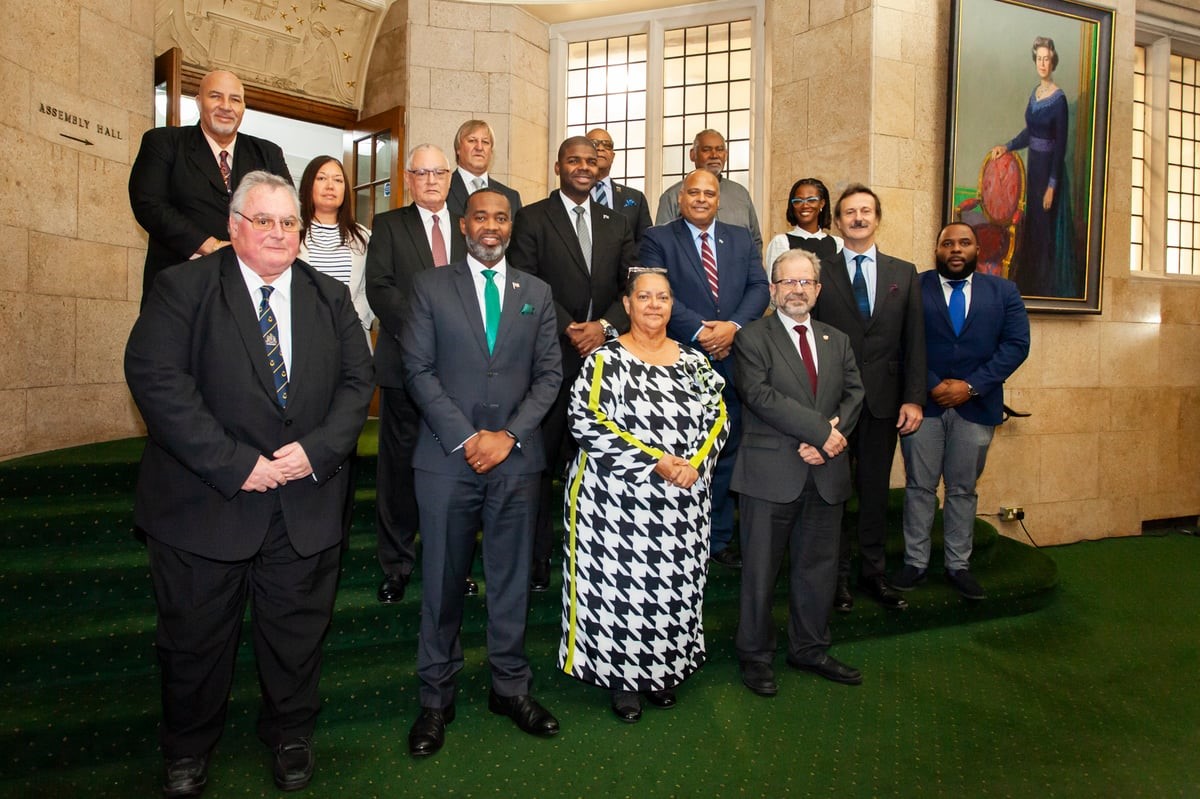
A Cayman Islands delegation is in London this week for talks with British government leaders amid renewed clamour for increased transparency from offshore financial centres.
The annual meeting of the Joint Ministerial Council, which brings together heads of government from Britain’s Overseas Territories including Bermuda, BVI and Cayman, has been preceded by a barrage of articles and editorials in the UK press castigating the islands’ for their perceived role in tax evasion and money laundering.
The summit promises to be a baptism of fire for Premier Juliana O’Connor-Connolly in her new additional role as Minister of Financial Services. She took over the brief from André Ebanks after he resigned form Cabinet last month.

Despite coming off the Financial Action Task Force’s ‘grey list’ last year and being commended by the global watchdog for its reforms, Cayman is still facing criticism from MPs, special interest groups and newspapers in the UK.
Labour’s Dame Margaret Hodge and the Conservative MP Andrew Mitchell, writing in the Guardian, criticised “dither and delay” over full public beneficial ownership registers.
“We know all too well that the overseas territories and crown dependencies play a pivotal role in helping crooks and tax dodgers launder and hide their dirty money,” Hodge and Mitchell said in a leader column in the left-wing broadsheet.
“Public registers, and the scrutiny that they bring, are the best antidote to the scourge of illicit finance.”
Industry group Cayman Finance points out that beneficial ownership information has long been available to law enforcement authorities. And since 2017, the islands have implemented a system of making such information accessible to UK tax and law enforcement officers within 24 hours.
Further transparency is coming, Steve McIntosh, the CEO of Cayman Finance, said in an emailed response to the newspaper, shared with the Compass.
“The Cayman Islands government has committed to making beneficial ownership information available to members of the public, such as journalists, academics and representatives of civil society organisations, who can demonstrate a legitimate interest, by the end of this year.”
MPs call for action
Such ‘legitimate interest’ filters have been dismissed by advocates of open registers as watering down their impact and creating delays and barriers that could frustrate those seeking information.
A group of 40 MPs signed a letter to UK Foreign Secretary David Lammy urging him to press for rapid progress on beneficial ownership registries at this week’s summit, the Financial Times reported.
The letter highlights a previous pledge by overseas territories and crown dependencies, like Jersey and the Isle of Man, to implement full public beneficial ownership registers by the end of last year.
It commends Lammy for apparently intending to make London the “anti corruption capital of the world” and suggests the UK can become the world’s “foremost anti-corruption champion” if it deals effectively with perceived gaps in compliance from its overseas territories.
“These territories previously pledged to introduce registers by the end of 2023 – yet almost all have failed to do so,” said the letter from MPs.
“Public registers are needed to combat money laundering… [and] so we can follow the money to identify potential wrongdoing.”
London faces its own scrutiny
Despite these claims and the grandiose ambitions, the UK and, in particular the City of London, remain closely associated with money laundering.
Respected international affairs think tank Chatham House highlights the UK’s “kleptocracy problem” in a paper that describes how “professional enablers” exploit loopholes in the country’s anti-corruption framework leading to accusations that it is the “global money laundering capital”.
“The exploitation of loopholes by professional enablers – have meant that little has been done in practice to prevent kleptocratic wealth and political agendas from entering Britain,” it states.
The Financial Conduct Authority has also found that significant weaknesses in oversight of the City of London is hurting efforts to halt the global flow of dirty money.
The Cayman Islands introduced legislation to widen access to company information over the past few years.

It has stopped short of making registers of company ownership fully public, citing data privacy issues raised in a recent ruling of the European Court of Justice.
“This ruling outlined that persons gaining access to information contained in a register relating to beneficial owners must have a ‘legitimate interest'”, according to an analysis by Cayman Islands law firm Ocarian.
Transparency International has criticised the changes – enshrined in the Beneficial Ownership Transparency Act and regulations 2024 – suggesting they do not go far enough.
“By making it less burdensome and more accessible to individuals and organisations with a legitimate interest, the Cayman Islands has an opportunity to champion effective legitimate interest frameworks and maintain its position as a financial centre of excellence,” the organisation stated.
Stephen Doughty, the Minister for the Overseas Territories, has previously indicated that “where legitimate interest filters are implemented it must be to a high standard and as an interim step to full public accessibility”.
Doughty will chair the 2-day joint ministerial council plenary, starting Wednesday.
Cayman Finance fights back against rhetoric
Citing analysis from the global Financial Action Task Force that shows Cayman is one of only a handful of countries to have implemented all 40 of its anti-money laundering regulations, Cayman Finance’s McIntosh hit back at UK media accusations that the territory, along with BVI, “has the worst track record” on illicit finance and has not provided a clear timeline for beneficial ownership registers.

“There is no evidence to back up any such claims with respect to illicit finance or sanctions evasion in the Cayman Islands. Indeed, the available evidence contradicts these claims.
“It shows that money laundering cases involving the Cayman Islands are in fact extremely rare and that sanctions have been implemented effectively.”
Premier hosts pre-summit talks
The Cayman delegation had a busy day of talks on the first day of the trip, Monday, including a meeting between the premier and Doughty.

“I believe that our dialogue, while open and frank has been undergirded by mutual respect and sets the right tone for the important meetings to be held this week,” said O’Connor-Conolly in a press release.
The premier who also hosted a meeting of overseas territories leaders on Monday, added, “It is clear the Overseas Territories share many common areas of interest and desire a truly modern and refreshed relationship with the new UK Government.”
Related Videos










On the subject of transparency it should be a requirement that Govt publish the names of Government members and employees attending overseas meetings together with the cost to include airfares, hotel, accomodation and other expenses. The public has the right to this information as it is entitled to know how Govt revenue is spent.