
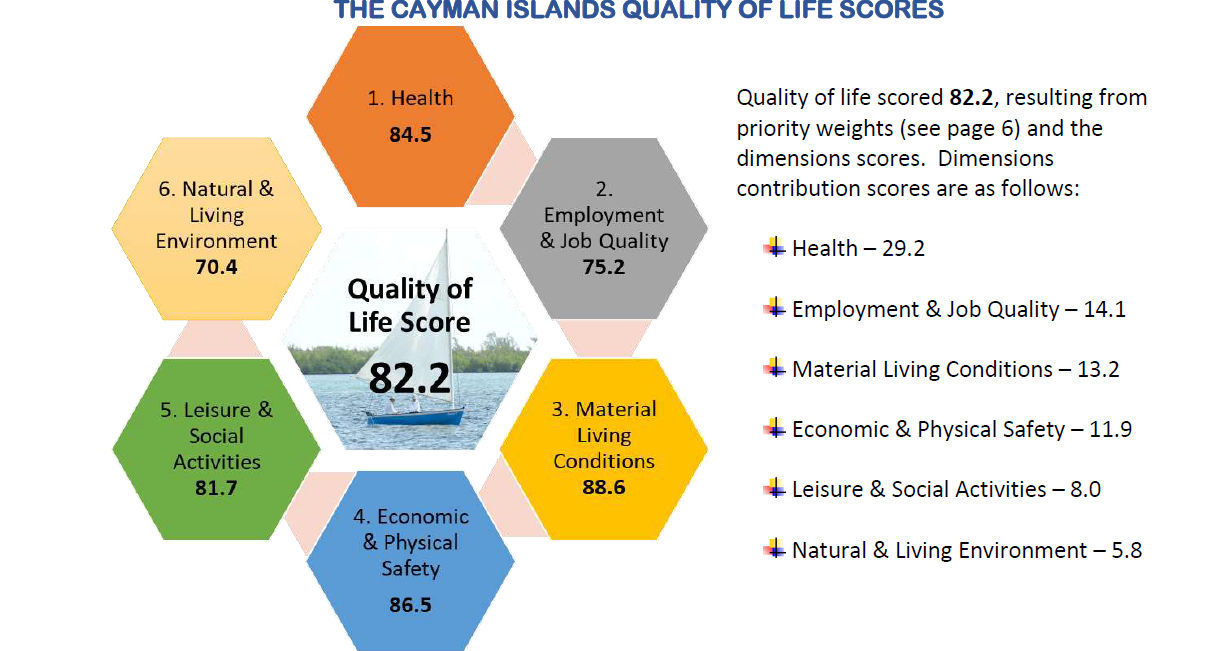
Despite somewhat turbulent political and economic challenges, Cayman’s residents are quite happy and are enjoying a quality of life ranked at 82.2%, data from the Economics and Statistics Office has shown.
However, nearly 40% of those polled in the ESO’s inaugural ‘Quality of Life’ survey say their total income was less than their standard of living, even though the majority of those surveyed expressed a healthy level of job satisfaction with overall employment and job quality being assessed at 75.2%.
The data from the survey found that health and wellbeing was the most important factor to residents when it came to happiness, surpassing job and economic stability.
The survey, which was launched this year, covered everything from life satisfaction and sense of wellbeing to loneliness and social inclusion.
Its findings were released Friday.
A total of 34.6% of the 3,091 survey respondents ranked health as the most important aspect needed to sustain a good quality of life, followed by employment and job quality in second place with 18.7%, and material living conditions in third place with 14.9%.
The ESO said fieldwork for the survey was conducted from 28 April to 16 June. Trained enumerators conducted household interviews.
Of the 2,000 randomly selected household samples, 1,651 were ‘in scope,’ and of these, 1,606 completed the survey fully or partially, it added.
ESO Director Adolphus Laidlow had previously indicated that the results from the survey would be used to produce a quality of life index for the Cayman Islands, with ongoing monitoring in future surveys.
Another ‘Quality of Life’ survey is currently in progress.
Focus on health
The report findings, given the emphasis placed on health, show that being able to afford health care and having access to quality service is important for life satisfaction.
“Emotional well-being and a positive outlook are key indicators of how people
perceive and experience quality of life. Reliable access to timely and appropriate health care provides peace of mind and promotes positive health outcomes,” the report stated.
The overall health score from the survey was 84.5%, which incorporated simple averages from sub-categories within the questionnaire, including health services and conditions, physical wellness, mental wellness and spiritual wellness.
Most respondents on average were happy with their physical health with a total of 81.2% of respondents saying they were generally satisfied with their physical wellness.
The satisfaction score among Caymanians was 77.3%, the survey found.
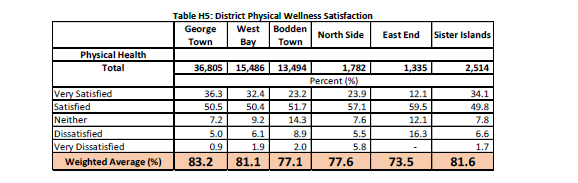
Among the districts, the satisfaction with physical health was highest for George Town residents at 83.2%, followed by the Sister Islands at 81.6%. The lowest satisfaction was in East End at 73.5%.
When it came to the delivery and availability of health services as well as staff competence, 79.8% expressed satisfaction with local facilities.
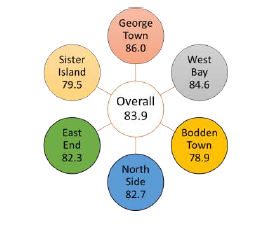
The majority of respondents found that their overall mental health was satisfactory, with the survey ascribing a score of 83.9% to mental wellness.
Spiritual wellness was ranked at a high of 93.1% by those surveyed.
Spiritual wellness, the report said, encompasses a sense of purpose and meaning in life, including one’s morals and ethics, which may or may not involve religious activities.
The majority of those polled engaged in at least one form of spirituality, whether that be going to church, spiritual healing or meditation.
Job satisfaction, employment stats
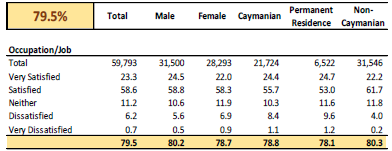
Those surveyed expressed a high level of job satisfaction with overall employment and job quality being assessed at 75.2%.
Employed persons with an income-to-standard-of-living gap was pegged at 36.3%, while unemployed persons had a gap of 75.1% and persons not in the labour force were at 49.9%.
At 64%, the share of males with income exceeding their standard of living was higher than that of females at 57.1%.
About 80% of respondents indicated that within the last six months, they were not behind
on any bill payments.
Of all respondents, 5.1% were behind on electricity payments, 4.3% on
personal loans, 3.9% on rent, 3.3% on water and 0.6% on mortgage repayments.
Generally, most people say they have remained in their jobs for more than five years.
“Relative to spring 2023, a larger share of residents (35.0%) and Caymanians (55.9%) spent more than five (5) years at the same place of employment [as of] Spring 2024. The transient nature of the non-Caymanian labour market impacts the overall low retention rate in jobs,” the report stated.
Over six years from 2018 to April 2024, approximately 16,116 jobs were created at an average of 2,686 jobs per year, the report stated.
In that time period, Caymanians’ job count increased by 1,430 jobs or 238 jobs per annum, which meant that approximately 8.9% of the jobs created during the period went to Caymanians.
“The labour underutilisation rate for Caymanians was at 8.5 percent meaning roughly 91.5 percent of available Caymanians willing and able to work are already working. Hence, expatriate labour is imported to absorb additional jobs created,” the report said.
The report noted that it is crucial to create jobs “but more essential to create ‘quality’ or ‘good jobs’. These jobs pay well enough to allow for a reasonable living standard, provide stability and security, and provide opportunities for career progression”.
Over time, good jobs equip workers with opportunities for self-development, purpose and fulfilment, it said, adding that alternatively, some ‘low-quality jobs’ come with a range of social and economic costs.
These may have “social consequences like exclusion, fractured families, addiction, and crime, as well as reduced mental and physical well-being”.
On average, workers’ monthly income increased from $3,286 in 2016 to $4,761 in spring 2024, reflecting a 44.9% increase and an annual average of 4.9%.
However, real income, adjusted for inflation, means wages, based on the 2016 value, increased to the equivalent of $3,559 in spring 2024, an average increase of just 1.2%.
Related Videos