

Operation El Niño exposed the methods of criminal gangs smuggling dirty gold out of illegal mines in the poorly policed Amazonian borderlands between Venezuela, Guyana and Brazil. The Cayman-led investigation did not end with the hoped-for money-laundering convictions, but both the plane and some $6 million of gold were seized by investigators as criminal profits linked to cartels. The Cayman Compass obtained a court order to access the case file and help tell the full story from shipment to seizure.
The gold itself was unmagnificent – 169 nuggets of varying shapes and sizes, some no bigger than coins, others crudely fashioned into thick bars and fat gleaming hearts you could balance in the palm of your hand.
It was sold at auction in London for £5,367,658.22 (about CI$6.1 million) and the proceeds were split three ways.
Just over £2 million went to the UK treasury, £2 million to the Cayman Islands government and £1 million to four companies who had contested its seizure as the proceeds of crime.
The cash – US$135,000 of it split across three clear plastic bags and one manila envelope and stashed in a hidden compartment under the floor panels of a private plane – had already been claimed by border patrol officials in Grand Cayman.
The Cessna 550 corporate jet is still in limbo. It currently sits on a scrappy piece of tarmac behind two mesh fences on the south corner of the Owen Roberts International Airport.

Its expected sale at auction later this year will net another windfall for law enforcement and close the file on a cross-border, multi-agency investigation that began when a fast-thinking detective slapped a seizure notice on the jet as it was preparing to depart Cayman on 30 May 2019.
At that point, the gold it had originally transported was already on its way to Heathrow, having been repackaged and loaded as cargo on a British Airways flight.
Financial crime investigators were working with little more than a hunch that something was not right, Nigel Armitage, the detective who led the investigation, told the Compass in an interview. They had just 10 hours – the duration of the flight from Grand Cayman to London – to provide enough evidence to stop the gold being shipped to a Swiss refinery and into the global financial system.
That hunch evolved into Operation El Niño, a sprawling investigation that ultimately helped expose the methods of criminal gangs smuggling dirty gold out of illegal mines in the poorly policed Amazonian borderlands between Venezuela, Guyana and Brazil.
The Cayman-led inquiry did not end with the hoped-for money-laundering convictions. Four men were acquitted on money-laundering charges after a lengthy trial in the Grand Court in 2020. The two pilots were also acquitted on separate smuggling charges in relation to the hidden cash.
But police and legal experts believe they quickly shut down efforts to use Cayman as a route to launder so-called ‘conflict minerals’ by disguising the origin of the gold and moving it on to Swiss refineries.

The trade – worth an estimated $2.2 billion a year – still goes on, but not through Cayman.
“We may have lost the battle in terms of the case, but I think we won the war,” said James Hines, KC, who led the prosecution.
“They lost the gold, they lost the plane and they attracted a whole lot of scrutiny from international investigators. I don’t think anyone will be attempting to use Cayman for that purpose any time soon,” he said.
Opening the case file on Operation El Niño
The case file, obtained by the Compass earlier this year after a court application, offers rare insight into how gold is transported out of Venezuela, obscured through a confusing paper trail of conflicting invoices and transformed into legitimate financial assets.
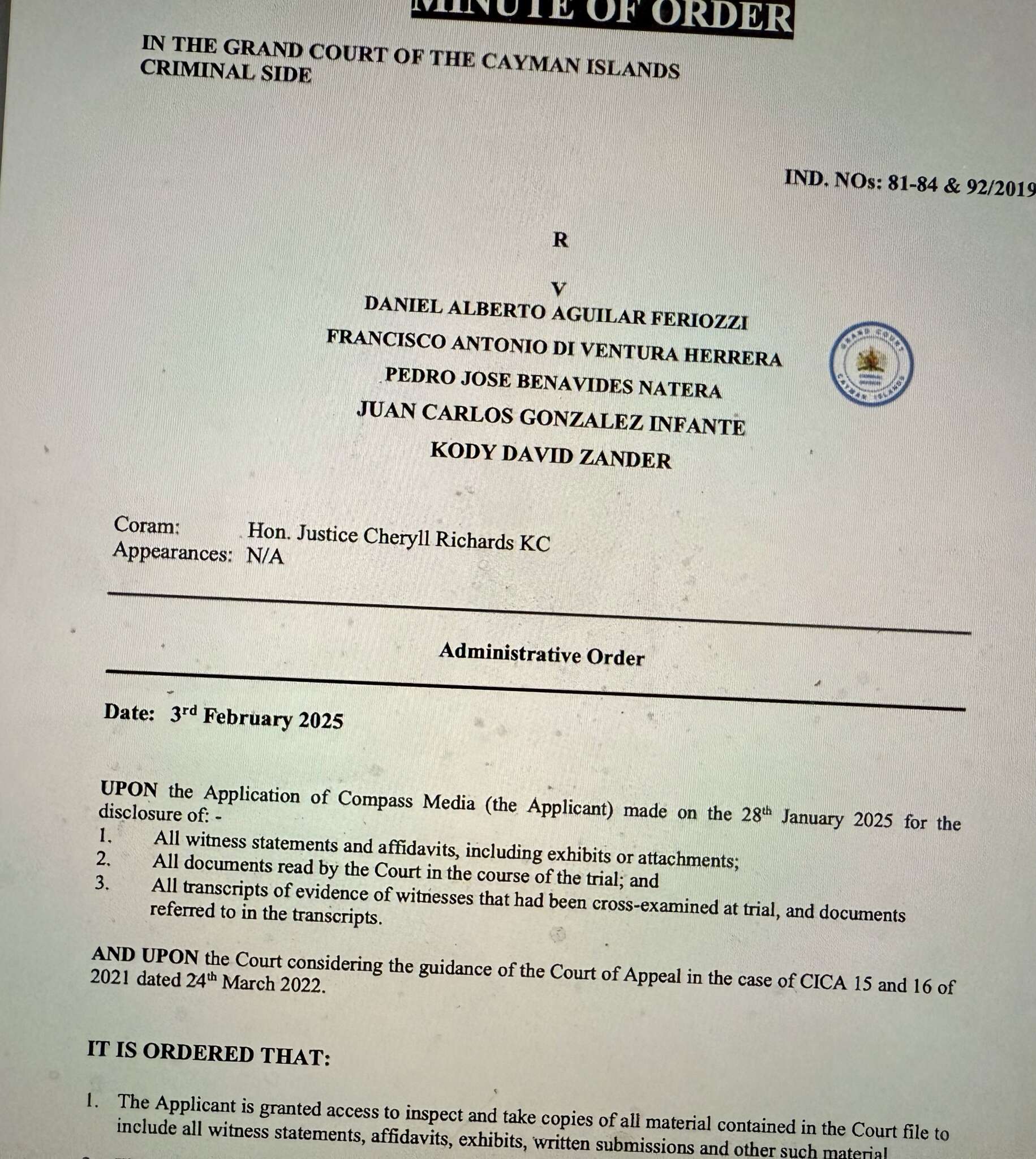
While the criminal money-laundering case was unsuccessful, this is linked to the culpability or otherwise of the specific individuals who were arrested in Cayman.
The evidence was not strong enough to persuade a jury that the individuals who arrived on the plane, and declared the gold to customs officers, or the dealer that handled the shipment in Grand Cayman were personally culpable.
In the case of the pilots, tried separately over the smuggled cash, Magistrate Philippa McFarlane ruled there was “no doubt” that the money was undeclared and that the aircraft had been adapted for smuggling.
But she ruled there was not sufficient evidence that the pilots personally had “guilty knowledge” of the smuggling operation.
Innocent defendants, guilty gold
Despite those losses in Cayman’s criminal courts, the inquiry – and the use of the same evidence to seize the gold in London under the UK Proceeds of Crime Act – ultimately netted one of the biggest financial windfalls in the history of Cayman policing.
The case file also provides a valuable new piece in the intricate jigsaw puzzle being assembled by a network of global crimefighters and human rights watchdogs focused on the illicit flows of wealth out of the failed South American state.
Victoria Templeman, who heads up the Cayman Islands Bureau of Financial Investigation, said the case demonstrated the islands’ ability to disrupt transnational crime, bring those involved before the courts and seize the assets.

“It also contributed considerably to the broader intelligence picture and strategic threat assessments across the region,” she said.
“People are going to think twice about moving gold in that way again. They may have lost some of their appetite for risk.”
An Organisation for Economic Co-operation and Development report, ‘Gold flows from Venezuela’, highlighted the Cayman case among others, to describe how conflict minerals are moved around the region.
It paints a picture of disrupting trafficking routes that conjures a game of ‘whack-a-mole’. As one route is shut down, another emerges.
But that process in itself forces gangs into riskier territory.
“Once an active trafficking route is put under a spotlight, illicit operators will quickly adjust and those adjustments will themselves be visible if a sufficient number of law enforcement, security and regulatory bodies co-ordinate their surveillance,” the report says.
Human rights abuses in Venezuelan mines
The gold trade touches only glancingly on Grand Cayman. An estimated 75 tons of gold is trafficked out of Venezuela each year.
There are only two documented cases of those flights coming through these islands. Armitage, who was head of the Financial Crimes Unit at that time, said he believed smugglers viewed Caribbean islands as a viable route to Europe that bypassed the US – where investigative agencies had turned up the heat on gold traffickers and applied punishing sanctions to Venezuelan cargo.
A US State Department report on the sale of gold from Venezuela’s Orinoco Mining Arc – where the private plane that travelled to Cayman started its journey – highlights how the area has become a “centre of illicit gold mining and smuggling” that it indicates is “enabled and facilitated” by the country’s authoritarian leader Nicolás Maduro.
The report, published last year, states, “The living conditions of miners are dire. Many lack basic services, such as sanitation, water, or electricity, and sleep under plastic and wooden boards as makeshift shelters.
“Violent crimes, including homicides, have become increasingly prevalent in these mining communities. Illegal mining has bred illicit economies, fuel and food smuggling, commercialization of harmful substances, such as mercury and cyanide, child labor, forced labor, and human trafficking.”

It is important to emphasise that specific criminal activity was not proven against any of the men who arrived with the plane or handled the gold in this country.
The trial of four men – Daniel Alberto Aguilar Ferriozi, Antonio Di Ventura Herrera, Juan Carlos Gonzales Infante and Kody Zander – ended in not guilty verdicts. The case against Pedro Jose Benavidez Natera, the second pilot, was thrown out for lack of evidence.
‘Prosecuting the assets’ – where the civil standard of proof is lower – only requires a judge to be convinced, on the balance of probabilities, that the gold was from criminal activity. That was achieved in 2023 when the High Court in London granted a recovery order after the evidence file from Cayman was used to link the gold to South American cartels.
The gold flights
Importantly, the civil case was able to put greater emphasis on some of the circumstantial evidence surrounding the gold, as well as the alleged criminal history of some of the characters involved in the background.
There were two gold shipments, originating in Venezuela, that came through Grand Cayman in May 2019, according to court documents reviewed by the Compass.
On the first occasion, the same plane, with the tail number YV2317, passed through the island without incident.
The gold, valued at that time at around CI$2 million, was declared to customs and transported by armoured courier service to a local brokerage called Byzantium.
The company – which then operated out of an unassuming premises on the George Town waterfront (now an auto repair shop) – packaged the cargo before putting it on the British Airways flight to London with a final destination of Zurich, Switzerland.

On board the plane on that occasion, according to records in the file, were four passengers, including two Venezuelan businessmen, Marco Flores and Wilson Aponte.
Flores was singled out in two law enforcement investigations, Operation Metal Hands in Venezuela and Operation Hesperides in Brazil, as the biggest supplier of gold on the border.
The 30,000-page case file from the 4th Federal Criminal Court in Boa Vista, Brazil, pinpoints Flores as one of the ringleaders of the gold-smuggling operations in the Orinoco Mining Arc in Venezuela, according to reporting by Armando.Info, an independent journalism platform based in Venezuela and Mexico.
The criminal case on the Brazilian side of the border focused on companies which were trading trucks of chicken, rice and oil for illegally extracted gold.

Aponte, who court records in Cayman link to the company that owns the aircraft, is known in his home country as the “casino man” because of his gambling business interests in the south of Venezuela.
The men, among a group of five that arrived on the first flight to Cayman, spent the night at a hotel on Seven Mile Beach, but were gone before financial crime investigators were alerted.
When the same plane touched down at Owen Roberts International Airport again two weeks later, this time declaring $4 million worth of gold doré – an industry term for rough or unrefined gold usually coming from mines – investigators were ready for them.
According to Templeman, who had not yet taken up her role in Cayman at that time but has been extensively briefed on the case, investigations of the plane’s ownership revealed links to an individual subject to US Office of Foreign Assets Control sanctions.
The strange route of the aircraft, which had travelled from the Venezuelan mainland to Margarita Island to the Dominican Republic before arriving in Cayman, also raised suspicions.
Inquiries with the Cayman-based gold dealer revealed a conflicting chain of invoices. The gold appeared to have been sold twice on the same day to two different buyers.
Cayman police sent an urgent message to their counterparts in London, and the gold was seized at Heathrow.
The case file also reveals connections to another character linked to the Venezuelan gold trade – Mario Pataro.
Fuelling suspicions further was a missing page in the ‘know your customer’ compliance paperwork required of the gold dealer on its relationship with Cupremeco (Curacao Precious Metals Company) – the official seller of the gold. The page requiring it to identify which mine the gold has come from was missing.
Emails between the principles of Byzantium, Kody Zander and its compliance officer, highlight alleged links between Pataro and the Cali cartel and Italian mafia and are annotated with the ballpoint instruction ‘don’t touch this one’.

The Cayman trial
Zander didn’t heed the warning. He said at trial that he understood the gold to be from a credible source, and that all the requisite paperwork was filled out. He was cleared of money laundering.
Prosecutors acknowledged from the start that they could not pinpoint the precise crime committed.
“This is dirty gold,” Hines told the jury in his opening statement in December 2019.
“This gold was derived directly or indirectly from crime …. The gold itself might be criminal property, in that it might have been stolen, or gained from an illegal mine, or it might be payment for a crime.”
While the source of the gold was vague, prosecutors claimed the suspicious paper trail – including multiple conflicting invoices, some of them linked to front companies – were designed to hide the true origin of the gold. They presented a cache of emails and WhatsApp messages between the group – including photographs of the men on private jets with bags of gold – to help demonstrate their involvement in illicit activity. The stash of hidden cash was also presented as evidence of suspicious dealing.
The defence highlighted the desperate socio-political situation in Venezuela, a country with a deteriorating economy, rampant inflation, and political and civil disorder, suggesting it would not be unusual to see innocent individuals moving legitimate assets out of the country.
Aguilar Ferriozi claimed that he was transporting the gold that originated from business ventures in his home country. The others claimed to have no involvement in the gold, saying they were simply pilots or passengers along for the ride.

They were acquitted on March 20 – just days before Cayman’s borders were shut down completely amid the COVID-19 pandemic.
Left behind as the borders closed were the pilots – Natera and Infante – who were acquitted for a second time in September of the same year.
Nonetheless, Infante remains in prison in Cayman today, fighting his extradition to the US in connection with an unrelated investigation dating back two decades.
He told the Compass in a call from Northward prison, “I am just a pilot. None of this involves me. I was just hired to fly a plane.”
Prosecuting the gold
The men may have been acquitted, but the investigatory work done by Cayman authorities didn’t go to waste. It all went towards a second set of prosecutions – against the gold, the plane and the cash.
Senior customs officials said it had been a relatively straightforward process to seize the cash under the Customs and Border Control Act – because it had not been declared and was hidden under the floorboards of the jet.
Similarly, the plane was forfeited because it had been “adapted to be used for smuggling or concealing” and is therefore subject to seizure under the act. Border control agents were first required to place advertisements in the Compass, which they did in June last year, seeking its true owners to come forward and contest its seizure.
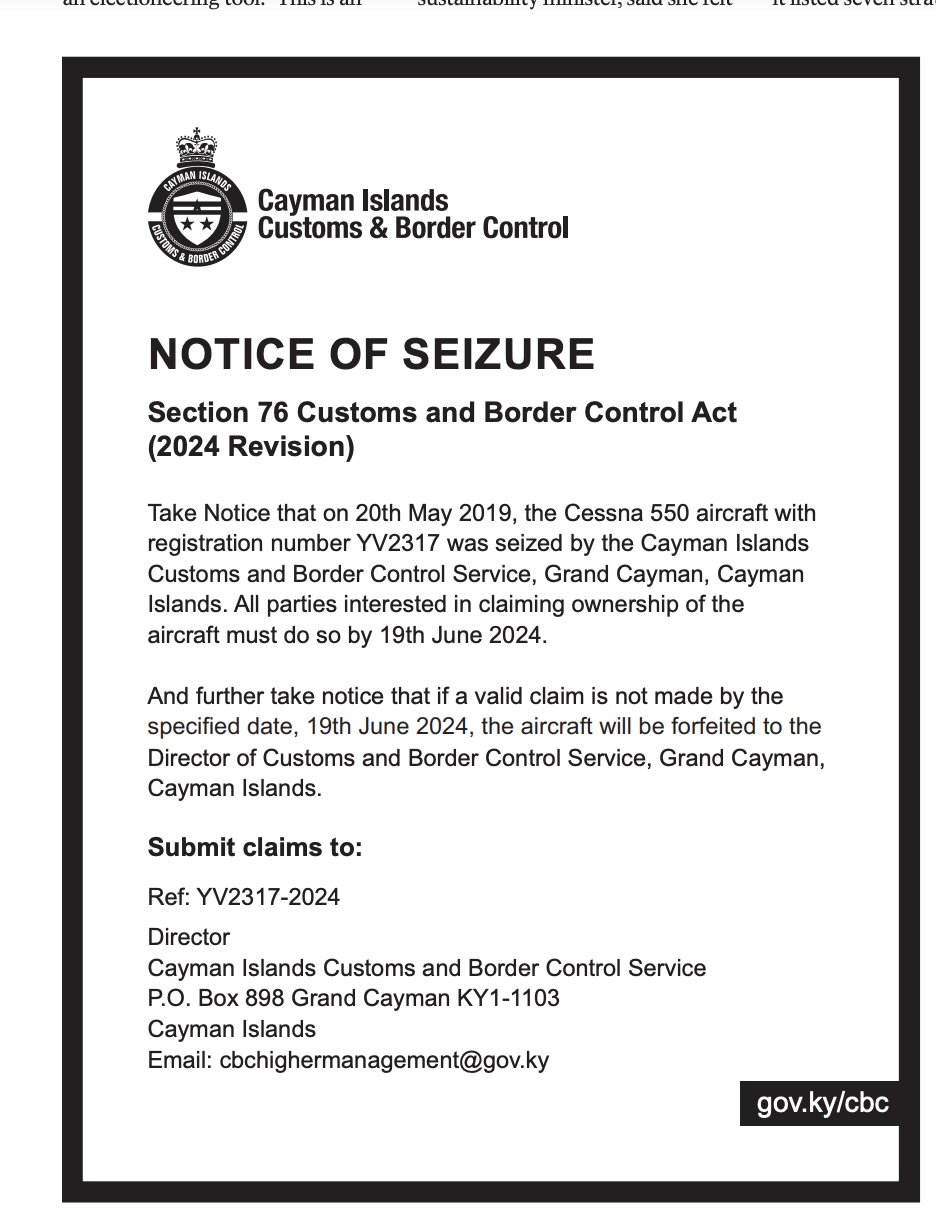
Now they can auction it off with the proceeds going to the Cayman treasury.
Meanwhile, the National Crime Agency in London went after the gold.
The Cayman acquittals didn’t prove to be a hindrance, says Templeman, formerly of the National Crime Agency and now head of the Cayman Islands Bureau of Financial Investigations.
In this case, there were two substantial differences. First of all, the burden of proof is different. Law enforcement is only required to prove that “on the balance of probabilities” the assets in question are the proceeds of unlawful conduct. Secondly, there is no need to prove criminal intent on the part of a specific individual – a high bar that makes money-laundering prosecutions especially difficult.
“You are prosecuting the asset, you’re not prosecuting the person,” said Templeman.
Using the evidence file from Cayman, the National Crime Agency was able to present a case that the gold was from the proceeds of crime.
It issued a press release in March 2023 revealing that it had successfully seized 80% of the bullion under the UK Proceeds of Crime act. National Crime Agency Branch Commander Andy Noyes said, “Criminals are attracted to gold as a way of moving drugs money due to the high value contained in relatively small amounts.
“Our investigation showed this shipment was linked to drug cartels operating out of South America.”
Barring that conclusion, the British have remained tight-lipped. The National Crime Agency did not respond to a request for information or provide a copy of the forfeiture order. A public records request from the Compass for the documents from the High Court in London is still in process.
However, paperwork in the criminal case file seen by the Compass shows that four companies – Panamanian Daguiron S.A, M&P Mining Equipment Supplies Inc, Moonlight Investments Inc and USA D&D International Inc – attempted to claim an ownership stake in the gold.
Journalists in Venezuela with Armando.Info have linked those companies to family members of Flores.
In January 2023, the parties agreed a ‘recovery order by consent’ which entitled the National Crime Agency to retain the bulk of the profits from the gold and for the rest to be split between those four companies.
Speaking generally, Templeman said such orders were often negotiated to avoid the expense of a court case. She said interested parties in a deal of this nature may not necessarily be complicit in a criminal conspiracy – for example, the unwitting purchasers of assets they did not know to be stolen.
The importance of Cayman’s evidence to the London case is demonstrated through the payment of $2.2 million dollars, representing half of the proceeds from the sale of the gold, from UK authorities to the government under an asset sharing agreement.
“Without our intelligence and evidence, the UK would not have been in a position to either initially seize or forfeit the gold. So they were happy to go into an asset sharing agreement,” Templeman said.
While a few million dollars can help a small force like the Royal Cayman Islands Police Service fund its investigative capabilities, that is not the sole point of asset seizure.
Going after criminal property serves as a deterrent, by depriving perpetrators of ill-gotten gains that could be pumped back into illegal schemes.
It may also have closed down efforts to open up the Cayman Islands as a potential waypoint in the gold-trafficking trade.
“It is difficult to say if this action totally put paid to that avenue as an attempted smuggling route; however, it is likely to have acted as a significant deterrent or disruption,” Templeman said.
“Most importantly, it demonstrated that the processes in place are effective and we have the ability to work successfully with our international partners to recover high-value assets and investigate cross-border economic crime.”
Economic grey zones
Global investigators have come to similar conclusions, applying pressure to smaller countries like Cayman to demonstrate they can play a role in helping stem the flow of illicit cash around the globe.
The 2021 OECD report raises concerns that almost all gold coming out of Venezuela is tainted.

“One key fact reaffirmed by the research for this report is that high-risk gold flows, such as those out of Venezuela, typically involve organized criminal groups,” the report states.
“Such organizations are now globalised in that they draw on multiple income streams, build and maintain transnational business relationships with other criminal, militant, and terrorist groups and are experts at exploiting gray zones in the global economy.”
For those reasons, among others, Cayman has been subjected to scrutiny from the Global Financial Action Task Force. The island was temporarily ‘grey listed’, in part, for lacking a sufficiently robust crimefighting infrastructure to match its profile as a financial centre.
One of the innovations that helped get Cayman off that list was the creation of the Cayman Islands Bureau of Financial Investigations, currently headed by Templeman.
She acknowledges demonstrating the ability to successfully conduct criminal prosecutions and secure convictions are still priorities for global watchdogs. But, she says, going after assets and providing international cooperation to other jurisdictions in cases like this, demonstrates Cayman’s reputation as a key ally in the battle against complex cross-border financial crime.
“Anywhere that has potentially got a nexus to this case – either assets, perpetrators, victims – we would share that that sort of financial intelligence and border security intelligence with them.
“Prosecutions and convictions are never a given, but there are other mechanisms – be it asset recovery, be it intelligence sharing or forming partnerships domestically or internationally – that can be a win,” she said.
The case also resulted in a clarification of the law on money laundering, which could prove helpful in future cases, and was an important part of Cayman’s efforts to get off the Financial Action Task Force’s ‘grey list’.
Elizabeth Lees, who was national co-ordinator for Cayman’s anti-money laundering steering group, said the “half-time judgment”, which determined there was a case to answer for the four defendants, confirmed – in the face of a challenge from defence counsel – that there was no requirement under Cayman law to prove a specific criminal offence in order to secure convictions for money laundering.
Any ambiguity on that issue was cleared up in the wake of the case with an amendment to the Proceeds of Crime Act in 2023 to spell out that prosecutors did not need to prove predicate offences and could simply demonstrate the goods was handled in such a way as to “give rise to the irresistible inference that it can only be criminal property”.
Lees, who now runs Claritas Legal, said the clarification and amendment were in line with modern jurisdictions. Without that distinction, she said, it was extremely difficult to bring money laundering cases.
Related Videos









This story has a movie script in the making.
Cayman Islands has for decades been in movies as a corrupt money laundering country especially going back to the 2009 movie “The Firm”.
Cayman Islands could use this new script to show the world on how Cayman has transformed into a safe and friendly island for legitimate offshore banking and transparent financial institutions.
One of the main reasons I moved to the Cayman Islands 45 years ago was to raise my family where Guns & Drugs were against the Law.
Safe Island & Friendly Caymanian on one of the most beautiful islands in the world.
An intriuing record of robust investigations, quite out of character for CIPS. Were they really involved?
Perhaps Financial Crimes Unit should investigate all serious crimes here. More efforts and skills utilized when asset seizures is involved, it appears.
Just saying….