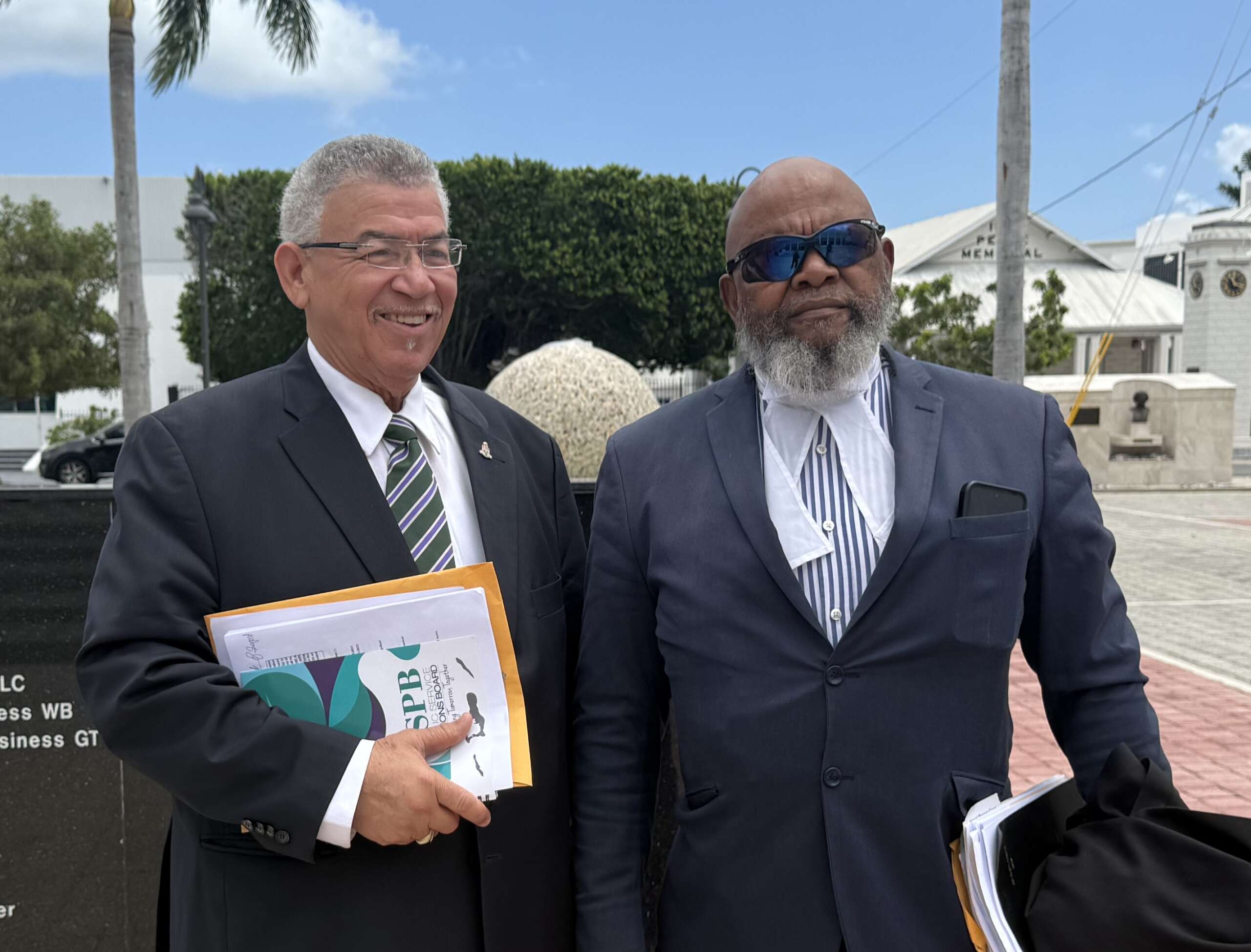
Court of Appeal judges have ruled that McKeeva Bush can be retried on charges of indecent assault in relation to a Grand Court case that was halted mid-trial last year.
In that trial, Bush had faced charges of indecently assaulting two female civil servants at a government-hosted tourism reception at The Ritz-Carlton hotel in September 2022. At the time of the alleged assaults, which he denied, Bush was speaker of Parliament.
Grand Court Justice Stanley John stopped the proceedings mid-trial on 29 Feb. last year, citing an “abuse of process”, and discharged the jury.
His decision came following submissions from Bush’s legal team that indicated, among other concerns, that one of the alleged victims, who had told police and prosecutors she did not want to press charges, had been “tricked” into giving evidence and ordered to appear as a witness in court or face arrest.
The defence team had also complained to the court about repeated late disclosures of relevant emails, WhatsApp messages and other correspondence.
The Office of the Director of Public Prosecutions appealed John’s decision, and on Friday, 11 July, the Court of Appeal’s ruling was read aloud in court, before Bush and his lawyer Denis Brady, by Grand Court Justice Emma Peters.
That judgment found that John had failed to “set out in necessary detail” what specifically it was about the trial that had “compromised the criminal justice system to an unacceptable degree”.
The appeals judges ordered that the case be sent back to the Grand Court, giving the DPP the option of taking Bush to trial again on the same charges.
“However, whether, in all the circumstances, the DPP considers that a retrial is now in the public interest, is a matter for him. No doubt, he would want to bear in mind, amongst other things, that a considerable time has now passed since these events,” the judges said.
Peters gave prosecutors until 5 Sept. to consider the Court of Appeal ruling and to inform the Grand Court whether it intended to move ahead with a retrial.
Reasons for decision
Both of the alleged victims, known during the proceedings as ‘A’ and ‘M’, had given evidence during the trial. The evidence in chief from one of them, A, consisted of video of her interview with police about the incident. The court heard that A had not consented to that interview being used for judicial purposes and that she had just wanted to put on record what had occurred on the night of 13 Sept. 2022 when, she said, a drunken Bush had given her a love bite on her wrist, leaving teeth marks.
Bush was accused of planting unwanted kisses on the shoulder of the second woman.
John, in an initial verbal ruling, halted the trial in relation to the alleged offences regarding both women. In a subsequent written judgment, he admitted he had made an error and should only have abandoned the charges relating to A.
In their ruling, the appeals judges noted that the submissions made by Bush’s lawyer, Sallie Bennett-Jenkins, KC, calling for the trial to be stayed, had been “serious”.
The judgment noted, “At the heart [of Bennett-Jenkins’ submissions] was the suggestion by a number of different police officers, in order to prosecute the respondent [Bush], and with the consent of the DPP, decided, in the absence of A’s consent, and contrary to her wishes and her view that no offence had been committed, instigated and continued with this prosecution for unexplained reasons of their own.”
The judges stated that Bennett-Jenkins’ submissions had noted that “in order to achieve that end, they lied to A and tricked her into providing an ABE [Achieving Best Evidence] interview, ran roughshod over her wishes and, notwithstanding A’s lack of consent, forced her to be summoned to attend court and give evidence under threat of arrest. Additionally, they sought to conceal and not disclose relevant evidence.”
They added, “It’s impossible to know from the judgment whether the judge accepted Ms Bennett-Jenkins’ submissions in whole, or in part, or not at all.”
They noted that John had highlighted in his ruling a defence argument that was highly critical of the assistant director of public prosecutions regarding disclosure of evidence, but pointed out that it appeared the judge had failed to take into account that one piece of supposedly undisclosed correspondence had “gone astray in Mr. Brady’s office”.
Another piece of correspondence, a WhatsApp message sent by A to her boss after she left the Ritz-Carlton on the night of the alleged offences in which she described what had happened, was disclosed to the defence only after the trial had already begun. The appeals judges stated, “As to the WhatsApp message, the circumstances in which it was not originally disclosed do not, it seems to us, suggest concealment, but incompetence.”
They concluded, “Finally, underlying the submissions of abuse of process and the judge’s decision appears to have been that, in the absence of the complainant’s consent, there is something improper in bringing a prosecution. That is not so. The public interest may justify, particularly in the context of allegations of sexual misconduct, that a prosecution be brought, even in the face of the contrary wishes of the complainant.
“And furthermore, the fact that a complainant may not think what happened amounted to an offence is not determinative of whether or not it does.”
The judges said that while they accepted that the court “should be slow to interfere with the exercise of a judicial discretion, we have concluded that we are bound to set aside the judge’s order for a stable for reasons we’ve set out”.
Related Videos