By Cayman Compass Contributor Christopher Tobutt
In ‘Agnes of God’, the play directed and designed by Henry Muttoo and performed recently in the Harquail Studio Theatre, there is no resolution in the normal sense.
The play closes, yet something continues to reverberate – a resolution of another kind, carried not in answers, but in the haunting voice of Agnes herself.
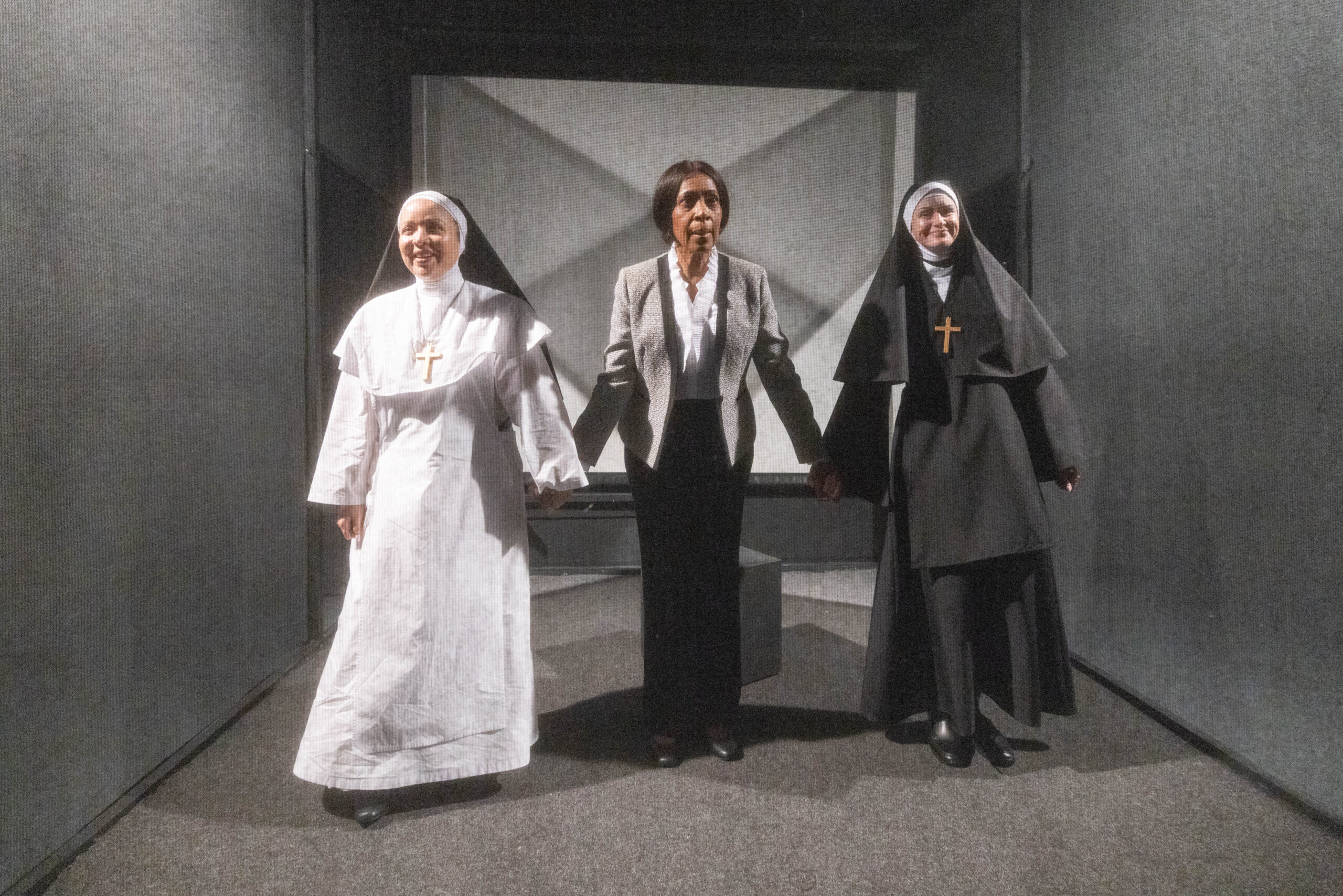
John Pielmeier’s ‘Agnes of God’ at first appears to set psychiatry against the church, Dr. Martha Livingstone (played by Marcia Muttoo) against Mother Miriam Ruth (played by Charley Burling), and fact against faith.
A childlike nun, Agnes (played Kayla Manderson) has had a baby, which has been found dead in a wastepaper basket and the court has asked Livingstone to assess her. Livingstone demands clarity: “I need facts, not miracles, because without facts we cannot know what happened … we cannot heal.” Miriam defends mystery: “You have no right to pry into her soul, for some truths belong to God alone and not to doctors.”

Their sparring is fierce, but it is not where the play’s deepest authority lies.
That belongs to Agnes. Her voice, fragile and radiant, punctuates the drama with hymns that seem to come from another world. She refuses the plain facts of memory, pleading, “I don’t remember, I don’t want to remember.”
For Agnes, truth is not evidence or doctrine, but survival – raw, visceral knowledge of absolute realities, the body’s way of speaking when intellect and theology falter.
Livingstone herself admits her own prejudice: “I lost my faith long ago,” she says – on a stage that is aptly set as a confessional. A nun had foolishly told her that her sister had lost her life because she had not said her prayers. She has been punishing believers ever since, by demanding proofs they cannot give. Miriam, too, confesses the leap she must make: “I believe her because without belief there is no mercy, and without mercy there is no God.”
Both women, in their different ways, rely on faith. But Agnes’s truth is different. It is not chosen or argued; it is embodied, sung and endured.
That is the brilliance of ‘Agnes of God’. It begins as a courtroom mystery, a debate between institutions, but it ends as something stranger and more compelling: a revelation that truth can be visceral, carried in wounds, in silence, in song – in fleeting visionary fragments of heaven; of God, of horror, disturbingly intertwined.
Agnes’ angelic singing, woven through the play, passes this truth directly to the audience. It unsettles and yet enriches – because it reminds us that the deepest truths are not always those we can prove or preach, but those we feel in the marrow.
Christopher Tobutt is a freelance journalist who has written for various publications in the Cayman Islands since 2003.
Related Videos