
Tensions around Venezuela are rising fast, and the Caribbean is once again being pulled into great power politics.
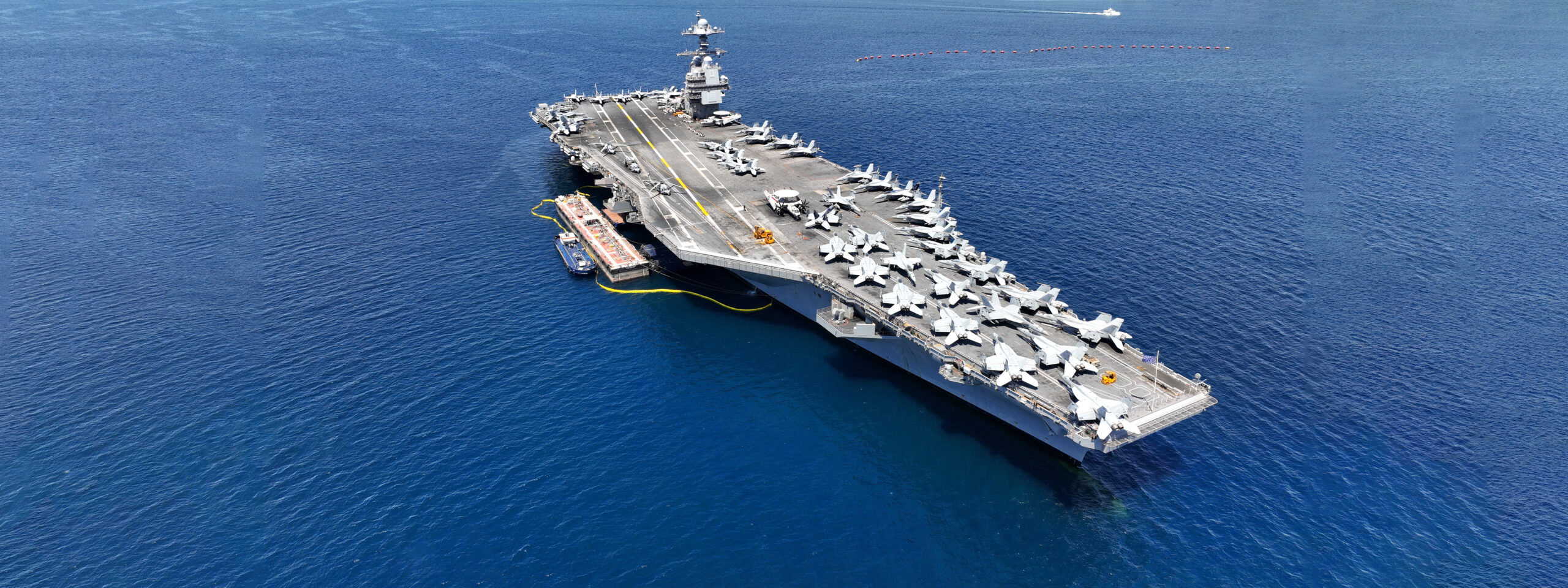
Under Operation Southern Spear, the United States has turned the waters off Venezuela into a forward operating area: instead of the usual one or two ships on counter-drug patrol, Washington has deployed a carrier strike group and an amphibious group with supporting vessels and aircraft. At around ten major warships and thousands of personnel, this is the largest US naval concentration in the Caribbean since the 1960s.
These forces are already active, striking small boats the US links to Venezuelan gangs and Colombian insurgents, and flying long-range bombers and fighters along the coast in what look like attack rehearsals. Caracas has responded with mobilisations and patrols but has so far avoided a direct clash.
In previous crises Venezuela could lean on Moscow and Beijing; today that backing is thin. Russia is tied down in Ukraine with little capacity to project power into the Caribbean, while China is nursing losses on past loans, managing a domestic slowdown and trying to stabilise relations with Washington. Neither is likely to confront the US to save Nicolás Maduro.
The world’s largest oil reserves
What makes this confrontation so important is what lies under Venezuelan soil. The country holds roughly 300 billion barrels of proven oil – the largest reserves in the world – plus substantial gas. Yet after years of mismanagement and sanctions, exports sit at about 900,000 barrels a day, less than half the level in better times.
Most barrels now go to China at a discount, with smaller volumes to India and Cuba, leaving a huge gap between what Venezuela could produce and what it actually exports. That gap is what energy markets – and Washington – are most likely focused on.
The best plausible outcome is not an American invasion but a negotiated transition in which Maduro and his circle receive credible amnesties, a broader but market-friendly administration takes over, sanctions are eased as it delivers basic reforms, defaulted sovereign and PDVSA (Venezuela’s national oil company) debt is restructured, and Western oil firms are allowed back in under clearer contracts and tighter oversight.
Even in that optimistic case, production does not snap back. Years of under-investment have left infrastructure degraded, cash scarce and many skilled workers overseas. In the short run, exports might rise by a few hundred thousand barrels a day simply through better operating practices, access to diluents and modest new spending.
Over the medium term, if contracts are stable and security improves, output could climb back toward 1.5–2 million barrels a day. Only over a longer horizon, with sustained capital spending and consistent policy, does a return to 2–3 million barrels a day look realistic.
For the US and the wider world, additional Venezuelan supply would be clearly disinflationary relative to today’s baseline.
Heavy crude from Venezuela fits refineries that have struggled to replace Russian and other sanctioned grades, reducing the price of diesel and jet fuel as well as headline crude. Lower energy prices mean lower inflation and stronger real growth, giving the Federal Reserve more room to cut or hold rates lower than in a high-oil scenario. Cheaper Venezuelan barrels also erode Russia’s ability to command even a discounted price for Its exports, tightening the squeeze on Moscow’s war finances – not enough to end the conflict in Ukraine by itself, but another structural headwind.
Mass migration
The human story is just as large as the oil reserves. Roughly eight million Venezuelans – more than a quarter of the pre-crisis population – now live abroad, mostly in Latin America and the Caribbean. If Venezuela stabilises, some will return with skills and savings chasing new opportunities and providing much needed foreign capital.
Host countries would lose some workers but gain relief as pressure on public services, housing and low-wage Labour markets eases. Cuba is directly exposed. It has relied on subsidised Venezuelan oil in exchange for doctors and political support, those flows have already collapsed and a post-Maduro Caracas is highly unlikely to keep gifting cheap crude.
In the near term that implies more hardship and probably more Cuban migration; over time, cutting off this external lifeline is the sort of shock that tends to force reform or eventually break an unreformed regime. A freer Venezuela does not guarantee a democratic Cuba, but it makes it more likely.
In a benign scenario, an open Venezuela and lower oil prices would broadly ease Caribbean electricity and transport costs, support household incomes and boost regional tourism. Stronger US growth with lower inflation would support travel and cross-border investment, while lower US policy rates would feed straight into lower Cayman mortgage and business borrowing costs. A stabilised Venezuela would attract foreign capital for energy, infrastructure and logistics, much of it structured through offshore vehicles that Cayman is well placed to host.
And if migration pressures from Venezuela – and eventually Cuba – ease, the risk of political or social crises in neighbouring states diminishes. Handled well, what now looks like a dangerous naval build-up could ultimately deliver a rare positive external boost for Cayman, the Caribbean and the wider world.
Reece Jarvis is VP, Group Head of Fixed Income, Asset Management, Butterfield.
Disclaimer: The views expressed are the opinions of the writer and whilst believed reliable may differ from the views of Butterfield Bank (Cayman) Limited. The Bank accepts no liability for errors or actions taken on the basis of this information.
Related Videos