After one of the driest and warmest years in recent memory, the Cayman Islands have opened 2026 under a very different sky – wetter, cooler and more unsettled than 2025.
January rainfall totals are already well above normal for both Grand Cayman and Cayman Brac, marking a sharp reversal from last year’s prolonged dryness and heat.
A dry, hot 2025
According to statistics from the Cayman Islands National Weather Service, 2025 was characterised by significantly below-average rainfall and well above-normal temperatures across the islands.
On Grand Cayman, total annual rainfall reached just 35.1 inches, making 2025 the second driest year on record and the driest within the past decade. Rainfall was approximately 32% below the 2015–2024 average and 37% below the 30-year climatological average, a shortfall of 20.9 inches.
The dry season, spanning December 2024 through April 2025, delivered only 6.2 inches of total rainfall, ranking as the 23rd driest dry season on record.
January 2025 was particularly stark, with just 0.03 inches, the second driest January ever recorded on Grand Cayman. Despite nine cold front passages during the year, Grand Cayman experienced rain on only 103 days.
Temperatures told a similarly extreme story. Average temperatures in 2025 were about 1.3°C above the 30-year average, placing the year among the warmest on record. Daytime maximums were especially elevated; up to 2.1°C above long-term norms, increasing heat stress, while night-time minimums remained unusually warm, reducing nocturnal cooling.
Cayman Brac was even drier. Total rainfall for 2025 measured just 21.3 inches, making it the second driest year on record and nearly 48% below the recent 10-year average.
January 2025 rainfall came in at 0.02 inches, also the second driest January recorded on the island. The dry season total of 3.8 inches ranked as the sixth driest on record, with an overall rainfall deficit for 2025 of 19.4 inches.
Temperatures on the Brac were similarly elevated, averaging 0.8°C above the 10-year mean, with night-time temperatures nearly 3°C above average, reinforcing the ongoing warming trend.
A wet start to 2026
That backdrop makes the opening weeks of 2026 stand out.
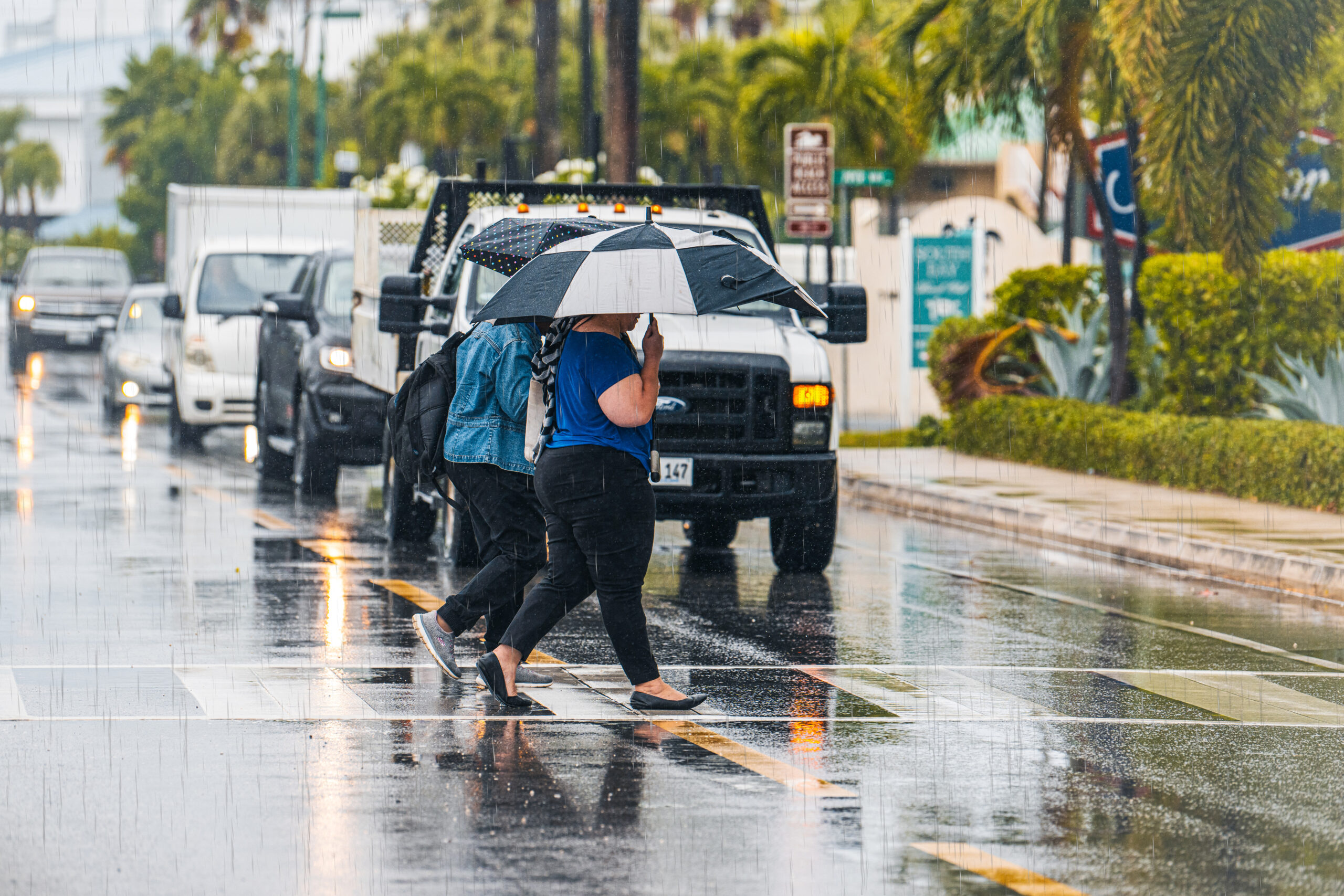
Between 17 and 19 Jan., Grand Cayman recorded approximately 4 inches of rainfall:
- 0.7 inches on 17 Jan.
- 1.1 inches on 18 Jan.
- 2.2 inches on 19 Jan.
By comparison, the 30-year average January rainfall is just over 2 inches for Grand Cayman and 2.2 inches for Cayman Brac; meaning twice the amount of a typical January’s rainfall fell in just a few days.
Kerry Powery, chief meteorologist at the Cayman Islands National Weather Service, said the rain was driven by two back-to-back cold fronts pushing unusually far south.
“The jet stream is bringing colder air deeper into the tropics, so that is why we are seeing more cold fronts and colder temperatures,” Powery explained. “It is not atypical; we normally see additional rainfall associated with cold fronts.”
Cold fronts and historic rain
Cold fronts are a regular winter feature in Cayman, but on rare occasions they have produced exceptional rainfall.
One of the most notable examples occurred on Saturday, 18 Jan. 2003, when a cold front became stationary across the Cayman Islands, bringing torrential rainfall that resulted in widespread flooding of the capital, George Town.
On that day, the National Weather Service recorded a record 9.06 inches between 1-7pm local time. This total was so excessive that the six-hour total was greater than any 24-hour total since records commenced in 1957.
This is an extraordinary amount of rainfall for a system driven not by a tropical cyclone, but by a winter frontal boundary. While hurricanes dominate public memory, these winter systems remain capable of delivering intense rainfall and very rough seas when atmospheric conditions align.
A reminder of variability
The rainy start to 2026 does not erase the longer term trend highlighted by 2025’s statistics. The past year still stands as one of the driest and warmest on record, consistent with a broader pattern of warming temperatures and more variable rainfall.
But the January rains serve as a reminder that Cayman’s climate is shaped by sharp contrasts; long dry spells punctuated by short, intense bursts of rain, whether from tropical systems in summer or cold fronts in winter.
As the dry season continues, forecasters will be watching closely to see whether January’s rainfall proves to be an early-season anomaly, or the opening act of a wetter than expected year after the parched extremes of 2025.
Related Videos