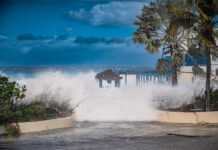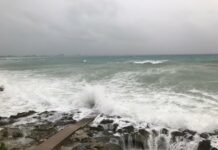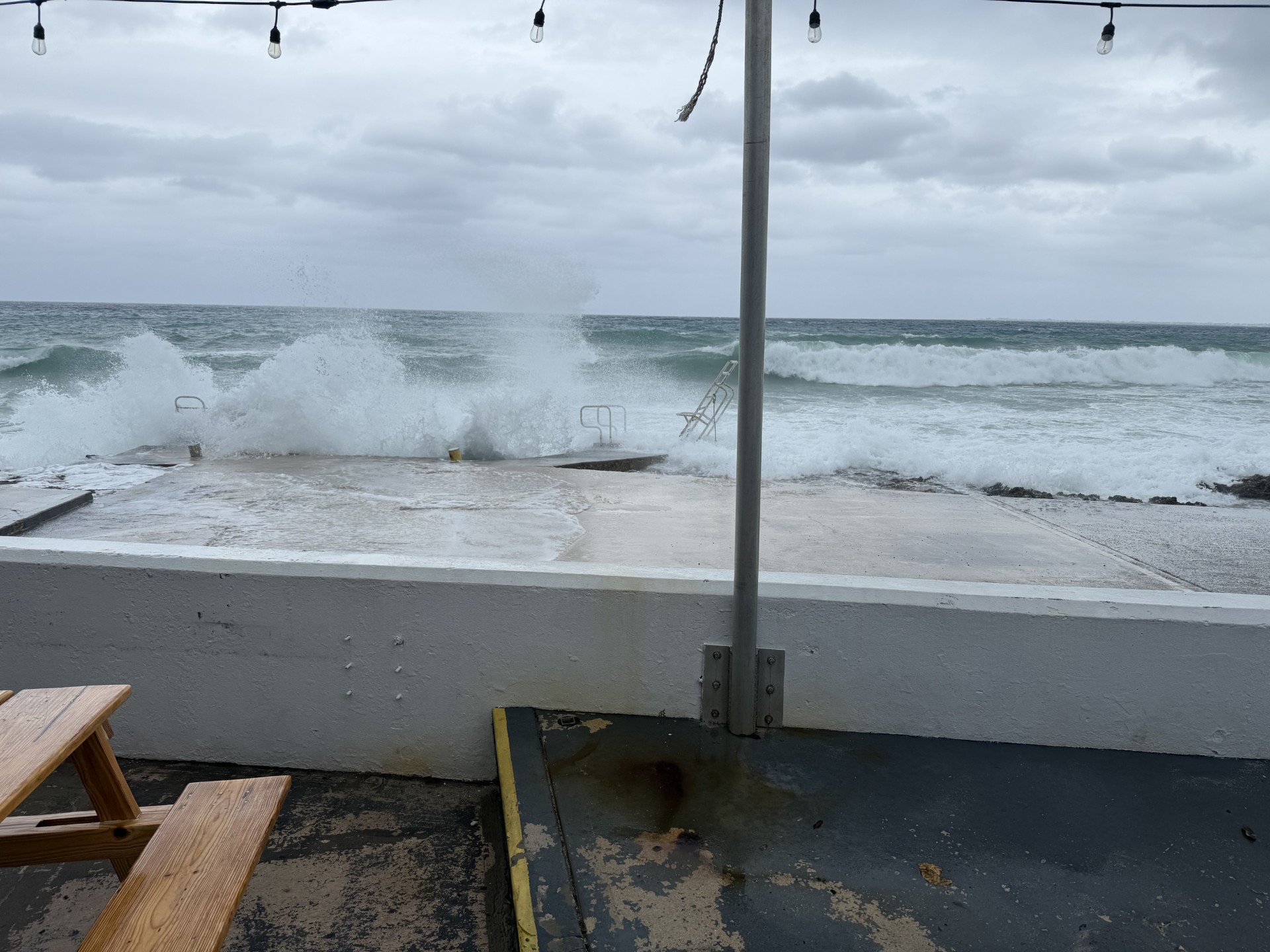
The Cayman Islands National Weather Service has issued a marine watch for 12 Nov., with a cold front forecast to bring strong winds and 8-to-10-foot seas to the Cayman area.
Cold fronts, also known as ‘northers,’ or in the Cayman Islands sometimes as ‘nor’westers,’ are weather systems that bring cooler air from North America into the Caribbean, primarily during the northern hemisphere’s fall and winter.
Shamal Clarke, manager of research and media services at the Cayman Islands National Weather Service said: “In the Cayman Islands, cold fronts can typically be observed between November to April. However, they can occur outside of that period, for example in October.”
With temperatures dipping down to the 40’s and even the 30’s in parts of Florida this week, weather forecasters in the state are warning of the possibility of iguanas falling out of the trees.
Temperatures in the Cayman Islands will stay relatively warm and there is no threat of falling iguanas here this week, but cold fronts can bring with them heavy rainfall, thunderstorms and strong winds, and they often generate large and sometimes damaging waves.
Over the years, numerous vessels have been wrecked in cold fronts near Grand Cayman, primarily because the normally calm, lee shorelines on the western side of the islands can become very rough.
As reported by the Compass last year on 6 Feb. 2024, Cayman experienced a strong nor’wester that resulted in waves breaching the coastline, causing significant damage to several coastal properties in both Grand Cayman and Cayman Brac.
When these fronts move through, the cold dense air from these northerly winds pushes under the warmer moist Caribbean air, forcing it to rise and this often leads to significant cloud formation and precipitation.
On Saturday, 18 Jan. 2003, a cold front became stationary across the Cayman Islands, bringing torrential rainfall that resulted in widespread flooding of the capital, George Town. On that day, the National Weather Service recorded a record 9.06 inches between 1-7pm local time. This total was so excessive that the six-hour total was greater than any 24-hour total since records commenced in 1957.
The arrival of the first of the cold fronts towards the end of the year is often believed to signal the end of hurricane season, but that is not always the case. Local weather enthusiast, Adam McDoom pointed out, “Hurricane Paloma which hit Cayman Brac as a category 4 hurricane in November 2008, actually formed from the tail end of a cold front, as did Hurricane Michelle in 2001 and Hurricane Marco in 1996.”
There is no danger that the current cold front will spawn tropical cyclone activity, but it is expected to interact with the warm Caribbean air, bringing very heavy rainfall to parts of Central America, including Honduras.
Related Videos