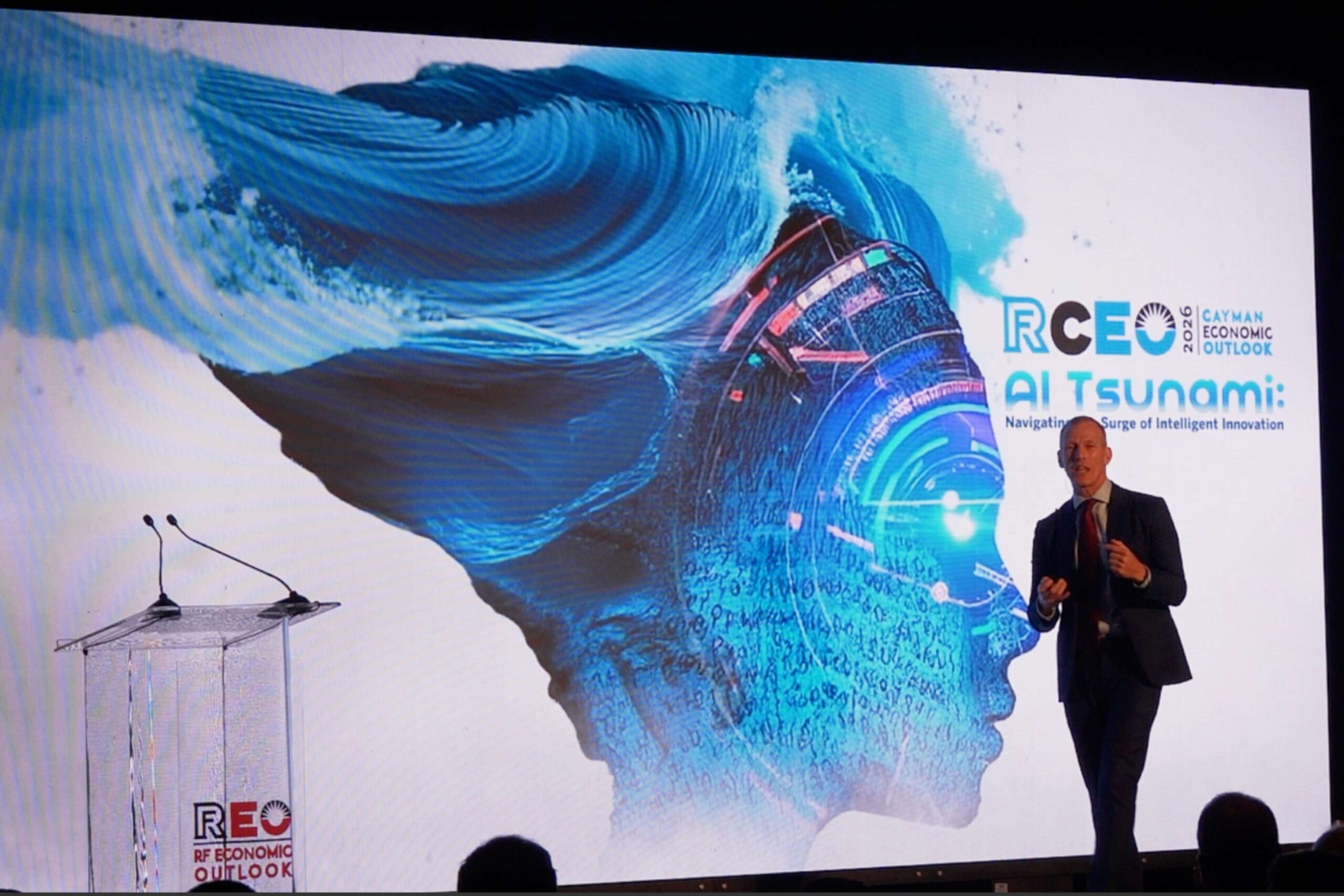
Jamie Metzl, a prominent early advocate for investigating a possible laboratory origin of COVID-19, told a Cayman audience this week that the same scientific tools that are giving humans “almost godlike powers” are now accelerating change at a pace few are prepared for and will touch each person in a unique way.
In his keynote address at the RF Economic Outlook conference on 11 Feb. at Kimpton Seafire Resort + Spa, Metzl warned that artificial intelligence and biotechnology are converging in ways that will reshape economies, healthcare systems and governance models worldwide.
“What will determine whether this is the most wonderful story in our history or perhaps the most terrible is whether we can learn to use our almost godlike powers wisely. And if we do, an incredible future will unfold for us,” he said.
Metzl, a senior fellow at the Atlantic Council and former US National Security Council official, was one of the early public voices calling for deeper scrutiny of a potential research-related origin of COVID-19, earning him the title of the ‘original COVID-19 whistleblower’. He was a key witness in the US congressional hearings on the issue.
In Cayman, however, his focus was not on revisiting the pandemic, but on what he described as a broader technological turning point. After flying in from what he described as “unprecedented” snow and cold in New York, Metzl said, that like periods preceding revolutionary change, Cayman’s calm ocean surface can be deceptive in moments of disruption.
“When you hear the sound of a tsunami alarm and you look out at the ocean, it pretty much looks exactly like it looked before,” he told hundreds of business leaders and policymakers gathered at the conference under the theme ‘AI Tsunami: Navigating the Surge of Intelligent Innovation’.
“It’s a smooth, calm ocean. The day looks perfect. And you could be forgiven for feeling … the noise is contrasting with what I’m experiencing.”
That disconnect, he said, mirrors how much of the world is experiencing artificial intelligence.
“When a tsunami is coming, the right thing for you to feel is fear,” Metzl said. “But if you’re not feeling a whole lot of excitement about what this has the potential to be and how it can help each and all of us live better lives in very many different ways, you’re also missing the story.”
Metzl framed the current era as a moment when humans are gaining the power “to engineer novel intelligence and re-engineer life”.
A significant portion of his talk focused on health care, an area he said is already being transformed by AI, genomics and data science. He described a shift from generalised treatment based on population averages to precision medicine tailored to individuals’ biology.
“The goal of technology is not technology, he said. “The goal of technology is to unlock human potential, to allow us to spend our time and energy and resources doing the things that we value most.”
Metzl illustrated that point with the story of his late father Kurt Metzl’s stage four pancreatic neuroendocrine cancer diagnosis. Rather than relying solely on conventional treatment pathways, his family pursued full genome sequencing of the cancer cells to identify a rare mutation that could be targeted with an existing drug.
The result, he said, was a level of remission that exceeded expectations and extended his father’s life by two years. The case was later published in a medical journal, potentially influencing care for future patients with similar mutations.
It’s not about DIY cancer care, he cautioned. It’s about how we integrate these tools responsibly.
That caution extended to consumer-facing health technologies and AI systems. Metzl warned against blind reliance on digital tools and unverified claims, particularly in areas such as genetic testing.
“If this becomes a totally decentralised free-for-all, we’re going to be in big trouble,” he said, stressing the need for governance and regulatory systems in high-stakes medical decisions.
He also addressed concerns about how advanced biotechnology could affect societal definitions of normality and diversity. “If we get an overly narrow definition of what it means to be ‘normal’ and what it means to be ‘abnormal,’ we could actually do real harm to ourselves,”
For Cayman, Metzl suggested the island has an opportunity to combine its reputation for governance and service excellence with emerging technology, particularly in healthcare.
“You have an incredible opportunity to marry the things that you already have here,” he said, citing hospitality, regulatory stability and an existing medical infrastructure. The challenge, he added, is ensuring that AI systems enhance rather than erode the human experience “to make healthcare more human, more humane, warmer and more affordable”.
He urged business leaders to rethink jobs as collections of tasks that may shift between humans and machines over time, warning that organisations risk turning employees into “second-rate machines” if they fail to redesign work thoughtfully.
Closing his remarks, Metzl pushed back against the idea that AI is an external force acting on society.
Technology is not something happening to us, he said. “Technology is us.”
Related Videos