

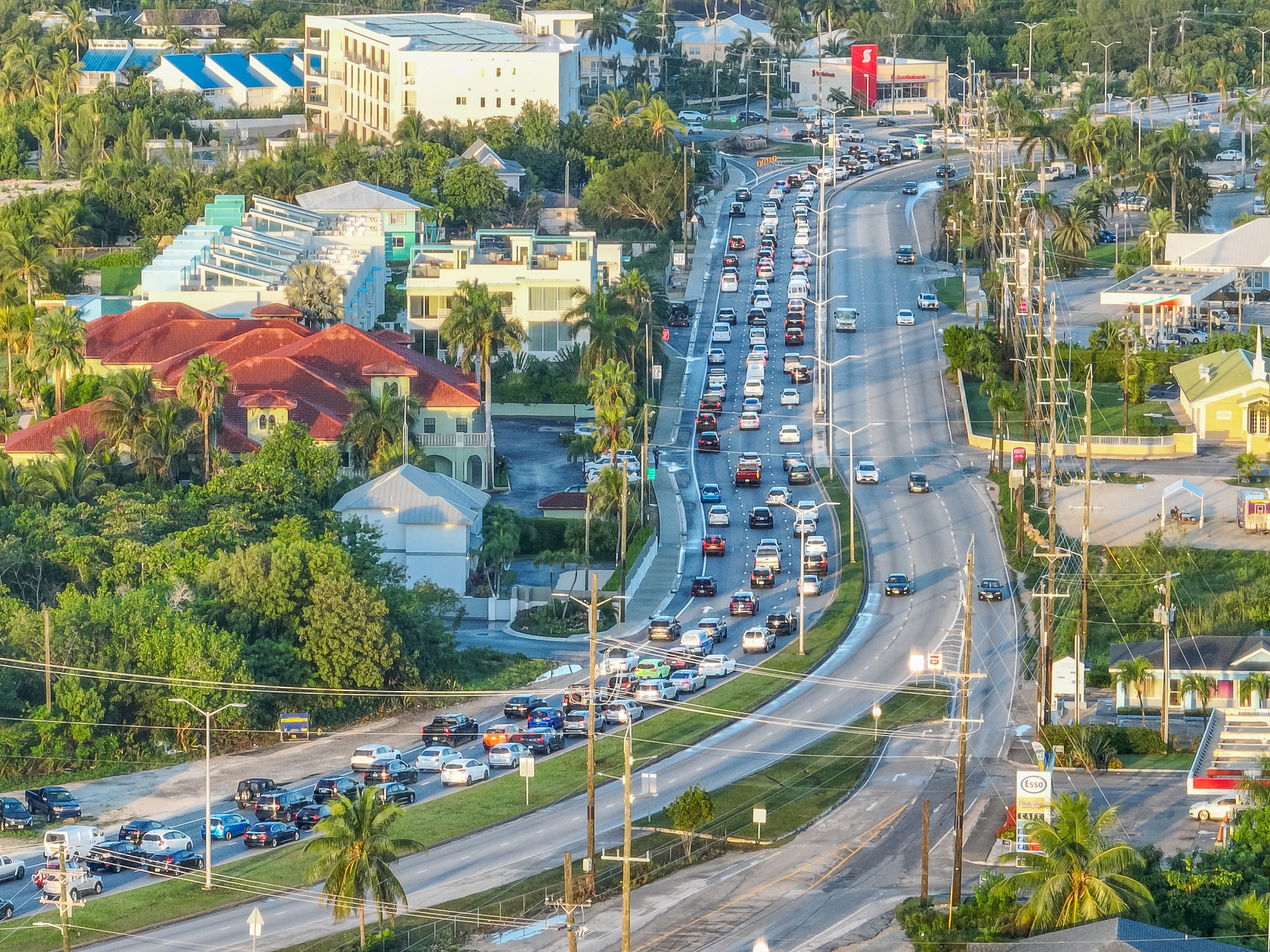
Flyovers, also known as overpasses, are being considered as a possible solution to Cayman’s mounting traffic problems.
Government is seeking market information on modular bridges and elevated road infrastructure as part of its analysis of how to unclog the Islands’ roads.
The National Roads Authority had previously ruled out the possibility of a flyover at the Grand Harbour roundabout – arguably the most significant choke point on the commute to George Town.
Elevated highways have also previously been debated as a possibility for the planned extension to the East-West Arterial highway, which cuts through the Central Mangrove Wetlands. However, the environmental impact assessment for the project published in April 2025, did not consider elevated highway options for the route.
The request for expressions of interest, posted last week, does not identify specific projects or possible uses.
Katherine Smith, a senior policy advisor in the Ministry of Infrastructure, said the aim was to scope out the technology on offer and see if it could be an option for Cayman in future.
“Modular bridge systems are used internationally in a variety of settings and may offer potential benefits where traditional construction methods are challenging or where environmental sensitivities need to be carefully considered.
“The [expressions of interest] process is intended to assist government to better understand the capabilities, limitations and sustainability of these systems before any decisions are made regarding future projects.”
The Grand Harbour dilemma
The Grand Harbour area remains the most challenging bottleneck on Cayman’s roads.
A 2024 National Roads Authority corridor study examined the 1.5-mile stretch between the CUC and Chrissie Tomlinson roundabouts, Grand Cayman’s slowest commuter corridor. That report projected that without intervention, traffic will have slowed to walking pace along that route by 2036.
The study examined multiple options for the Grand Harbour roundabout, including eliminating it entirely in favour of signalised intersections. At that time engineers ruled out a flyover specifically, citing geometric constraints, construction impacts and cost.
Developments on both sides of the intersection leave little room for traditional elevated construction.
However modular and prefabricated systems are designed for such constrained environments suggesting the concept could be revisited if the technology proves viable in Cayman.
Participating firms are being invited to conduct site visits and preliminary discussions in Cayman between mid-June and mid-August.
Related Videos










It works in NJ where there are no left turns on major roads The problem besides money of course is space It takes room to make an overpass. It does cut down on accidents and keeps traffic moving
Exactly where will the overpass roads come back to earth?.
The problem is not road leading into town… the problem is there is nowhere in town for cars to go!!! Stop making roads into town and fix the problems in town.
Dear Ms Smith,
I read your comments in the Compass on the expressions of interest for modular bridges and elevated road infrastructure. I appreciate that government is scoping options before committing, so I want to make the case — early, while it still matters — that flyovers are the wrong direction for these islands.
The core problem with elevated highways is that they don’t fix congestion, they relocate and grow it. Decades of evidence from other jurisdictions point to induced demand: add road capacity and you generate new car trips that fill it, and within a few years you’re back to gridlock — only now with a concrete structure overhead, more noise, and a corridor permanently committed to cars. The NRA’s own 2024 corridor study ruled a Grand Harbour flyover out on cost, geometry and construction grounds. Modular systems may change the engineering math, but they don’t change the demand math.
Flyovers would also be a continuation of a direction that is already going wrong. Six-lane highways, ever-wider arterials — the pattern is to build more and bigger for cars, and the congestion keeps coming back anyway. It’s hard to escape the conclusion that the planning has lost its way: every problem is met with more asphalt, and the only future being designed for is one where everyone drives everywhere.
That has a cost beyond traffic. Cayman is fighting one of the most serious obesity problems in the region — the 2023 national health survey found seven in ten adults overweight and around a third obese, rates the Chief Medical Officer put roughly level with the United States. Yet the infrastructure is being built so that walking or cycling anywhere is unpleasant or unsafe. You cannot design physical activity out of daily life and then wonder why the population is unhealthy. Planning only for cars and fighting an obesity epidemic are pulling in opposite directions, and right now cars are winning.
There’s also the character of the place. Cayman’s appeal — for residents and the visitors the economy depends on — has never been its road network. It’s the quiet and the scale. Elevated highways erode that irreversibly; once it’s built, it’s built.
The more durable answer is to take cars out of the equation rather than build larger conduits for them: meaningful public transit, safe cycling and walking routes (the recent attention to pedestrian collisions and cyclist safety shows the need is already recognised), and land-use measures that cut the peak-hour crush in the first place. These are cheaper, reversible, better for public health, and they make the island better to live on rather than just faster to drive across.
I’d welcome the chance to expand on any of this, and I’d urge that whatever the EOI process turns up, the assessment weighs the long-term cost to the island’s character and its people’s health alongside the engineering.
Kind regards,
Chris