Twenty-three green sea turtle hatchlings were released into the sea Sunday evening having been rescued that morning from various places around a condominium complex on Seven Mile Beach.

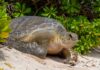
A turtle hatchling. Photo: File |
Residents at Discovery Point Club on West Bay Road and volunteers with the Department of Environment’s Sea Turtle Programme rescued the confused hatchlings from the property’s bushes, parking lot and even one stuck in the swimming pool filter.
‘They must have hatched on Saturday night or early on Sunday morning because they were found really early on Sunday morning,’ explained Department of Environment Research Officer Janice Blumenthal.
She explained that sea turtle hatchlings find their way to the sea by moving toward the brightest light and they must have become confused by light in the complex or on the road, and moved toward that instead.
It was a Security Guard at the Discovery Point Club complex on the West Bay Road who called the DoE to alert them to the problem.
Volunteers with the DoE’s Sea Turtle Programme husband and wife team Sherry and David Johnson were quickly dispatched to the scene.
‘There were tracks going in every possible direction you can imagine,’ Ms Johnson explained.
‘It was like an Easter egg hunt trying to find the hatchlings,’ she said. ‘We all rounded up as many of the new hatchlings as we could find – they hide really well. We found the little fellows everywhere – under bushes, in the grass, in the pool, under stones, in the parking lot.’
The hatchlings were unharmed from their confused adventures and were released that evening, having been placed on top of sand in a bucket, with a towel over the top. ‘We kept the baby turtles safe and comfortable until it was dark enough to release them,’ said Ms Johnston.
They could not be let go during daylight hours as there was more of a chance of them being eaten by predators, said Ms Blumenthal.
The manger, staff and residents at the Discovery Point Club were very helpful, said Ms Blumenthal.
Ms Johnson noted that when she arrived at the scene, some of the complex’s residents had already rescued some of the hatchlings from danger.
She thanked them for calling DoE and alerting them to the potential danger the turtles were in. ‘It’s nice to know there are so many people in the community that care enough to call.’
The turtles were released on the same area of beach their nest was in an hour after sunset to give them the longest time possible under cover of darkness. They were released onto the sand so they could imprint in the hopes that one day they would come back to this beach to nest.
‘Who knows, maybe one of them will be back in 20 or 30 years to continue the cycle,’ said Ms Johnson.
The DoE does put in a big effort to try to minimise the danger to baby turtles on Cayman’s beaches.
The DoE and the turtle programme volunteers monitor the beaches several times a week for nests and tracks. Generally, if a nest is detected in an area very near a property or the road a protection cage is placed over it whereby the baby turtles cannot immediately leave the nesting area once hatched, but can be kept in a safe environment until it is safe to release them later in the evening.
The DoE works with people who have properties on the beach in lit areas if they are expecting a turtle nest to hatch, and they also work with CUC in the case of street lighting.
With the co-operation of the public, lights are often turned off in such cases.
However, in the case of an undetected nest, a problem with disorientated baby turtles can sometimes occur, as in this case.
Although in general the DoE has a good handle on where the nests are, Ms Johnson noted that this was a nest that they were not aware of, which happens sometimes.
Another problem sometimes can be turtles hatching sooner than anticipated.
DoE Director Gina Ebanks-Petrie noted that at the beginning of each nesting season properties and CUC are made aware of issues with light, especially in the Seven Mile Beach area. ‘We try to do this because there is no legislation and it’s got to be done with the co-operation of the property owners,’ she said.
Ms Blumenthal again wished to remind those living on the beach to turn off unnecessary lights during hatching season. Shades over lights can also help. She said that properties are generally very co-operative on the issue.
Earlier this season there was another case of hatchlings getting confused in the South Sound area, she said.
Cayman’s struggling nesting population had a blow early last month when a female green turtle of about 350 pounds that was about to lay her eggs on a West Bay beach was slaughtered.
Later last month a 350-pound green turtle was saved from slaughter after environmental officers found it tied up in a yard in West Bay.
Cayman was once the home of one of the largest green turtle breeding grounds on earth and each year it is estimated about one million turtles came ashore to lay eggs. But hunting of the turtle has brought the nesting population to the brink of extinction.
Turtles breed from late April to September and last year there were 100 nests recorded here in the Cayman Islands. From the tracks on the beach and eye witness sightings, the Department of Environment has determined that about 20 turtles (10 green turtles and 10 loggerheads) are still using Cayman’s beaches to nest. Each turtle comes ashore and deposits eggs at least six times in a season.
Only between one in 100 and one in 1,000 sea turtle hatchlings survive, said Ms Blumenthal.
‘This is why it is so important to protect adult turtles, so the hatchlings keep coming,’ she said.
Cayman’s legal turtle fishery, where a few local traditional turtle fishermen are granted licences, is also a danger to sea turtles. ‘The annual legal catch limit is more than double the number of nesting turtles in Cayman’s waters,’ said a GIS press release.
People are urged that if they see turtle tracks anywhere on the beach they should immediately contact the Department of Environment on 949 8469.
Related Videos