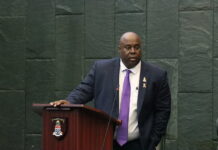
Former MLA Lyndon Martin was found guilty Wednesday of three counts of obtaining property by deception.
The same jury found him not guilty of two other charges of obtaining by deception and not guilty of four charges relating to false documents.
Justice Paulette Williams granted an application for bail to continue until Friday, 2 May, when Martin is to be sentenced. She refused a request that he be allowed to travel to Cayman Brac while on bail.
Martin must report to the police station daily and observe a curfew from 9pm to 6am.
Charges against him arose after an incident in May 2006. As Justice Williams summarised evidence fore the jury, the case began when Jamaican national Weldon Shaw took two documents to Immigration headquarters.
That action led to an investigation and the investigation led to a search of Martin’s office and home. The search led to recovery of immigration-related documents, which prompted officers to contact two other men -Clint Adolphus Myrie and Harold Spence.
Mr. Myrie gave evidence about the defendant helping him with an application for permanent residence for his foreign-born wife.
Martin gave evidence that he was arrested before he could submit the application. Meanwhile, he had received three sums of money from Mr. Myrie, telling him it was needed for the application.
Martin was found not guilty found of obtaining $100 from Mr. Myrie between 1 January and 30 April 2005. He was found guilty of dishonestly obtaining $250 from Mr. Myrie some time in July 2005 and guilty of obtaining $475 in March 2006.
In the matter involving Mr. Spence, the charge was dishonestly obtaining a bank draft for $500 by falsely representing it would be used with an application for permanent residence for Mr. Spence.
Martin told the court he did use it for someone else’s application because the draft was going to expire and he could not contact Mr. Spence. He said he logged a credit to Mr. Spence on his spreadsheet.
The jury found him not guilty.
The final charge of obtaining by deception related to Mr. Shaw, as did charges of making two forged documents and then issuing them to Mr. Shaw.
Mr. Shaw had been in Cayman since 1997 on work permit as a carpenter’s helper. He had received a letter from Immigration advising him that he had reached his term limit and had to leave the Cayman Islands. He knew Mr. Martin through his employer and asked his help to stay on the island.
The jury found Martin guilty of obtaining $350 from Mr. Shaw in April 2006 by falsely representing it would be used for a permanent residency application.
The jury found Martin not guilty of all document-related charges.
One document purported to be a fixed term work permit that would have allowed Mr. Shaw to remain in Cayman. The other was a receipt purporting to show that he had paid for a permanent residence application.
As Justice Williams pointed out, there was no direct evidence of anyone seeing the false documents being made.
But the case for the prosecution, presented by Crown Counsel John Masters, was that the documents were made by Martin.
The Defence asked the jury to infer it was Mr. Shaw who could have made the documents using Martin’s computer equipment.
Mr. Shaw did not come to court to give evidence. Senior Immigration Officer Jeremy Scott told the court of his efforts as far back as February to get Mr. Shaw here from Jamaica. In the end, Mr. Shaw told him he could not get someone to look after his young children and could not bring them with him because he did not have passports for them.
Justice Williams said jurors were left to rely on Mr. Shaw’s statements, but they had not been able to see him. He had not given evidence on oath and had not been cross-examined by the Defence.
The law says in certain circumstances statements are admissible regarding any fact. ‘You have to scrutinise this evidence with particular care’ because it is untested and unverified, the judge explained.
If Mr. Shaw’s statements left jurors in any doubt, they were obliged to resolve those doubts in favour of Mr. Martin.
Martin gave evidence that Mr. Shaw came to his house and asked to use his computer to write a letter. He had been left alone with the equipment. Martin’s father told the court he was at the house that night and saw and spoke to Mr. Shaw (Caymanian Compass, 23 April).
Related Videos