

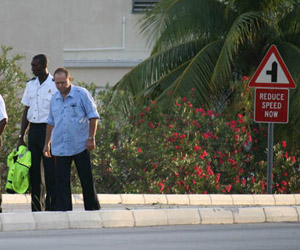
A reorganisation of Royal Cayman Islands Police Traffic Management Unit staffing seeks to put more police officers on the streets, according to department officials.
Chief Inspector Angelique Howell, who has overall responsibility for the unit, said its a simple change.
“What we’ve done is, where the officers that were predominantly placed at traffic management, we’ve now moved those officers over into regular shift,” she said.
What that means is that instead of working out of traffic management, the police officers are now responding to calls from the police station, which essentially gives the department more flexibility in deploying police rather than designating a specific group of officers as traffic investigators. So if the traffic officers aren’t out on accidents, they can respond to other calls for police service.
“Every policeman is a traffic officer,” Ms Howell said. “When the officers were being deployed from traffic, yes of course, they would answer a call, but they were mainly focusing on traffic matters. What we are trying to do is maximise our officers’ skills and potential.”
Specialist investigative skills are still needed at certain types of accidents. Reconstruction experts employed by the RCIPS are called out as necessary to recreate the scene and do damage assessments in fatal collisions. Those officers are called out on assignment as necessary, Chief Inspector Howell said.
For routine accidents where there are not serious injuries and that mainly involve vehicular damage, there’s no reason that any line officer can’t handle it, Ms Howell said. “Our skills haven’t gone down, we’ve maximised them if anything else.”
“The traffic officers….can assist the regular officers that don’t investigate traffic matters on a daily basis, and assist them to bring them up to standard,” she said.
“It’s just a matter of us putting all our resources together to get more. It’s not like the traffic department is depleted or done away with…we have an inspector there that deals with all the administrative work.”
Mostly administrative staff now works out of the RCIPS traffic building on Lyndhurst Road in George Town, although officers can go there to complete paperwork and file reports as needed.
Some local insurance companies have privately expressed concerns that traffic officers might be depleted by the move, which, in turn, could end up affecting insurance rates.
But Ms Howell said this should actually end up putting more officers to the task of handling traffic collisions.
“That’s definitely not an issue,” she said. “If they put in for an accident report, they will get their accident report like the normally do,” she said. “If they feel like they’re not getting their report, then they should complain to the management of the traffic department.”
Refocus on traffic
Plagued by a record number of serious traffic accidents toward the latter part of the last decade, the Royal Cayman Islands Police Service had appeared to be getting a handle on road safety through 2009 and 2010.
Then the holidays hit and the number of collisions that occurred over a six-week period at the end of 2010 nearly doubled the number of crashes seen on a weekly basis in Cayman.
“For a country the size of the Cayman Islands, 298 collisions in six weeks is a terrible figure and clearly demonstrates the lack of care and attention paid by many people on our roads,” said RCIPS Chief Inspector Angelique Howell.
According to figures available, January through September 2010, the Cayman Islands averaged about 25 road accidents per week.
During the six weeks of the holiday traffic enforcement effort at the end of 2010, Cayman averaged 50 collisions per week.
“It’s clear that much more needs to be done by all agencies involved in road safety to address the issue,” Chief Inspector Howell said, adding that work would begin early in 2011 on a national road safety strategy. Part of that strategy involves a police proposal to ban the use of hand-held electronic devices while driving.
The number of fatality accidents in Cayman nearly doubled in 2010 from the previous year, 2009, when four people died on local roads.
However, seven traffic-related deaths is still considerably lower than what Cayman saw in 2006, 2007 and 2008 when a total of 36 people died in wrecks for the three years combined; 14 in 2006, 11 in 2007 and 11 in 2008.
So far in 2011, four people have died on Cayman Islands roads.
Related Videos











Awesome photo.
why not hire Traffice technicians–people who will not be police, but trained to work traffic details and other traffic related jobs. These people could be paid at a much lower rate then police and help allow more police to work on the serious crime issues facing the island.