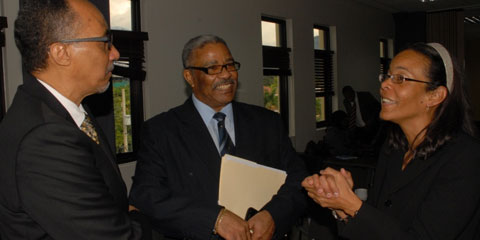
More than three out of every four Jamaicans have limited access to safe and low-cost payments channels, said US Economist Dr. Dawn Elliott at the Mobile Financial Services Conference 2011 at the University of the West Indies, Mona, on 12 December 2011.
Jamaica has a hidden problem as the majority of the population own bank accounts; but only a fraction of this group has access to the financial services, which allows them to participate easily and effectively in the economy, Dr. Elliott said.
“Most Jamaican make payments using cash,” the Associate Professor in the Department of Economics at Texas Christian University stated. A comprehensive research survey, which she headed, showed that only 12 per cent of the population own the types of accounts which allows them to transfer money, write cheques or make credit card payments.
The survey, contracted by Solutions for Society, a Think Tank of the UWI, showed that 33.65 per cent of the adult population do not own bank accounts and therefore use cash or the non-bank payment outlets at relatively high costs.
In addition to this group, she said that almost 80 per cent of those who own a bank account cannot make payments easily or conveniently to support efficient commerce, as they do not own transaction accounts.
Mobile Financial services covers mobile banking, mobile remittances or money transfers and mobile payments, said Dr. Maurice McNaughton, Director of the Centre of Excellence of the Mona School of Business (MSB), at The UWI and a member of Solutions for Society. He told the conference that the use of mobile phones to conduct such transactions “has enormous macroeconomic potential,” with implications for economic inclusion, as well as the efficiency of commerce.
“You have many folks outside of the system and those are the ones who have no payment access through account ownership,” Mr. Elliott stated. “They are not borrowing from the banks, they are not investing, they are not building assets, they are not building wealth and their businesses stay in a survival mode.”
She argued that a country where a large part of the population cannot easily satisfy their need for financial services will benefit from the introduction of a Mobile Financial System. Financial institutions attract deposits from more than two thirds of the adult population, but these institutions fail to redirect these deposits into borrowing and wealth generating activities, and they fail to support money-transfers on the island.
Livingstone Morrison, Deputy Governor at the Bank of Jamaica said the development of a regulatory framework for retail payment systems had to be guided by the fact that innovative retail payment mechanisms could play a significant role in expanding access to payment services for a wider segment of the population and in providing more choice for consumers.
He said the domestic payment services sector is already well developed with non-bank financial entities, including credit unions, building societies, bill payment entities and money changers, being active players in the payments market. Wendell Smith, assistant general manager, Management Information Systems and Operations, at Jamaica National Building Society said the introduction of the mobile phone as a payment point in the remittance business promises to be a major breakthrough.
JN Money Services, a JNBS subsidiary, a smart card based remittance service was introduced in 2004 which decoupled recipients from fixed branches or agent locations. Mr. Smith said the card is used by one third of all JNMS customers as recipients can now access an additional 550 ATM’s, as well as some 8,000 point of sale terminals at merchant locations, throughout Jamaica.
With the near universal penetration of cellular phones, the use of cell phones as a payment point would provide a significant edge for its users, Mr. Smith said. He added that by removing fixed agent and branch locations from the remittance system, “the costs for both domestic and international remittances will be reduced.”
Dr. McNaughton pointed out that given the clear advantages of the introduction of such services, consultations could now begin on the actual implementation of a system targeted at reaching the unbanked population of the country.

Related Videos