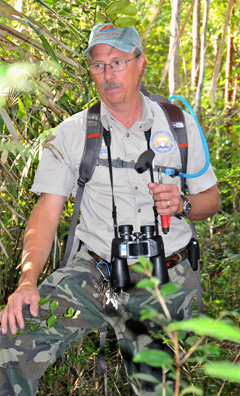
Cayman’s birding scene received a lot of attention at the recent London Wild Bird Watch 2012 expo. Stuart Mailer, field officer with the National Trust for the Cayman Islands, was invited to attend the conference by Don McDougall, regional manager Europe for the Cayman Islands Department of Tourism.
“I found the event to be a wonderful learning experience, and I am very grateful for the opportunity to attend,” said Mr. Mailer, who leads birding and Mastic Trail tours for the National Trust.
“Many of the visitors with whom I spoke were surprised to learn that there were birding opportunities in Cayman and seemed interested in a future visit to the Islands,” he said.
According to Mr. Mailer, most people’s responses when asked what they associated with the Cayman Islands were upmarket beach resorts, water sports, offshore finance centre and a highly developed island.
“Most people do not think of Cayman as a place to experience tropical forests, tranquil wetlands or deserted beaches, which are prime birding habitats,” Mr. Mailer said.
Grand Cayman has seven bird sanctuaries including the Queen Elizabeth II Botanic Park, Colliers Pond, and the National Trust’s Salina and Mastic Reserves. In the Sister Islands, the trust has established the 180-acre Cayman Brac parrot reserve and the trust’s Booby Pond Reserve in Little Cayman is home to the largest colony of red-footed boobies in the western hemisphere.
Birding has been growing in popularity not only in Cayman but globally, with the United States Fish and Wildlife Service saying birding is one of the fastest growing recreational activities, outpacing golf and rivalling gardening for number of participants in the US. Birding is becoming a multi-billion dollar industry.
“Nature tourism in general and birding in particular are becoming increasingly popular. One organisation, Carefree Birding, organises focused birding cruises. They first contacted the National Trust in 2007, and had their first tour with me the following year. Since then, they have had several visits to Cayman each year, and the number of participants has increased from about seven or eight to nearly 20 per trip. Cayman is routinely voted the favourite port of call by the participants,” Mr. Mailer said.
The show presented Mr. Mailer to build up contacts with other birding organisations as well.
“One of the groups I met was Wild Caledonia, a Scotland-based company which organises conservation based wildlife holidays worldwide. The principal was very interested in learning about birding opportunities in Cayman with the National Trust,” he said.
Birding is also an opportunity for local residents to learn more about the Cayman Islands and the National Trust can help getting started.
“The simplest way for residents to get started would be to purchase or borrow a pair on binoculars and join one of my occasional public birding tours, or just go on a standard Mastic tour. Birds are one of the highlights, and I make an effort to point out all the birds we encounter. We can also arrange introductory birding outings for corporate groups or clubs,” Mr. Mailer said.
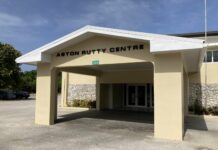
He said that the trust also has presentations on native birds which can be presented to groups, as well as selling copies of Birds of the Cayman Islands at the trust’s visitor’s centre, along with plastic bird ID cards and species checklists.
“We are happy to assist the public with bird identification based on photographs or description, but also behaviour, habitat and time of year, as well as provide additional information on the birds,” Mr. Mailer said. “We can point birders toward the free online database eBird. This service allows birders to keep track of their observations, has maps showing birding hot spots and can be set to automatically alert them by e-mail to interesting observations, including locations, by other local birders.”

Related Videos