

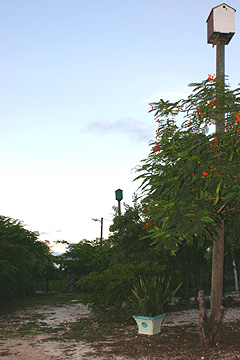
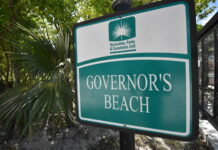
Bodden Town bees have gone batty … they are sharing house with a colony of bats.
And this is of concern to some residents visiting and working in the Harry McCoy Community Park in Grand Cayman, who view the insects with awe and fear, as they can inflict painful stings.
Local craftsman Pedro Watler has felt the bee effect. “It is not a good thing. People visiting the park will get stung,” he said. “I left a can of Pepsi sitting out and when I went to have a drink, a bee stung me in the mouth and on the face, something needs to be done about the bees.”
Mr. Watler said a beekeeper from Mr. Otto Watler’s bee farm came out and removed the bees a few weeks ago, but they were right back there the following week.
The bees have taken up residence in a number of bat houses placed in the park as well as Mission House grounds by bat expert Lois Blumenthal and the National Trust for the Cayman Islands. These houses were created to save the bats after their mangrove habitat was destroyed during Hurricane Ivan in 2004.
At the end of 1999, Ms Blumenthal had 41 houses at a variety of sites across Grand Cayman, with 46 per cent of those occupied. The islands’ most common house-dwelling species, Pallas’s mastiff bat, appears to take well to bat houses. According to Mr. Otto, there is one way to deal with the problem of the bees and that is to get rid of the bat houses, but he said that would undo the efforts of Ms Blumenthal.
“The bee population is making a comeback and simply put, the bees have nowhere to go and are taking up habitat wherever they can,” he said. “Before the hurricane, the bees made their homes in the hollow of dried-out mangroves. Now they are using odd places such as under house eves, in walls, pipes, over doorways and even in pipe fittings,” he said.
Ms Blumenthal recommends anyone removing bees from the bird-house section on a bat house seals up the round hole that accesses the bird section. She said the crevices on the bottom are what the bats use and there has been no major problem with bees in the area, so sealing off the bird house permanently is the best way to keep the bats in the bat houses and out of roof spaces.
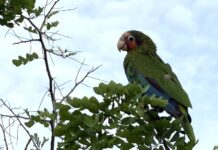
Ms Blumenthal also said a number of birds also lost their habitats during the hurricane. She said the woodpeckers lost forest nesting sites and owl nesting boxes were set up. These bird-house prototypes, she said, were both successful for years, but about three years ago they began to have a problem with bees colonising a large number of the bird houses; both the “apartments” on the sides of the bat houses and the purpose-built bird-houses of all types.
The problem became so widespread that she no longer includes bird-house sections in the bat house plans or promotes any kind of bird houses. She said bats in bat houses are insect-eating species and farmers can rest assured that fruit bats never live in them, so protecting bat houses is an important component of insect control. She said bats appear to be able to live side-by-side with the bees, and one bat house where bees moved in first, was still colonised by bats later.
What has changed, according to Ms Blumenthal, is the predominance of bees invading almost every woodpecker hole on her bat houses.
She said: “Perhaps the bees have just learned – as the bats did – to recognise these structures. Perhaps this is normal behaviour. An entomologist could confirm this and I am happy to donate sample bees from the two bee-colonised bat houses in my own garden – one of which was in storage on the ground, and is easily accessible.”
Ms Blumenthal wonders if the bees colonising bat houses and bird houses are the same species of traditional honey bees always found in the Cayman Islands.
According to Mr. Watler, this problem arises every so often, when people wonder if the bees are getting “Africanised”, but he dismisses such speculation.
Mr. Otto made reference to the incident where a dog was stung to death. He said: “They were using soap to shampoo the dog close to the biggest bee hive I have ever seen,” he said. “When the bees got the scent they just took over. If you don’t trouble bees they will not trouble you – there might be the odd one to sting you but as far as them coming out and swarming someone, I don’t think so.”
Mr. Otto said that his honey is far better than it has ever been.
“I do not know what has happened, but whatever blends of pollen the bees are consuming it is making the honey sweet,” he said.


Related Videos









All of Lois’s efforts to conserve the bats, birds, butterflies and other wildlife are so appreciated! It sounds as if she has found a solution to keeping the bees out of the bat houses. If only the CI government would preserve the mangroves. Such selfishness in our government – destroy our islands to enrich their wallets.
I love Lois. She’s done so much for Cayman’s wildlife, especially the bats. We need more people like her in the DOE, who are active, engaged and know what they’re talking about.
As for the bees, now that they’re homes have been destroyed, naturally, they need somewhere else to go. Perhaps we need to approach this in much the same way as Lois has with the bats?
The problem is actually not with the bat houses, but with the bird houses that were added on. Here is an idea to try that might prevent bees from colonizing the BIRD houses (including the BIRD houses that are part of some bat houses). Rub the inside of the roof with a bar of hard soap or Vaseline, making a sticky, waxy surface, so that bees can’t attach. This is just one on-line suggestion I found. There are others.
Humans have changed the balance of nature drastically and we are entering a future where management and intervention will always be necessary. There are government agencies to do that, especially the DoE and the DoA. Solutions can be found, and they are not poisoning everything and killing off the bees, birds and bats. Bats are native animals and an important natural insect control. They eat mosquitoes, moths and beetles but they don’t eat bees. Honey bees are not native here but were brought by people. We need the bat houses so bats don’t live in human roofs, and we need the bats to control the crop pests and mosquitoes. If we want to raise honeybees here, we have to be smarter than the bees!
Because bees are imported, farmed and part of Cayman Agriculture, and the DoA has entomologists on staff, I think they will be able to come up with solutions that work for everyone. I am only a volunteer. My expertise is with bats – not bees, but I have noticed that most bee colonies are not in bat houses. The incidents of bee attacks over the past years have all be from wild bees. They can move into walls, hollow trees or any space that seems protected and has an access hole.