

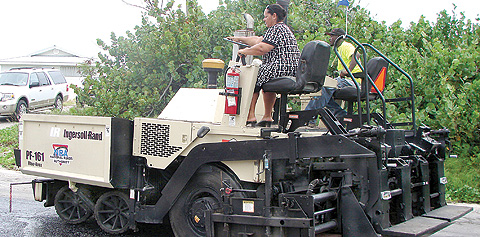
Paving equipment transferred to Cayman Brac and used to pave public and private roads and parking lots left the National Roads Authority in Grand Cayman without its own paving equipment, the Public Accounts Committee heard Tuesday.
Giving evidence as a witness before the committee, former managing director of the National Roads Authority Brian Tomlinson explained that the transfer of the equipment to Cayman Brac in 2010 meant the roads authority had to hire outside staff and equipment to pave Grand Cayman’s roads.
He said the roads authority had previously bought asphalt for roadworks from the one of the two local asphalt companies – Island Paving or Advanced Road Construction and Paving – but after the equipment and the staff to operate those machines were sent to Cayman Brac, the roads authority had to also hire the machinery and operators from the private companies.
“We were directed by [project manager and chairman of the National Roads Authority] Mr. Colford Scott to send certain pieces of equipment over there. The asphalt paving machines and trucks, rollers, saws … What we were doing previously to sending the equipment to the Brac was we were buying hot-mix asphalt from one of the two suppliers and laying it down ourselves with our equipment, but when we sent the equipment to the Brac, it changed our tendering process, so we tendered for supply and placement by one of the two local contractors on Grand Cayman,” he said.
The Public Accounts Committee, whose chairman is Sister Islands Member of the Legislative Assembly Moses Kirkconnell, was examining a public interest report by the auditor general on the expenditure of almost $3.5 million on paving in Cayman Brac, including more than $500,000 on private parking lots.
Auditor General Alastair Swarbrick told the committee that his office had found that public money earmarked for paving public roads on the Island had also been spent on commercial and private parking lots.
Mr. Swarbrick said the government needed to establish a policy to deal with the issue of using public funds to pave private roads and parking lots.
Committee member Kurt Tibbetts pointed out that using public money to pave private roads was not new and there were plenty of examples in Grand Cayman of this happening in the past.* Other members agreed, saying the auditor general had taken the issue of paving of private roads and car parks on the Brac in isolation and had not mentioned in his report that there had long been a precedent for the use of public funds to pay for the paving of private roads in the Cayman Islands.
Ellio Solomon said the report made it look as though such things had never happened before in Cayman, even though they had been going on for decades. Mr. Swarbrick responded that he was carrying out a report on a specific matter that had been brought to his office’s attention and about which he had evidence and not on projects that had been done in the past.
“This was a specific review to highlight a specific issue for the attention the committee to raise and ask questions, like they’re doing today, of the ministry and see if there’s a way forward,” Mr. Swarbrick said.
“We don’t audit history,” he added.
Mr. Tomlinson told the committee that, even though there had been a precedent of public funds being used to pave private roads that had fallen into disrepair, it was the roads authority’s official policy to use public money only for public roads, although an exception had been made in April 2011 when the ministry requested that work be carried out on a private road in Bodden Town and the roads authority board agreed.
The auditor’s report also addressed the contracting of Colford Scott, chairman of the National Roads Authority, as the project manager for the paving on Cayman Brac, pointing out that he was appointed without any formal procurement or formal competitive recruitment.
Alan Jones, chief officer for the Ministry of District Administration, Works, Lands and Agriculture, said the ministry had taken into consideration that the hiring of Mr. Scott could lead to a perception of a conflict of interest, but had decided that there was no issue of a conflict of interest and Mr. Scott had done an “exemplary job”.
Mr. Scott’s hiring came at a time when the roads authority was being downsized, from 2009, the committee heard. Mr. Tomlinson said by December 2009, 26 of the NRA’s 135 staff members had been made redundant, mostly expatriate workers and retired staff on contracts. After that, the late Peter Ogden was made redundant in February 2011, and Mr. Tomlinson’s own contract was not renewed in February this year.
“I find it rather ironic that my contract was terminated due to budget constraints, yet we hire and pay the chairman [of the NRA], with all due respect to Mr. Colford Scott who has been my mentor and colleague for over 30 years, but we, as a government, hire a consultant to step in and do that role and we terminate staff we have who are performing quite well,” Mr. Tomlinson said.
He said it was “curious” that the government would not shed consultants first rather than retain its own staff. “During this whole downsizing, I did not see any other heads of departments or authorities be terminated,” he said. Asked by Mr. Tibbetts how private sites were chosen for paving, Mr. Jones said there were several reasons why a particular area was picked and some decisions were “taken on the spot”.
These included using excess paving material left over at the end of a working day to pave a private road or car park rather than let it go to waste and paving areas next to a public road because the newly laid asphalt had raised the height of the road, leading to increased run-off of water into areas beside that road. Mr. Jones said individuals had also sent in applications to the Ministry of District Administration, Works, Lands and Agriculture.
He said all the work on private areas had been done with the permission of the owners and no favours were given and no one was charged for the work.
Mr. Tibbetts called for the government to draw up a clear-cut policy in relation to the use of public funds to pave private areas. The roads authority’s only involvement in the Brac paving project, which began in June 2010, was the provision of staff and equipment – the project was run by District Administration, a department within the ministry. In April 2010, District Administration entered into a memorandum of understanding with the roads authority for the provision of equipment, labour and engineering services.
As of October 2011, the project had cost nearly $3.5 million, not including the cost of the $614,547 hot-mix asphalt plant. The committee heard from Mr. Jones that the money for the project came from two executive asset accounts, but Mr. Tomlinson pointed out that an additional $1 million from the roads authority’s Grand Cayman road maintenance budget had also been used.
Mr. Tomlinson pointed out there had been a lack of quality control in the Brac paving, as highlighted by the fact that $30,000 worth of testing equipment sent to Cayman Brac was still sitting unpacked in shipping crates as of February this year, when Mr. Tomlinson left the roads authority after his contract was not renewed. The auditor general found that as part of the road paving project, 56 private parking lots, including church and business parking areas, had been paved as of October 2011, at a cost of $521,090.
According to the auditor’s report: “We confirmed with the ministry that no financial contributions were sought or required from the beneficiaries of the paving of private parking lots, although we were led to understand that in a number of instances the beneficiaries did offer to pay for the paving, but were informed it was not required.”
Committee member Cline Glidden asked if there was any evidence to show that the paving of the private lots and roads was illegal. Mr. Jones responded that there was nothing the NRA Law or the Roads Law that prevented the work. Committee member and Bodden Town MLA Dwayne Seymour said he marvelled at the “great outcry from the Auditor General’s Office trying to deprive Cayman Brac from this beautification bestowed upon them”. Mr. Swarbrick said he had made no comments about the improvement of public roads on Cayman Brac. “It seems like a worthwhile project. For me, my only questions are around using public funds for private benefit or paving private roads and private parking lots,” he said.
Editor’s note: This story has been amended to clarify Mr Tibbett’s comments.


Related Videos









Actually, Mr. Seymour, although beauty is in the eye of the beholder. large areas of asphalt paving does not seem to be beautification. It increases the ambient temperature, leads to water run-off and deprives the Brac of one of its truly beautiful and majestic inhabitants as our rock iguanas get systematically killed by speeders on these new race tracks.
I am not remotely qualified to comment on the subject of this story but I can make one observation.
The tone of the attacks being made on the current Auditor General reminds me of the criticism levelled at his predecessor, Dan Duguay, when he took a long, hard look at how public money had been handed over to fund Operations Tempura and Cealt.
What has happened since is only too well-documented so are we seeing history starting to repeat itself?
Remember the role of an Auditor General is to provide independent, professional scrutiny of public expenditure and the important word here is – independent – so when politicians start trying to interfere you all better start to get worried.
If the AG is not going to be allowed to do his job because, not for the first time, local politics get in the way then you have a serious problem developing.
You don’t believe me? Fine, run it past the people in TCI and they’ll put you straight.
Now I understand why my side street is paved with a mixture of (very much) gravel and a (little tinny bit) of tar.
I guess Grand cayman wants their equipment brac?
*snare drum
Did the Deputy Premier have a licence to drive a paver?
Or was she the ballast?
Its hard to know where to begin here.
1. The politician’s opinion is that favors have been going on for years so spending 500,000 of government money to pave private roads and parking lots is no big deal. Then they blame the auditor general for even investigating it!
2. Entire drive ways and parking lots were paved using material that was left over at the end of the working day so it would not be wasted. Does anyone really believe this? Who was budgeting the material? So the workers that actually did the work; were they paid straight time, overtime, or did they perform the work for free?
3. Its not strange that Brian Tomlinson’s contract was not renewed. Politicians were pissed off that he was honest with the media and Auditor General about what happened over there so they fired him. Shame because he is an honest and competent man. Looks like you have to be a crook to work for government.
4. How can they ask the question with a straight face was there anything illegal about the work? The ENTIRE work was illegal when you used public money to fund work for private citizens. Hell, in Grand Cayman, I cannot even get government to pave the road reserve going to my driveway; I had to hire Island Paving to do it. Took 2 months and cost 3,000.
5. One last note, what taxes (aka import duties) do they pay in Cayman Brac? Oww, that’s right, ZERO! Grand Cayman pays their bills for them. Must be nice.
iTS amazing to see our cost of living go through the roof overnight when government increased fees across the board, yet no mention was made of the sister isalnds paying import duty. The only thing bipartisan in Cayman is corruption, even the PPM will not call them out on this b/c they know they are guilty of it themselves when they were in power. How sad.