

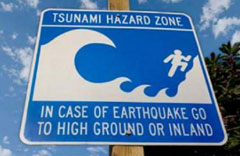
Alerting the public quickly, clearing the beaches and advising tourists to move to the upper floors of hotels, would be part of the Cayman Islands’ response in the event of a tsunami in the region.
Hazard management experts took part in a Caribbean-wide exercise last week to test the readiness of territories in the event of a tsunami. As part of the exercise officials had to show how they would respond to a fictitious earthquake measuring 8.5 on the Richter scale, 90 kilometres off the coast of Aruba.
The Cayman Islands Hazard Management team put out a dummy bulletin to local media at 8.50am on 20 March, as part of the exercise, alerting people of the quake and warning a tsunami was expected to hit Grand Cayman at 9.57pm.
The initial bulletin asked people to evacuate coastal areas by 9.20am.
A second bulletin added: “A tsunami warning is in effect for all coastal areas in Grand Cayman, Little Cayman and Cayman Brac. Residents and visitors should immediately evacuate all beaches and low lying areas, and head inland or evacuate vertically to higher floors in multistory concrete buildings.”
The bulletin warned of a wave height of 1 to 3 feet and cautioned the tsunami could have an impact on the coastline.
McCleary Frederick, director of Hazard Management Cayman Islands, said communication would be key in the event of a real tsunami. He said depending on the location of the earthquake, there could be a small amount of time to respond.
He said the hazard management team was in talks with LIME and Digicel about setting up an emergency e-mail or text message alert to be combined with news releases in local media. He said the fundamental difference between planning for a hurricane and planning for a tsunami was reaction time.
“We have strong plans for a hurricane but we have done less work on these quick onset disasters,” he said. “In this scenario there would be no time to think about securing property. It would be all about preservation of life and personal safety.”
He said the exercise had provided some food for thought and his team would now produce a clear action plan, highlighting individual areas of responsibility.
Issues like how to handle cruise ship passengers on shore or crowds of tourists arriving at the airport have to be clarified, he said.
Omar Afflick, deputy director at HMCI, said: “The key thing is public information management. Even though the risk of a tsunami is rather low you can’t be complacent.”
Geographical features like the Cayman Trench make the possibility of a large scale tsunami affecting the Cayman Islands extremely unlikely.
Last week’s readiness exercise organised under the auspices of the Intergovernmental Oceanographic Commission of the UN Educational, Scientific and Cultural Organization (UNESCO) involved 30 member states and 15 territories in the Caribbean and surrounding region.
“Even though the risk of a tsunami is rather low you can’t be complacent.” OMAR AFFLICK, deputy director, Hazard Management Cayman Islands

Related Videos












This is like the lads on the Titanic organizing the deck chairs after she had hit the iceberg. There are two possible serious Tsunami events which might affect Cayman.
A major earthquake in the Cayman Trench or, the long predicted mega-landslip on one of the Canary Islands on the Eastern side of the Atlantic.
Bearing in mind that about 80% of Grand Cayman is barely 12 feet above sea level, it would only need an Indonesian 2004 Tsunami to completely wash across the island at 20 miles per hour, and all the pre-event warning/preparation in the World wouldn’t make a jot of difference to the possibility of most of the population being obliterated.
Serious scientific research has shown, and been illustrated on television, that the predicted eventual collapse of the Western side of one of the Canary Islands would produce a Tsunami which would cross the Atlantic Ocean at 500 miles per hour, barely noticeable on the surface until it reached the undersea Continental Shelf of the US and any islands in it’s path. It is estimated that at that point it would rear up to as much 500 feet – should that event ever occur, then the best you could probably do is to put your head between your knees, and kiss your ass goodbye !
Forgot to ask in my previous commentary – Precisely what scientific qualifications the members of the Hazard Management Committee have in relation to Tsunamis, and what actual, practical experience ANY of them have had in a real life situation . Hypothetical, book learned knowledge isn’t worth a damn when you are up to your ass in alligators, and your original objective was to clear the swamp.
Ironically, Cayman is perched on the very edge of the Fracture Zone of the North American/Caribbean Techtonic Plates – the very region where a Tsunami generating earthquake could occur. Do not believe the Cayman Trench would do anything to mitigate the effect of a serious Tsunami created by a shallow level major earthquake.
So the question is – in event of the earthquake, should we leave building or not? Last time it happened we were asked to leave building until further notice. It didn’t make much sense to me at that point in time, especially because of possibility of tsunami.
Jabberwocky, you are truly living up to your namesake. It is highly unlikely that a tsunami would ever cause significant damage to Cayman. No scientific qualifications are required here, just basic high school physics and geography.
You correctly state that tsunamis are barely noticed in the open ocean. Even though they are moving at 500mph their wavelengths in deep water are also hundreds of miles long. To ships (and small islands in very deep water) these thing blow right by and are experienced more like a quickly rising and falling tide (hence their also being called tidal waves).
Cayman is far more analogous to being a ship in open water than it is to one of the islands in Indonesia or a city on the US coast.
I’ll explain. The western-Indonesian islands are surrounded by shallow water which gets gradually deeper over hundreds of miles. Any waves heading their way will ‘shoal’ and become amplified as the water became gradually shallower over a long distance. Thankfully Cayman sits upon a montain peak surrounded by extremely deep water. The sides of this mountain are very steep. Any tsunami coming to cayman will not have the distance or the gradually-decreasing bottom profile required to shoal and significantly increase it’s wave height.
The problem here is that there are no tsunami manuals published for small islands such as ours. So instead, our public officials and news media borrow from the literature produced by large countries such as the US. These countries have very different geography and the advice they provide needs to be taken in context.
I remember about three or four years ago there was an earthquake and some business (I think it was Dart) sent an email around with tsunami preparedness tips geared for the US coast. This caused a mild panic on the island and parents were crowding outside the schools demanding to get their children out. Needless to say nothing happened.
VoiceofReason, Question regarding your analogy, while I can understand the small effect this could have on a large Cruise Ship. Would the effect be different to Cayman which does not float ? Wouldn’t a wave even if hundreds of miles long cause the seas level to rise? A big ship may just rise with the sea level but wouldn’t a small island like Cayman which has a stationary height which is practically just above sea level still get overwhelmed by a tide rising above this height even if it rises rather slowly or worse if it rises quickly.
NJ2Cay a boat of any size would not notice a tsunami pass by in the open ocean. The common perception is that there is this big wave or wall of water the rushes across the surface of the sea. Which is not the case.
A quick internet search confirms that most tsunamis have a wave height of around a foot or two. Couple this with a wave length of 250 miles and you would never notice it at all in a boat.
On an island like Cayman a 1 foot wave travelling at 500 mph with a wavelength of 250 miles would result in a 1 foot high and a 1 foot low tide over the course of a half hour. I suppose this extra tide change may pose a problem of flooding if it happened during our high tide. However given that our typical tide range is 1.5 feet odds are that it would hardly be noticed.
If we were on a large continental shelf and our surrounding waters gradually became deeper then the approaching tsunami would be able to change shape as it approached. The front of the wave would slow and the back would catch up with it thus increasing its height. Then it would look like what we saw in asia in 2004. Thankfully that simply cant happen here.