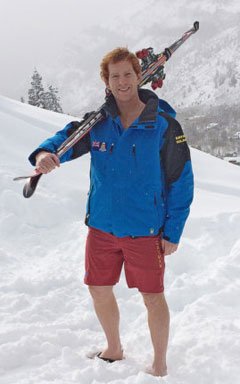
After his recent Olympic experience, Dow Travers intends to concentrate on improving the Cayman Islands.
Travers, 26, was Cayman’s sole competitor in the Sochi Winter Olympics, where he crashed in both the Men’s Giant Slalom and the Men’s Slalom, suffering a mild concussion in the process. The Ivy League alumnus, who attended Brown University in Rhode Island, says the next step is going green.
“I would love to keep training, but I will now return to Cayman to work on my green start-up,” Travers said. “I have co-founded a company in Cayman called Island Biodiesel, with fellow graduates from Brown. Our aim is to provide Cayman with renewable energy and reduce Cayman’s dependence on imported fuel by recycling waste cooking oils and creating biodiesel.
“Our venture, unfortunately, is yet to gain any support from government.”
Travers – born and raised in Cayman – hopes to find more success in people’s trash than he did on Russian slopes.
In the Men’s Giant Slalom, he had a DNF (Did Not Finish) result, along with 29 other competitors. Travers was one of 109 racers, with the United States’ Ted Ligety winning the gold medal ahead of two Frenchmen, Steve Missillier (silver) and Alexis Pinturault (bronze).
In the Men’s Slalom, Travers skied the first section in one minute, seven seconds and three milliseconds, finishing 76th out of 117 competitors. In the second run, he took a high-speed tumble and received a DNF result.
In the initial run, 40 skiers crashed, including Missillier. In the second stage, Travers was one of 35 skiers to fall, including Ligety. Mario Matt of Austria claimed the gold medal ahead of countryman Marcel Hirscher (silver) and Norwegian Henrik Kristoffersen (bronze).
At the 2010 Vancouver Games, Travers placed 69th in the giant slalom.
In Russia, he had been joined by coach Jake Zamansky, a former U.S. Olympic skier, and a delegation that included David Carmichael as chef de mission, Cayman Islands Olympic Committee president Donald McLean, and Bernie Bush, Olympic Committee treasurer.
Travers said his results at the 2014 Winter Olympics exemplify his sport’s unpredictable nature.
“Ski racing is renowned for being one of the sports with the most uncontrollable variables – those that are out of the competitors’ control. The best racer in the world may ski the best run of his life and still not win a race because of all the conditions that can change from one racer to the next. The conditions may not have been ideal, but what may hinder me one day may just help me on another,” he said.
He added, “Giant Slalom and Super-G are my best events, but even so, I’m not happy with the way that I skied in my first run of the Men’s Slalom. I held back trying to just finish, which wasn’t conducive to a good run.
“In the second run, I skied a little better but I hooked a tip trying to get the best line. That’s when one of your skis begins to go the wrong way around a gate, which in this case led to another quite ‘spectacular’ and painful crash. Having said that, I never really stood a chance on such a rutted course.
“The course was unrecognizable from the first racer to the 119th. It’s very difficult to adapt one’s skiing to meet a course in that shape,” he said, “which is one of the reasons that there were only 43 finishers out of a field of 119 – almost unheard of.”

Related Videos