

Guy Harvey says ‘pest control’ unit would protect dive industry

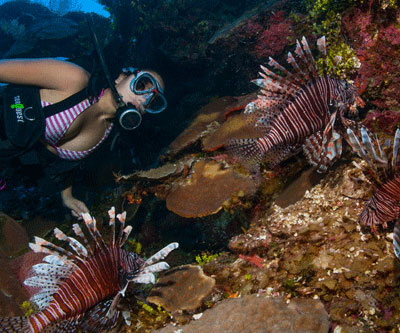
A government-funded team of lionfish cullers could be required to fight the threat posed by the invasive predators to Cayman’s dive and fishing industries.
That’s according to conservationist Guy Harvey, who believes a public sector team – similar to the Mosquito Research and Control Unit – should be set up to systematically remove lionfish from reefs around the island.
He said the level of threat to the dive industry in particular is far greater than people imagine. He believes some of the costs could be recouped by selling the fish for food, but government would be required to come up with some cash – a potential stumbling block in an era of severe budget constraints.
Mr. Harvey believes the kind of proactive steps taken to protect the island’s tourism industry from mosquitoes in the 1960s could be the template for similar intervention to protect the dive industry now.
Dive leaders on Grand Cayman and Little Cayman support the concept. They say the cost of doing nothing will be far higher than the cost of financing regular culling.
Lionfish are voracious eaters of juvenile reef fish. They have no known natural predators in the Atlantic, and culling by scuba divers is the only proven way to control numbers.
They breed at a staggering rate, with adult females spawning up to 2 million eggs every year. At “control sites” in Little Cayman where no culling takes place, the population density is 400 lionfish per 10,000 square meters, or 12,000 square yards.
Mr. Harvey, whose Guy Harvey Research Institute funds ocean research around the world, accepts that lionfish will never be eradicated completely from Cayman’s waters. But he said keeping populations down would provide vital protection to commercially valuable reef fish.
“You have to factor in the long-term impact of inaction on the survivability of the reef system,” he said. “In places where there is no culling at all, such as certain parts of the Bahamas, there has been complete devastation.
“This is a much more significant socioeconomic problem than many people realize.”
He said the dive industry is currently bearing a large part of the burden and the expense of lionfish control through organized tournaments and culls. He said this works to an extent, and studies had shown the value of consistent culling in preserving fish populations.
But he said government support would enable a more consistent and systematic approach and send a signal to the dive industry, including tourists worldwide, that the Cayman Islands is coming to grips with a problem that is plaguing the region. He said it would help make Cayman the go-to place for divers over regions that had lost large numbers of native reef fish to the lionfish invasion.
“Lionfish culling from an organized government-funded team would be a first for the region, and I think we would see the economic benefit within a couple of years,” he said.
Neil van Neikerk, of Southern Cross Club, Little Cayman, said the Sister Islands Tourism Association put a similar proposal in for government review in September 2011 for a pilot project in Little Cayman.
He would like to see a three-person team diving three times a day, six days a week, over the course of the trial period. He said the size of Little Cayman and the presence of the Central Caribbean Marine Institute, which has been doing significant research on the lionfish threat, makes it the ideal location to test the concept of a dedicated culling team.
He said the precedent of using government resources for “pest control” in order to protect the islands’ economy has been established through the mosquito control unit and could be followed for lionfish, which potentially pose an equivalent threat to the dive industry.
Steve Broadbelt of Ocean Frontiers in the East End of Grand Cayman, said his dive shop supports any proactive measures to fight lionfish.
He said he is philosophically against any expansion of government, but added, “The price of doing nothing is even higher than the cost of a new government department or unit, so I would still support such an entity.”
He added that other options could be considered, including contracting the work out to the private sector.
“Another alternative would be to have a nongovernmental organization that serves a similar purpose and is not for profit,” he said.
Neither Mr. van Neikerk nor Mr. Broadbelt believes commercial fishing is an option for eradicating lionfish.
Mr. Broadbelt added, “An effective culling program would be the exact opposite than what a viable commercial fishing program would be – the most effective culling is to remove the lionfish before they have reached breeding age and ‘eating size’ – whereas a viable commercial fishing program would need the fish to be larger, if they were relying solely on fish sales revenue by the pound.
“Right now, any culling is good culling and very worthwhile. We should act fast and have a plan for the next 10 to 25 years. Just like mosquitoes, lionfish are here to stay, and we need to protect our coral reefs as a critical natural resource.”
Premier Alden McLaughlin, who was in the Sister Islands last week, visited the Central Caribbean Marine Institute to hear firsthand about the lionfish problem. He did not respond to requests for comment on Monday.


Related Videos








There are many divers that would do it for free if we were given the equipment. I spend 5 months a year here and usually dive 4 days a week. I would be glad to help out and do it a few days a week and I know there are many others that would also help
If the CIG can subsidize the Turtle farm to the tune of nearly 10 Million Dollars a year they should be able to find a way to do this. After all this is a much larger threat to Cayman than the threat of not having Turtle meat to eat. I would also think that the Environment Protection Fund would be able to be tapped for this effort. If something isn’t done these Lion Fish will eventually eat us out of a house and a home. Imagine seeing nothing but Lionfish on empty reefs. Currently their only natural predator in Cayman is us and they actually taste good, a lot of people would eat them if we could get the freezers at fosters stocked with them. If Cayman’s restaurants started marketing them as delicacies and buying them it would essentially put a bounty on their head.
I never quite understood what the Mosquito Research and Control Unit actually does most of the year. Perhaps we should send them diving during the off mosquito season since they are getting paid anyway.
Great initiative and the analogy is valid for many reasons.
The key advantage of a professional group doing it versus ‘best effort’ people is that the professionals can methodically cover places not covered by dive sites and shore dives and go beyond recreational depth(hopefully).
There is still a place for people to help the cause too and many organised lionfish culls that people can get involved with.
That’s a hell of a lot of baby fish on the table and the condition they’re in looks like it’s only from one feeding whatever spawning those little guys came from was most likely wiped out. These guys are going to pick the reefs dry eventually..