Mizu Asian Bistro & Bar’s executive chef Dylan Benoit spent the summer in Asia with his brother Lucas, exploring the region’s cuisines, techniques and ingredients, with the aim of enhancing and further perfecting the menu at Mizu. In the second of a five-part series, he shares his culinary adventures.
Hong Kong is the culinary epicenter of Asia, full of sights, sounds and smells, unfamiliar and exhilarating to someone raised in the West.
I had the pleasure of traveling here in 2012 with my friends and business partners, Chad Gilbert and Steve Shienfield, on a research and development trip just before we opened Mizu at Camana Bay.
Chad had lived in Hong Kong for a few years prior to returning to Cayman and knew all the best hole-in-the-wall restaurants, so when my brother Lucas and I got off the plane this time around, I knew exactly where to go.
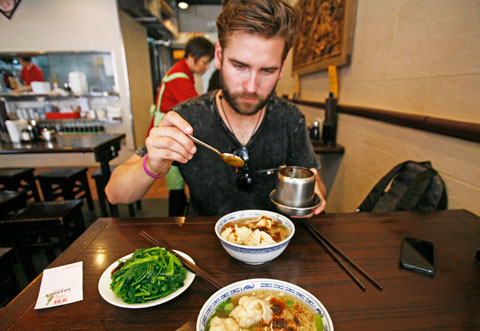
Tsim Chai Kee is a small noodle house in central Hong Kong that sells only noodle soup. We arrive around 3 p.m. on a Thursday and the small 30-seat restaurant is packed full of locals.
Diners can tailor the noodle soup to their liking, adjusting the protein, noodles, and sauces to taste. There are won ton dumplings stuffed to the point of explosion with hand-chopped king prawns, minced beef meatballs with herbs and garlic, or thinly shaved raw beef that cooks almost instantly in the hot broth. If you’re the kind of person who has commitment issues, you can have all three toppings.
Noodle options include yellow noodles, flat white noodles, or vermicelli noodles. As we peruse the menu options, the pressure is mounting. The elderly Chinese lady waiting for our order is running out of patience. What she lacks in teeth and stature she more than makes up for in wrinkles, and the expression on her face lets me know we are wasting her time.
She has a full restaurant and many hungry mouths to feed, but I’ve done this before so I am quick with my decision. “Prawn won ton with yellow noodles.” I also order the only non-noodle dish on the menu – vegetable and oyster sauce. (I find out later during a trip to one of the local markets that the leafy green vegetables are in fact “ong choy” (more commonly known this side of the world as water spinach).
Our soup arrives in what seems like 15 seconds flat as I watch the single cook 10 feet in front of our table pumping out bowl after bowl of piping hot tong (Cantonese for soup). The cook slings the noodles from one side of the kitchen to the other, dumping crates of mystery vegetables into steaming pots of water, portioning prawn-packed won tons into small blue and white bowls and finally, crowning these bowls of perfection with the piping hot broth.
While we wait for our bowl of soup to cool – it has a temperature almost as hot as molten lava – we bask in the aroma of the roasted shrimp with a hint of sweetness.
On the table are three accompaniments: soy sauce, chili oil and roasted chili paste. I add some of the chili paste, swirling it into the hot broth.
Lucas and I raise our beers in a toast to arriving in Hong Kong and dig in to our lunch – a delicious masterpiece filled with flavor.
We don’t speak for a moment, completely focused on the task at hand, slurping noodle after noodle, adjusting the spice, and scooping in spoonful after spoonful of fresh vegetables from a side plate.
We finish our bowls, pay our tab, grab our bags and hit the street. It’s now 3:30 p.m. and dinner is only three hours away. We have a lot of walking to do if we are going to make room for our scheduled dim sum feast tonight.


Related Videos