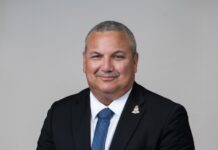
A senior civil servant told a jury Thursday she was asked to hand over government credit card records for five people, including former Premier McKeeva Bush, to anti-corruption officers in November 2012.
Sonia McLaughlin, who was deputy chief financial officer for the Cayman Islands government at the time, told the Grand Court jury in the trial of Mr. Bush that Deputy Governor Franz Manderson asked her to provide documentation on per-diem expenses, air travel and credit card usage for the five individuals. The four others, whose details were provided to police following an official request from the Anti-Corruption Commission around a month before Mr. Bush’s arrest, were not named in court.
Mr. Bush is facing a string of corruption charges connected to allegations that he used his government credit card to withdraw nearly $50,000 in casinos in the U.S. and Bahamas between June 2009 and April 2010.
Ms. McLaughlin, giving evidence via video link from Florida on the fourth day of the trial, was also asked to describe the government processes in place for monitoring the use of the government credit cards.
She agreed with the suggestion from prosecutor Duncan Penny, QC, that there had been a form that credit card holders were required to fill out, along with supporting documentation, when they returned from official travel overseas. Ms. McLaughlin, who previously served as accountant general, said there were also guidelines in government’s “general orders” about official travel expenditure.
She also agreed there was an expectation that if ministers or civil servants made personal purchases on their cards, they would pay it back by cash, check or salary deduction.
Another witness, Kerrilyn Rivers, an accounts officer in the Ministry of Tourism, took the stand later on Thursday. She described how the financial unit in the ministry would sometimes receive credit card statements that had been annotated by Mr. Bush and she would be required to calculate how much should be refunded by the then premier.
“In some instances, he would indicate by highlighting or putting a mark of some sort and asking for a calculation to be done,” she said. She gave evidence about several occasions when she had calculated the precise amount owed by Mr. Bush and how he had paid the debt by check or banker’s draft and been issued with a receipt, accounted as “refund of travel advance.”
She accepted the prosecutor’s assertion that, on two occasions in April 2010, Mr. Bush had made two payments in “round numbers” of CI$9,000 and US$13,000 and that she had issued receipts, also accounted as “refund of travel advance.” On these occasions, she acknowledged, she had not been asked to go through the bill and make specific calculations. She said she was instructed by her superiors to deposit the funds and did as she was asked.
Asked if she knew how those round numbers had been arrived at on those two occasions, she said she had no clue. Her job had been to process the payments, she added, but not to question ministers about the reasons for the expenditure.
She also gave evidence that the bills of government credit card holders were paid off quickly to avoid late charges or fees. She said there were occasions when staff in the financial unit would be required to pay off a bill online in the middle of a month because the card had reached its limit.
Mr. Bush’s personal assistant Jodie Whittaker gave evidence that she had passed on memos and credit card statements to the premier at various times requesting he reconcile his bills. She said, to the best of her knowledge, he had always paid the amounts owed when requested to do so.
She said she had no recollection of a September 2010 memo from a civil servant called Wendy Manzanares to Mr. Bush with a spreadsheet attachment showing outstanding credit card expenses that needed to be accounted for.
Mr. Penny suggested in his opening statement that Mr. Bush had failed to pay back some CI$10,000 withdrawn on his government card for personal use until more than two years later when he realized he was being investigated.
“Do you recall somebody following up and saying, the premier hasn’t paid?” Mr. Bush’s lawyer Geoffrey Cox, QC, asked the witness.
“Not with me personally,” she replied. She agreed with Mr. Cox that the former premier was “computer illiterate” and relied on her to print out emails and bring them to him. She accepted that he was “moving a mile a minute” and delegated a lot of administrative duties to his staff.
The trial continues.
Related Videos