After the most active hurricane season on record in 2020, there will be some changes to how storms are named.
The World Meteorological Organization’s Hurricane Committee announced that it will no longer be using the Greek alphabet to name storms.
The group said using the Greek alphabet creates a distraction from the communication of hazard and storm warnings and is potentially confusing.
The record-breaking 2020 Atlantic hurricane season was only the second time the Greek alphabet was used to name storms, as the standard list of 21 rotating names had been exhausted by mid-September.
Two of last year’s Greek-named storms, Eta and Iota, would have been retired from the name list, anyway, as they were deemed to have been so destructive that they would not be used again.
Dorian and Laura are also being retired as storm names from the rotating list of Atlantic tropical cyclone names due to the death and destruction they caused.
Cayman did not suffer any major damage during the 2020 hurricane season, although the jurisdiction had a near miss with Eta on 7 Nov., when the storm passed within 50 miles of Grand Cayman, bringing heavy rains that flooded streets, and strong winds that downed trees and electricity poles across the island.
FIRST USE
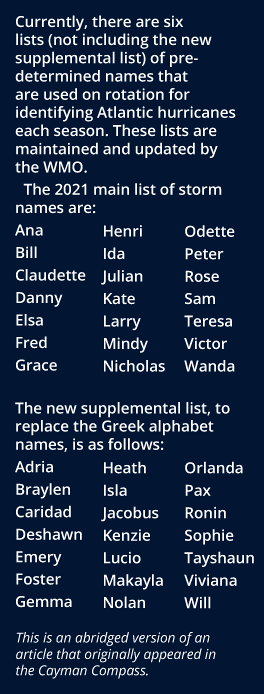 The first time the Greek alphabet was called into use after the main list was exhausted due to the frequency of storms was in 2005, when the last named storm of the hurricane season was Zeta, the sixth letter of the Greek alphabet. In 2020, the last named storm was Iota, the ninth letter of the alphabet. In all, there were 30 named storms in 2020.
The Greek alphabet list – used to supplement the annual list once that was exhausted – will be replaced with another back-up list of names, which will include all the letters of the alphabet apart from Q, U, X, Y and Z, as is the practice with the standard list.
The Hurricane Committee gave several reasons for its decision to do away with the Greek names, including that there is often confusion with some Greek alphabet names when translated into other languages used within the region.
It noted, too, that the pronunciation of several of the Greek letters (Zeta, Eta, Theta) are similar and occur in succession. In 2020, this resulted in storms with very similar sounding names occurring simultaneously, which led to messaging challenges rather than streamlined and clear communication.
Related Videos