
Police have begun using court-issued Protection Orders to keep domestic violence offenders away from their victims, in cases where the abused individuals cannot or will not apply for such an order themselves.
Although legislation enabling Protection Orders has been in place since 2012, it has mostly been used by the victims going to court and applying for the orders directly. More recently, Royal Cayman Islands Police Service officers have been using such orders to protect people who they feel are at extremely high risk.
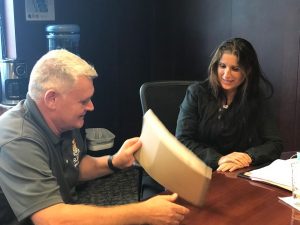
Detective Constables Elizabeth Owens and Brian Faint from the RCIPS Family Support Unit, speaking at a press briefing on Thursday, 21 Oct., said they had both, this year, filed successful applications for Protection Orders under the Domestic Violence Act, after Owens began developing an offender management programme in December last year.
While in the past, officers in the Family Support Unit have supported and assisted victims in obtaining a Protection Order, prior to March, there had never been an instance of police unilaterally applying for an order for a victim where the criminal case had not first gone before the court.
Victims unwilling or unable to act
In a case in March this year, Owens said, she applied for a Protection Order after a female victim came to her attention in relation to a “high-risk offender in the community”.
What does a Protection Order ban a person from doing?
A Protection Order may prohibit the respondent from:
- engaging or threatening to engage in conduct which would constitute domestic violence towards the applicant;
- being on premises specified in the order and that are premises frequented by the applicant including any property, business, school or place of employment;
- being in a locality specified in the order;
- engaging in direct or indirect communication with the applicant;
- taking possession of, damaging, converting or otherwise dealing with property that the applicant may have an interest in, or is reasonably used by the applicant;
- approaching the applicant within a specified distance; or
- causing or encouraging another person to engage in the above conduct.
“It was a very vulnerable victim who had made a report of various issues relating to domestic violence [about] one particular offender,” Owens said. “She had initially given consent [to seek a Protection Order] and then withdrew that consent.
On the day of the full Domestic Violence Court hearing for the Protection Order, she resumed her consent but she did not actually have to attend court, and that was the whole process.
“In my interaction with her, I identified that she was overwhelmed with her situation … and was ill-equipped for various different reasons to make the application herself, so I took that initiative on and made the application.”
The court granted the order, which will remain in place for a year.
In that instance, the victim eventually cooperated with police on applying for the Protection Order. That’s not always the case, Faint pointed out.
He referred to one domestic violence case in which serious assaults had occurred, but the victim did not want the offender prosecuted and wanted to stay in the relationship.
“For me, the threat-harm risk to that individual was of such that it gave me grave concern about what would happen should another incident occur,” Faint said. Initially the court granted an interim Protection Order, followed by a full hearing a week later, at which the application was challenged by a family law firm. The application was ultimately approved, and a Protection Order was put in place for three years.
Faint said the offender in this case is now in prison. The victim still does not support the police’s actions in seeking the Protection Order, he added.
“However, from our perspective, the safeguarding aspect, there has been no further [domestic violence] offences,” he said. “[The victim is] living in the community with the knowledge that they are not going to be subject to assault.”
Penalties
If an offender breaches a Protection Order, police have the power to arrest the individual responsible for that breach.
A respondent who contravenes the terms of a Protection Order could face a maximum fine of $10,000 and/or imprisonment for two years. In the case of a continuing breach of an order, the penalty is an additional $100 for each day that the breach continues.
Stalking Act
Owens said she had also applied for two other Protection Orders. One was deemed by a judge to be outside the time limit of the law, while in the other case, the judge advised that a Protection Order under the Stalking Act would be a more appropriate avenue to pursue. The order was subsequently granted, she said.
Until 2018, there was no law governing stalking in Cayman, but once the Stalking Act was enacted, changes were made to the Penal Code, which enabled Protection Orders to be issued in response to stalking offences.
The detectives pointed out that Protection Orders do not just serve to keep an offender away from a victim, but they can also impose conditions, such as mandatory counselling, anger management, drug or alcohol rehabilitation and other measures.
They said police would only apply for Protection Orders in “exceptional circumstances”, such as when other avenues prove unsuccessful or when they consider that a victim is in serious danger, but is unable or unwilling, for whatever reason, to apply for an order themselves.
‘Victims leave seven times before finally leaving’
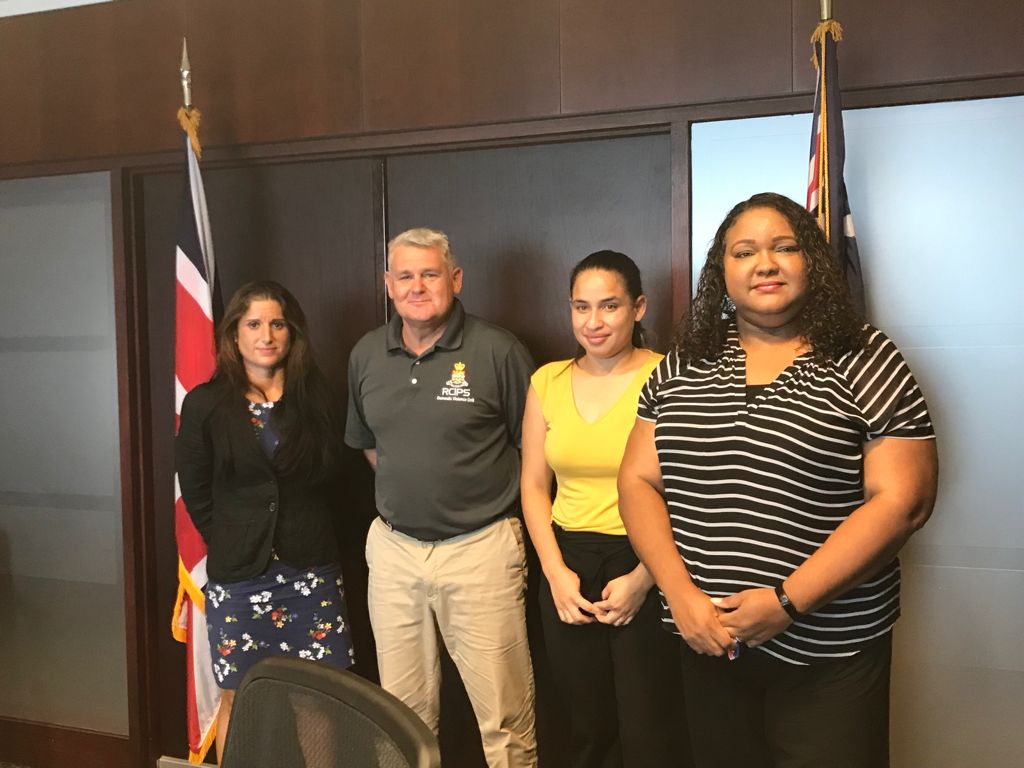
Victims of domestic abuse, on average, leave their partners at least seven times before finally leaving for good, Nicole Quinland, from the Department of Children and Family Services, told reporters at the briefing, as she highlighted the importance of police and other support services being advocates for victims.
“The idea that police can go ahead and do this order for them is a great benefit for them, even if they are not willing to go ahead and do it for themselves,” she said.
Police and the Department of Children and Family Services work with the Multi-Agency Support Hub, that offers safeguarding for victims in Cayman. These agencies also link up with the Cayman Islands Crisis Centre, WORC, the Needs Assessment Unit, the Health Services Authority, Customs and Border Control and NGOs.
All reports of violence involving children in domestic abuse situations are reported to MASH.
Quinland said there had been 826 referrals relating to children to the MASH unit between 1 Jan. and 30 June this year, 11% of which involved domestic violence. Throughout last year, 27% of such referrals involved domestic violence.
The total number of domestic abuse cases reported to police last year was 2,288. So far this year, 1,358 cases have been reported.
Finding help
KEY NUMBERS:
911 – Emergency Services (Or your local police station)
943-2422 – Cayman Islands Crisis Centre 24hr Crisis Line
649-5437 – Kids Helpline
949-1693 – Department of Community Rehabilitation
949-0006 – Family Resource Centre
949-8789 – The Counselling Centre
945-8869 – Legal Befrienders Clinic. *only available by phone Tuesdays & Thursdays 5:30-6:30pm*
949-0545 – Multi-agency Safe-guarding Hub (MASH)
946-0024 – Needs Assessment Unit
1-800-534-6463 – Mental Health Helpline
Estella’s Place (run by the Cayman Islands Crisis Centre) is also available for walk-in appointments. Call 949-0366 to make an appointment, or contact Carol-Anne Fordyce at 623-4825 or [email protected].
Victims often find it difficult to leave an abusive relationship because of fears over how to support their family or a lack of somewhere to go outside the family home, or due to concerns that the abuser will find them and the violence will escalate.
That’s where the various support services in Cayman come into play, Marjorie Whittaker of the DCFS said.
Whittaker said, once a referral of domestic abuse is received by her department, either directly, via police, from the Crisis Centre or other organisations, the team carries out a welfare check and speaks with the victim.
“A victim of domestic violence has a lot of decisions to make. ‘If I stay in this relationship, what needs to be done to ensure that similar incidents do no occur and do not continue to happen?’ If they want to stay, that’s OK, it’s their right to stay, we can’t force them,” she said.
In those circumstances, the DCFS tries to connect both the victim and the perpetrator with various resources in the community that can help them.
If the victim does decide to leave, they often seem ashamed to seek financial or other support services, Whittaker said.
“Cayman being such a small community, they don’t want people knowing what they’re going through…. Sometimes you have to take them yourself to make sure they go,” she said.
Assistance can be sought from the Crisis Centre and other local charities, as well as from the NAU. The Crisis Centre’s has a walk-in facility, called Estella’s Place, where children and parents, teenagers, young adults, and male or female victims of domestic abuses can access programmes and services, including individual or group counselling and support group sessions.
Who to call for help
Crisis Centre 24×7 hotline: 943 CICC (2422)
Department of Child and Family Services: 949-0290
MASH: Email: [email protected]
Police emergency services: 911
Related Videos