

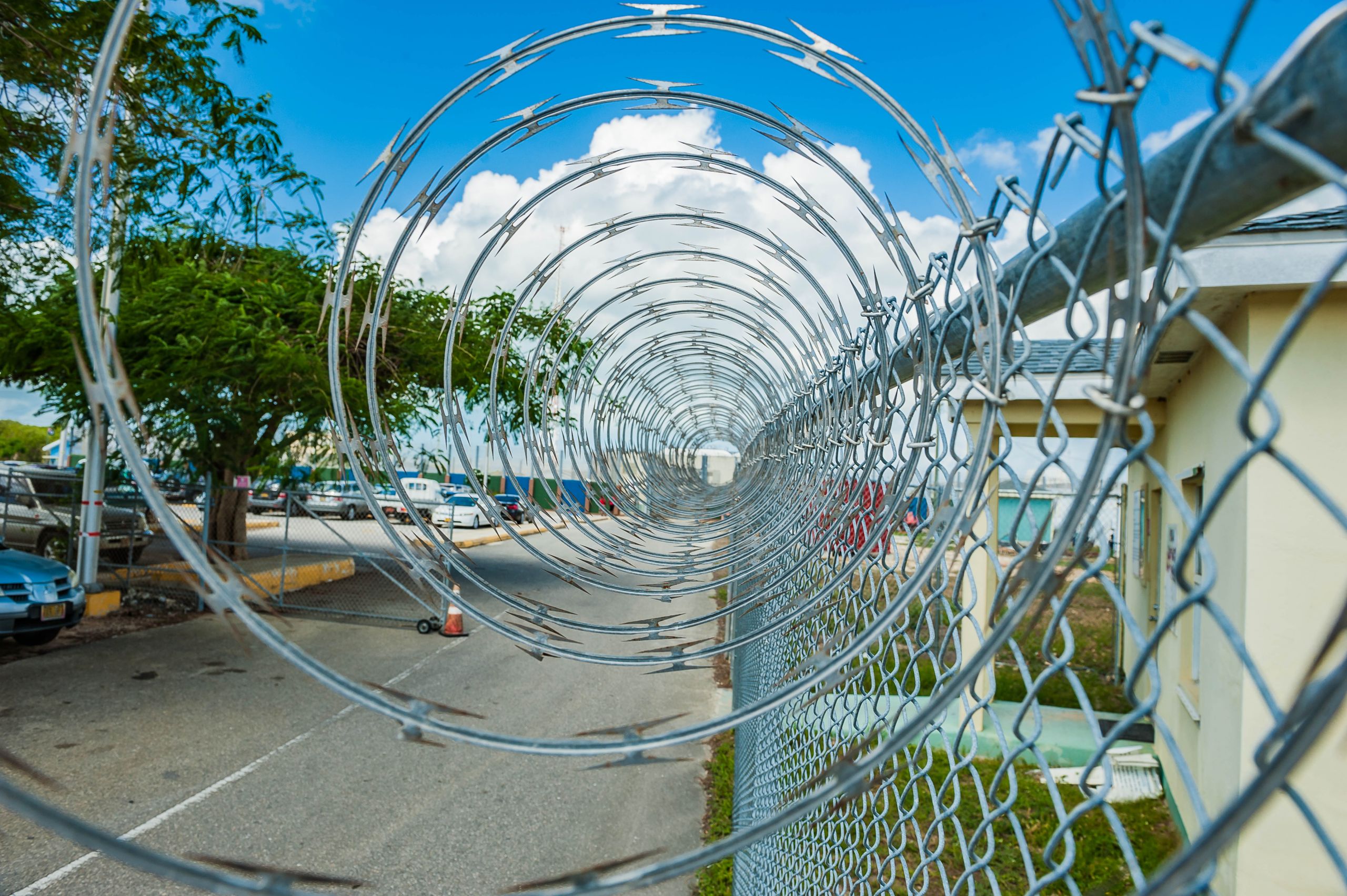
A pair of gang killers had to be transferred out of the Cayman Islands because of claims they were planning an armed prison break, the appeals court heard Tuesday.
Brothers Justin Ramoon and Osbourne Douglas were transferred to London’s infamous Belmarsh prison after the Governor’s Office decided they were too big a security risk to serve their life sentences at Northward Prison.
The decision was made on the basis of ‘intelligence’ gathered by Northward Prison staff suggesting the brothers were planning a dangerous armed escape involving high-powered weapons.
Court of Appeal judges, hearing the case this week, said details of the planned prison break were raised during an earlier judicial review, and that based on the evidence presented at that hearing, the brothers were rightly deemed as security risks, and subsequently transferred overseas.
The brothers are challenging the decision to transfer them to the UK prison, saying they have a right to be imprisoned in Cayman.
So far, they have been unable to directly challenge the evidence about the alleged planned escape because the Cayman Islands does not have procedures for closed-door hearings in cases impacting national security.
Lawyers acting for the brothers, jailed in 2016 for the execution-style murder of Jason Powery in 2015, say they have been denied the chance to contest the basis for their transfer.

Their attorneys argue that crucial information, such as who supplied the information about the planned jail break, has been kept from them, which they say amounts to a breach of their constitutionally-protected rights to a fair hearing.
Douglas and Ramoon are serving 30 and 33 years, respectively, for Powery’s murder, which was described by the trial judge as a “public execution of the most chilling kind”.
They originally contested the transfer decision by way of a judicial review in April 2021, at which time they argued the transfer to a UK prison far from their home was an infringement of their right to a family life, as set out by the Constitution.
Justice Michael Wood, who presided over the judicial review, ruled against Douglas and Ramoon. However, the reasons for his decision have not been released to the public.
A national security risk
Prior to the judicial review, a Grand Court hearing was held to decide what information was to be kept from the brothers and the wider public, as a matter of national security.
That hearing, which was presided over by Justice Marlene Carter, resulted in the details of who supplied the information and how the information came to prison officials, being kept from the two convicted men and the public.

When urging the appeals judges to quash the transfer, Hugh Southey, QC, argued that in instances where the security of a country is at risk, the standard process is for a Closed Material Procedure hearing to be held, which would provide a means for the courts to address the validity of the sensitive information without jeopardising the country’s security.
“There is no such legislation in Cayman,” said Southey. “Because of the lack of legislation, there is no way for us to test the validity of the sources, or indeed the information. What if the informer had a grudge against one of the defendants? There would be no way for us to know or indeed to be able to challenge this because of the lack of identifying information.”
Southey argued that the lack of legislation to allow for such a hearing amounted to a breach of Douglas and Ramoon’s constitutionally-protected rights to a fair hearing.
Southey told the judges that in light of the lack of legislation, the appeals court had three options – rule in favour of the defendants and quash the transfer order; rule against the defendants and uphold the transfer order; or set aside the transfer until legislation can be brought in to facilitate a Closed Material Procedure hearing.
“While we would be happy should your Lordships choose the first option, we say that perhaps the most appropriate option would be the third,” said Southey.
Disproportionate and no consideration
Southey went on to argue that despite the convictions, the rights of Douglas and Ramoon must be upheld.
“The respondents say the defendants are the ‘authors of their own misfortune’,” he said. “While the convictions cannot be appealed, the conviction alone cannot deprive them of their rights. Instead, it is submitted that it was their subsequent behaviour that triggered the proceedings which are now in dispute.”
Southey argued that there is no evidence to suggest that when deciding whether to transfer the brothers, the governor, who at the time was Helen Kilpatrick, took into account the impact it would have on Douglas and Ramoon, or their families.
“From the evidence that has been made available, the decision process to transfer the defendants began in April, but no transfer occurred until June,” said Southey. “This would suggest there was no great urgency to transfer them, as there was no imminent danger. Despite this, neither defendant or their families were consulted about an impending transfer.”
“Mr Southey, it would have been madness to tell your clients that there was a real risk of them being transferred,” interrupted Judge Alan Moses. “Telling them would have triggered the very plan they sought to avoid.”
Southey revealed that the government had established a fund for all-expenses-paid round trips to the UK for up to six family members of each brother.
“The fact that this fund came into existence after the defendants challenged the transfer and articulated the breach of their human rights is clear proof, on the face of the evidence, that the decision-maker did not consider the impact it would have on the family,” said Southey.
He wrapped up his opening arguments by saying the transfer was disproportionate because Cayman’s inability to house high-risk prisoners should not directly result in such prisoners being transferred.
“As far as brick and mortar is concerned, it is quite clear from the evidence that Cayman’s prison currently houses several persons convicted of serious crimes, including murder,” said Justice Richard Field, who is the presiding judge in the case.
He added, “The difference with your clients and those convicted individuals is the considerable notoriety they command, not just in the prison as gang leaders but also in the wider community.
“As gang leaders incarcerated on a small island of some 60,000 people and actively planning an escape, it appears the decision-maker was right to have found them a security risk.”
Justice Michael Birt is the third appeal judge presiding over the case.
The hearing continues on Wednesday.
Related Videos













So 12 family members get all expense paid trips to the UK (presumably on a regular basis) to see these convicted murderers, whilst the family of the deceased will never get to see him again?.
We should table a new law requiring all violent crime/serious offenders to be incarcerated overseas as a deterrent to serious crime, regardless of citizenship or nationality. Paying to house them in the UK is cheaper than here and the community would feel less intimidation and pressure removing these individuals from the Country. How do we begin to float such a law for discussion?