

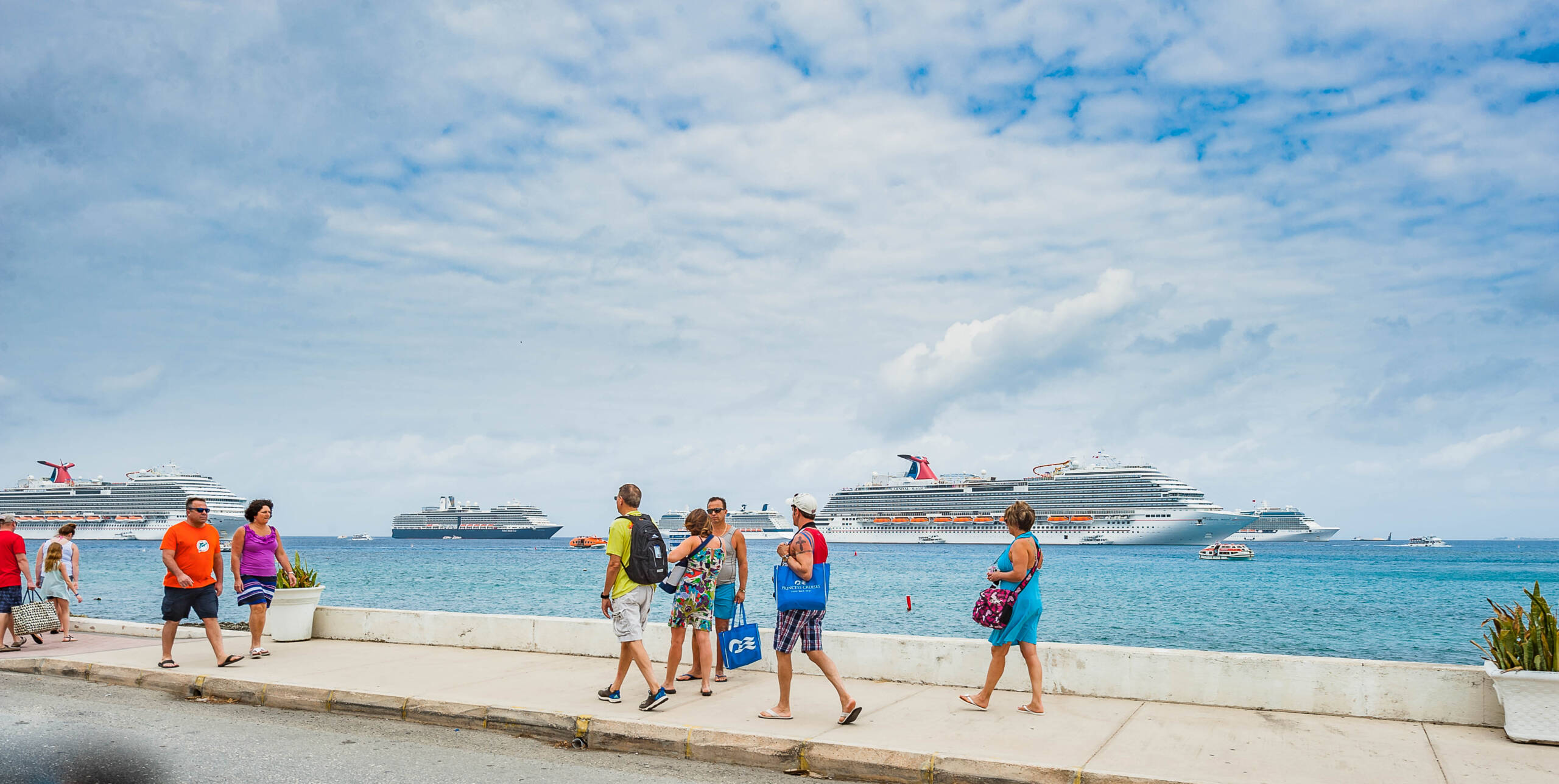
Representatives of the Florida-Caribbean Cruise Association will meet with tourism, health and government officials on Tuesday on how to safely reintroduce cruise ships here.
Among the items on the agenda is lateral flow testing for all cruise passengers disembarking in Cayman; the Cayman Islands being the first port of call for ships; and the establishment of a new association of local tour and water-sports operators to revamp how profits from services offered to cruise passengers while they’re on island are shared between local businesses and the cruise lines.
Tourism Minister Kenneth Bryan, speaking on Radio Cayman’s ‘For the Record with Orrett Connor’ on Monday morning, said the meeting was being held to “discuss the road map to success and the recovery and rebooting of the cruise industry”.
The government had approved a single cruise ship – Holland America Line’s Nieuw Statendam ship – to stop in Cayman on 28 Dec. last year as a trial run for the return of this sector of tourism, but the visit was later cancelled amid growing concerns over the Omicron variant. Cases of COVID were subsequently reported on board the vessel.
No cruise ships have been allowed to stop in Cayman since borders closed in March 2020.
While stayover tourism is slowly building up as Cayman goes into Phase 5 of its reopening plan, cruise ships are still banned from stopping off here.
Bryan said a large swathe of tourism workers in Cayman depend on the cruise industry for their livelihoods.
Testing and vaccination requirements
He hopes that if the Florida-Caribbean Cruise Association agrees to certain protocols, cruise liners can be reintroduced to Cayman safely.
Among those protocols are lateral flow tests for all passengers and crew immediately before they disembark in Cayman; all passengers must be vaccinated and boosted; and Cayman must be ships’ first port of call on their itinerary.
Bryan said requiring passengers to be tested before they visit Cayman is the “safest way for us to be sure they don’t have the virus before they get off” the ship.
He acknowledged that, as the virus is already widespread in the Cayman, this step could eventually be removed for incoming cruise passengers.
The minister said mandatory rapid testing for passengers entering Cayman earlier had been ruled out by cruise lines, due to the logistics involved in testing up to 3,000 passengers at one time. However, now, with the cruise industry continuing to suffer and the number of destinations for ships limited, Cayman was in a stronger bargaining position to request certain protocols are put in place.
He said it was vital that cruise ships returned, both for the sake of Caymanians who have been displaced from their jobs and for the local economy.
Government is currently paying displaced tourism workers a $1,500-a-month stipend, which is costing $5.5 million a month in public funds, Bryan said. According to a survey carried out by the Department of Tourism in July last year, 36% of people receiving the tourism stipend had been primarily serving cruise visitors.
Bryan noted that, as well as the cost to the public purse of continuing to pay tourism workers while cruise ships remain banned, revenues are also being missed from landing fees and work-permit fees associated with the cruise industry.
Tour operators association
During the Radio Cayman interview, Bryan also said work needed to be done on restructuring profit margins, so that local operators get a higher percentage of revenue from running tours and offering services, rather the cruise lines taking the bulk of that money.
“What the cruise lines have been able to do over the years is convince our own people to fight against themselves” by undercutting each other for the services they’re running, he said.
“We keep undercutting ourselves till we’re down to the bare minimum,” he said, “and in the end the only thing you’re covering is the expenses on the fuel and paying the labour on your boat, and you’re not making one bit of profit, but you’ve got insurance to pay and your asset is being devalued every year.
“We’re cutting each other’s throats, while the only people making money is the cruise lines, because they’re selling that same tour for $100 [for example], and while we’re beating ourselves down, they’re still selling it for $100, so the more we beat each other down, the more profits they make. We’ve got to cut that out.”
This issue has been a bone of contention for local operators for years, who complain that the cruise lines take the majority of profits from the tours and experiences being offered to the cruise passengers.
Troy Leacock, vice president of the Cayman Islands Tourism Association, and that association’s director of water sports, said CITA was encouraged that the issue of how much of a share local operators get from cruise-related activities was one of the priorities that government will discuss with the FCCA.
He said CITA had brought this up with the tourism minister in previous meetings with him and other Cabinet members, and he was now glad to see it being brought to the table as part of the talks with the cruise industry.
“We said it was really important we look at various means of us being able to retain more of the revenue” brought in by cruise passengers, he said.
He added that it had been a long-time concern of operators that setting the price points for tours and experiences was “really in the hands of the cruise lines”, rather than of the owners of the businesses delivering those services.
He said Cayman’s prices for excursions, for example to Stingray City in the North Sound, were lower than comparative trips in other Caribbean Islands.
Leacock said whether the approach was one of collective bargaining, or enabling operators to sell directly to cruise passengers rather than through the cruise lines, it was evident that a different approach than the one used before the pandemic was needed.
Fewer cruise ships
Bryan, in his radio interview, also addressed whether, after the cruise lines return, if a cap should be placed on how many cruise ships and passengers should be allowed into Cayman.
He said that neither the government nor the public wanted to see a return to the same level of cruise ship tourists on island as before the pandemic. However, the challenge for Cayman will be to retain the same level of revenue, but with fewer ships and tourists.
In 2019, 1.83 million cruise passengers visited the Cayman Islands.
Bryan said a report on the sustainability of cruise numbers in Cayman would be carried out, but he estimated that Cayman would aim for 75-80% of the numbers seen in earlier years.
“How do we have less people coming off the ships and make the same amount of money?” he asked, before answering his own question – stating that an association of local tour operators using collective bargaining to set prices for services would eliminate undercutting and ensure everyone got their fair share.
He added that with the difficulties facing the cruise industry at the moment, this was the “perfect time” for Cayman’s government and tour operators to revise the existing arrangements on how profits from tours and services being offered to passengers are shared.
This was currently under review by the Port Authority board and a select committee, Bryan said.
Fewer cruise ships, with potentially higher spending customers, could lead to more revenue for local operators and businesses, as well as a reduction in traffic in downtown George Town, compared to pre-pandemic levels, and would negate any renewed calls for a new cruise dock. He added that, under his government’s administration, no such dock would be built in George Town.
Among those expected to attend the meeting with the cruise association on Tuesday, Bryan said, were Premier Wayne Panton, Deputy Premier Chris Saunders, Minister of Health Sabrina Turner, Interim Chief Medical Officer Dr. Autilia Newton, as well members of the Department and Ministry of Tourism. He added that members of the private sector would not be involved in the government meeting with the cruise line association, but said he hoped some members of that sector could meet with the cruise line association while its members are on island.
Related Videos








I suggest a $10/month tax on all Seven Mile Beach properties, and we get rid of the cruise ships for good, and hire those workers to do something else. Clean up the beach trash. Welcome tourists. Promote culture. Anything.
If we want to maintain our status as an elite destination for our far more profitable stayover visitors, 80% of previous cruise ship arrivals is far too high. With all the new hotels and housing developments and already more cars on the roads we will be bursting at the seams if this is allowed, and quality of life will suffer for all our residents.
I don’t remember exactly when cruise ships first came to Grand Cayman however there were certainly none in 1982 when I moved here.
George Town was a proper town rather than a collection of jewelry stores and local people used to actually have a reason to go to George Town.
Yet there was almost zero Caymanian unemployment.
How was that possible if cruise ships are so vital to our economy?
Let’s focus please on high value stay over tourism and encourage people to stay as long as they want.
Get rid of the pointless tests on days 2, 5 and 7. Everyone must test negative before they arrive. We have some 6,000 local cases of covid. Someone is more likely to catch it here than bring it with them.
And what a nightmare if they do. Confined to their expensive hotel and forced to stay there until negative. Probably missing their return flight and perhaps losing their jobs.
No wonder the hotels are almost empty.
I can’t see the cruise lines agreeing to test passengers immediately before disembarkation. If they had 3,000 passengers to disembark in two hours and a test takes five minutes to administer, they would need 125 testing stations!